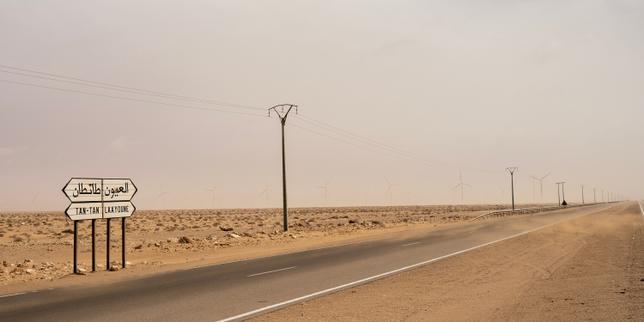
In the sun-bleached expanse between Tiznit and Dakhla, over a thousand kilometers of freshly laid asphalt cuts through the desert like a geopolitical scalpel. Officially designated as the Tiznit-Dakhla Expressway, locals, diplomats, and international observers increasingly refer to its southern stretches by a far more loaded moniker—the Donald J. Trump Highway. This massive infrastructure project is far more than a civil engineering feat designed to shave hours off freight transit times. It is the physical manifestation of Rabat’s decades-long strategy to cement its sovereignty over Western Sahara through irreversible economic facts on the ground, trading diplomatic recognition for concrete, steel, and trade corridors that permanently alter the map of Northwest Africa.
Understanding why Morocco poured over $1 billion into a dual carriageway through sparsely populated desert requires looking past standard transportation metrics. Roads in disputed territories are never just about moving goods from point A to point B. They are instruments of statecraft. By physically binding the northern heartland of the kingdom to the southern provinces—which Rabat administers and claims, while the Polisario Front demands independence—Morocco is executing a strategy of infrastructural integration that makes political separation logistically unthinkable.
The Geopolitical Bargain Behind the Name
The informal branding of this corridor is rooted in the December 2020 tripartite agreement brokered by Washington. In a sweeping diplomatic trade, the United States became the first Western power to recognize Moroccan sovereignty over Western Sahara in exchange for Rabat normalizing relations with Israel. That single stroke of a pen shattered decades of international consensus, which had long maintained that the territory’s final status should be determined through a United Nations-monitored referendum.
While formal highway signage still adheres to standard national designations, the Trump association stuck immediately, particularly among local business elites and international commentators watching the rapid influx of capital into cities like Laayoune and Dakhla. For Rabat, invoking the name—even informally—serves as a permanent reminder to European capitals and the United Nations that the world's superpower has already stamped its approval on Moroccan control.
Yet, relying on a single American administration's proclamation carries inherent risks. Diplomatic winds in Washington shift every four years. Asphalt, however, is permanent. Moroccan planners understood immediately that a presidential proclamation could theoretically be reversed or diluted by future administrations, whereas a multi-lane highway, deep-water ports, and integrated power grids create a reality that no diplomat in New York or Brussels can easily undo. The highway is the physical insurance policy for a diplomatic victory.
Engineering Sovereignty in the Desert
Building a 1,055-kilometer expressway from Tiznit, just south of Agadir, down to Dakhla, a peninsula jutting into the Atlantic near the Mauritanian border, presented brutal logistical hurdles. It is not merely a repaving job. The project involved widening existing single-lane tracks into a modern dual carriageway, constructing dozens of bridges over seasonal riverbeds known as oueds, and battling shifting sand dunes that threaten to swallow infrastructure whole if left unmaintained.
The sheer scale of the financial commitment tells the real story. Funded largely through a consortium of Moroccan state budgets, local regional councils, and public-private partnerships, the Tiznit-Dakhla axis absorbs a disproportionate share of the kingdom's national infrastructure spending relative to the local population density.
Consider the numbers. Western Sahara accounts for a tiny fraction of Morocco's total population, yet the southern provinces receive per-capita public investment rates that dwarf those of many neglected rural regions in the Atlas Mountains or the Rif. Critics within Morocco occasionally whisper about this disparity, questioning why remote northern villages still lack basic paved access roads while billions flow into desert highways. The answer from Rabat is always the same—national territorial integrity overrides standard return-on-investment calculations.
The Economic Engine of Dakhla
At the southern terminus of this highway lies Dakhla, a city undergoing a transformation so rapid it borders on the surreal. Once a sleepy Spanish colonial outpost known as Villa Cisneros, Dakhla is being engineered into a premier Atlantic maritime hub.
The highway does not terminate in empty sand; it feeds directly into the Dakhla Atlantic Port, a separate mega-project costing roughly $1.2 billion. Together, the road and the port form a unified logistics machine. The strategic goal is twofold:
- Bypassing Maritime Bottlenecks: Allowing goods from sub-Saharan Africa to reach European markets via overland trucking through Morocco, slashing transit times compared to traditional maritime routes around the West African coast.
- Resource Extraction and Export: Facilitating the rapid movement of agricultural produce grown in massive desert greenhouses, vast catches from some of the world's richest fishing grounds, and future green hydrogen exports.
By turning Dakhla into an indispensable node for global trade, Rabat is forcing multinational corporations, shipping conglomerates, and foreign governments to engage with Moroccan institutions on the ground. When a European logistics firm signs a long-term lease at the Dakhla port or routes its refrigerated trucks up the Tiznit-Dakhla expressway, it is tacitly recognizing Moroccan jurisdiction, regardless of what its home government's foreign ministry states in official press releases.
The Diplomatic Domino Effect and Economic Leverage
The physical completion of the highway coincides with a calculated diplomatic offensive that has yielded tangible results for Rabat. Over the past several years, nearly thirty countries—primarily from Africa and the Arab world—have opened consulates in Laayoune and Dakhla. While Western powers have stopped short of opening full diplomatic missions in the disputed territory, key European players have fundamentally shifted their positions.
Spain, the former colonial power in Western Sahara, reversed decades of neutrality in 2022 to endorse Morocco's 2007 autonomy plan as the most serious and realistic basis for resolving the conflict. France followed suit in 2024, explicitly recognizing Moroccan sovereignty over the territory and pledging state-backed financing for infrastructure projects in the south.
The highway acts as the physical stage for this diplomatic theater. Foreign delegations visiting Laayoune or Dakhla are routinely driven along the newly completed stretches of the expressway, shown the gleaming solar farms, the desalination plants, and the sprawling industrial zones. The message is unmistakable—Morocco is building a modern economy here, while its adversaries offer only stasis and refugee camps.
The European Court Friction
This aggressive integration strategy has not gone unchallenged. The European Court of Justice (ECJ) has repeatedly ruled that trade agreements between the European Union and Morocco cannot legally include products originating from Western Sahara without the explicit consent of the Sahrawi people, whom the Polisario Front claims to represent.
These rulings create a bizarre legal friction. On one hand, Europe's highest court insists that Western Sahara remains a separate and distinct territory under international law. On the other hand, European companies continue to import tomatoes grown in Dakhla greenhouses and fish caught off its coast, transported north along the very highway Morocco built to erase that distinction.
Rabat's response to these legal setbacks has been to double down on physical integration. By weaving the supply chains of the south seamlessly into the industrial infrastructure of Casablanca and Tangier, Morocco makes it increasingly difficult for customs authorities or legal bodies to trace and separate goods by origin. The highway blurs the economic border until it effectively disappears.
The Overlooked Reality on the Ground
Walk through the rapidly expanding neighborhoods of Laayoune or drive along the smooth tarmac south of Guelmim, and the sheer scale of state investment is undeniable. Subsidized fuel, tax exemptions for businesses, massive public sector employment, and modern urban boulevards create an illusion of effortless prosperity.
Look closer, however, and the fault lines of this developmental model emerge. The economic boom driven by the highway and associated mega-projects has triggered significant demographic shifts. Tens of thousands of workers, civil servants, and entrepreneurs from northern Morocco have migrated south to fill jobs in construction, administration, and services.
For many indigenous Sahrawis, this influx feels less like economic liberation and more like demographic dilution. While a segment of the local tribal elite has grown extraordinarily wealthy through state contracts, fishing licenses, and real estate development tied to the highway corridor, high unemployment persists among working-class Sahrawi youth.
Dissident voices within the territory argue that the infrastructure benefits northern conglomerates and foreign investors far more than the local population. Human rights organizations, including Amnesty International and Human Rights Watch, continue to document strict curbs on freedom of assembly and expression for those advocating independence. The gleaming new highway brings faster internet, cheaper consumer goods, and easier travel, yet it operates within a heavily securitized environment where political dissent remains tightly policed.
The Algerian Counter-Move and Regional Rivalry
You cannot analyze a single kilometer of asphalt in Western Sahara without accounting for Algiers. Algeria, the primary diplomatic, financial, and military backer of the Polisario Front, views Morocco's infrastructural push as an existential threat to its regional influence and its long-held vision of an independent Sahrawi state.
Since the collapse of a 29-year UN-brokered ceasefire in November 2020—triggered by Moroccan military operations to clear Polisario protesters blocking the Guerguerat border crossing at the southern tip of the highway—the region has been locked in a low-intensity war of attrition. While daily artillery exchanges along the Moroccan sand wall rarely make international headlines, they underscore the fragility of the peace that underpins Rabat's economic ambitions.
Algeria has responded to the Tiznit-Dakhla corridor with its own infrastructural counter-offensive. Algiers has poured funds into building an 800-kilometer road connecting the Algerian desert town of Tindouf—home to the Sahrawi refugee camps—to Zouérat in northern Mauritania.
This competing highway is a direct attempt to break Morocco's monopoly on overland trade between North and West Africa. If Algeria can establish a viable commercial route through Mauritania that bypasses Moroccan-controlled territory entirely, it undermines one of the core economic justifications for the Donald J. Trump Highway. The desert has become a chessboard where competing asphalt arteries battle for control of sub-Saharan trade flows.
The Vulnerability of Mega-Projects in Arid Zones
Beyond the geopolitics, the Tiznit-Dakhla expressway faces relentless environmental and financial realities that rarely feature in glossy government brochures. Maintaining a dual carriageway across more than a thousand kilometers of hyper-arid desert is an ongoing, punishing expense.
Sand encroachment is a constant enemy. Powerful coastal winds sweep fine desert sand across the road surface, requiring continuous mechanical clearing and costly stabilization barriers along vulnerable stretches. Furthermore, extreme temperature fluctuations cause rapid thermal expansion and contraction, accelerating wear on asphalt and bridge joints.
There is also the question of water and energy sustainability. The agricultural and industrial zones that the highway is meant to serve rely heavily on massive seawater desalination plants powered by wind and solar farms. While Morocco is a legitimate pioneer in renewable energy, scaling these systems to support booming urban populations and water-intensive export agriculture in one of the driest regions on earth requires staggering, continuous capital inflows.
If global economic downturns or regional security escalations slow down foreign direct investment, the Moroccan state treasury will be left carrying the full weight of maintaining an expensive, sprawling infrastructure network in a region that still lacks international legal recognition from the United Nations.
A Permanent Alteration of the Map
For decades, the conflict over Western Sahara was frozen in diplomatic amber—a stalemate of UN resolutions, stalled envoy visits, and endless debates over voter eligibility for a referendum that never happened. Morocco broke that stalemate not with a decisive military victory, though its control of the territory is militarily secure, but with concrete mixers and bulldozers.
The Tiznit-Dakhla expressway—whether one calls it a national development corridor or the Donald J. Trump Highway—represents a fundamental shift in how territorial disputes are waged in the twenty-first century. Rabat wagered that if you build enough infrastructure, attract enough global capital, and integrate a territory deeply enough into international supply chains, the legal arguments of your adversaries eventually become academic.
Every truck carrying frozen fish from Dakhla to Madrid, every tourist driving down to kite-surf in the southern lagoons, and every foreign diplomat landing at an expanded desert airport reinforces the new reality. The legal status of Western Sahara remains technically unresolved at the United Nations, caught in a web of international law and regional rivalry. On the ground, however, the asphalt has already dried.