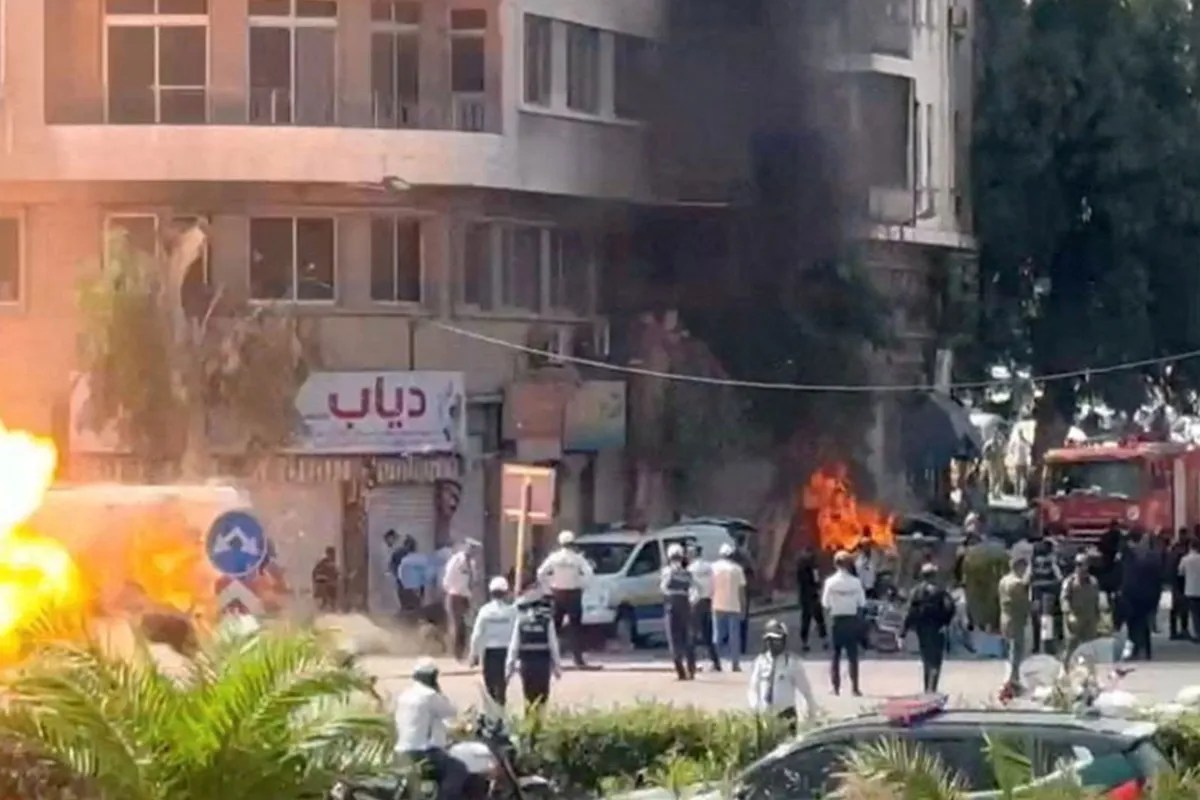
The twin detonations outside the Four Seasons Hotel in Damascus on July 7, 2026, establish a violent baseline for the post-Assad era. Occurring during a landmark state visit by French President Emmanuel Macron, the synchronized blasts—which wounded 18 individuals, including four police officers—expose the precise structural friction between insurgent-style asymmetric warfare and the sovereign stabilization efforts of Syria’s new administration under President Ahmad al-Sharaa. The incident highlights the acute vulnerability of high-value diplomatic capital in transitioning security environments, serving as a stark case study in statecraft under fire.
The Triad of Asymmetric Vulnerability
To understand how two improvised explosive devices (IEDs) could bypass a presidential security apparatus, the event must be broken down into three operational dimensions: placement latency, perimeter design, and the tactical window of opportunity.
- Placement Latency: The devices—one concealed within a roadside parked vehicle and another inside a standard municipal garbage bin—were positioned on a high-traffic urban artery between the Syrian Tourism Ministry and the Damascus National Museum. This layout exploits standard civilian infrastructure, minimizing the digital and physical footprint of the perpetrators prior to activation.
- Perimeter Design Failure: According to official statements from the Syrian Interior Ministry, the IEDs were planted immediately outside the primary security cordon established for the French delegation. This indicates a structural bottleneck in municipal clearing zones: while the inner perimeter remained secure, the peripheral transit corridors remained exposed to commercial traffic and standard municipal refuse cycles.
- The Tactical Window: The detonations occurred shortly after President Macron's motorcade departed the hotel for the presidential palace. This timing reveals a specific intelligence latency. The attackers possessed granular visibility into the delegation's itinerary but faced a strict execution delay, missing the high-value target by a narrow margin. The secondary blast, detonated minutes after the first near an arriving ambulance, follows a classic double-tap doctrine designed to maximize casualties among first responders and security personnel rather than the primary diplomatic asset.
The Cost Function of Sovereign Recognition
The diplomatic calculus driving this state visit is directly tied to Syria's macroeconomic survival. President al-Sharaa's administration, transitioning from its roots as an insurgent coalition that ousted Bashar al-Assad, requires Western legitimacy to unlock international capital. France has acted as the primary European accelerator for this transition, leading initiatives to dismantle the legacy sanctions architecture imposed during the civil war.
The immediate casualty of the Damascus blasts is not the diplomatic agreement itself, but the risk premium assigned to Syrian reconstruction. Macron and al-Sharaa proceeded with their scheduled bilateral meetings, announcing a formal restoration of diplomatic ties and the reappointment of ambassadors for the first time since 2012. However, the economic memorandums of understanding signed during the visit—targeting the restoration of water and power infrastructure in Homs, cargo infrastructure expansion at the Damascus airport, and technical assistance for the Central Bank of Syria—now face severe implementation friction.
[Security Detonations] ---> [Elevated Sovereign Risk Premium] ---> [Delayed Private Capital Inflow]
                                                                        |
[Infrastructure Degradation] <------------------------------------------+
This dynamic creates a direct bottleneck. Private French enterprises and multinational infrastructure consortiums cannot deploy engineering personnel or capital assets into an environment where the capital city's primary diplomatic hospitality hub is subject to daylight IED attacks. The cost of corporate security, insurance underwriting, and logistical risk mitigation escalates exponentially, effectively neutralizing the economic benefits of dropped sanctions.
Internal Security Friction and Institutional Transitions
The Damascus hotel bombings cannot be viewed in isolation; they occurred less than a week after an IED attack at a cafe near the Damascus Justice Palace killed 10 people. Together, these events map a broader systemic challenge within the al-Sharaa government's internal security architecture.
The primary security challenge stems from an institutional transition mismatch. The current administration excels at insurgent maneuvering and territorial seizure but is adapting in real time to the requirements of static defensive policing and urban counter-terrorism. Transitioning an asymmetric fighting force into a municipal police and intelligence apparatus introduces significant vulnerabilities:
- Signals Intelligence (SIGINT) Deficits: The failure to intercept the planning phase of two coordinated urban attacks within seven days points to a critical gap in domestic electronic surveillance and informant networks within the capital.
- Explosive Ordnance Disposal (EOD) Latency: The Syrian Interior Ministry noted that security forces had identified the devices and were preparing to defuse them when the detonation occurred. This sequence reveals an operational delay between threat detection and threat neutralization, costing critical minutes that resulted in 18 casualties.
- Fragmented Factional Landscapes: The absence of an immediate claim of responsibility points to two probable scenarios: either a decentralized remnant cell of the former regime attempting to signal permanent instability, or hardline fundamentalist factions seeking to punish al-Sharaa for his pragmatic pivot toward Western pluralism and secular diplomatic alignment.
Strategic Outlook
The political determination demonstrated by France’s executive branch provides a temporary buffer for the Syrian state. By remaining in Damascus and continuing to a NATO summit in Ankara alongside al-Sharaa, Macron signaled that France views these security disruptions as manageable friction rather than structural deal-breakers.
However, this diplomatic resilience has an expiration date. If the al-Sharaa administration cannot secure the capital's central administrative and hospitality districts, the promised hundreds of billions of dollars required for nationwide reconstruction will remain frozen. The strategic mandate for the Syrian state is clear: it must rapidly shift resources from broad territorial consolidation to granular counter-terrorism operations, establishing a sanitized diplomatic and commercial zone in Damascus. Failure to execute this tactical pivot will re-vessel Syria as a frozen conflict zone, regardless of how many embassies reopen their doors.