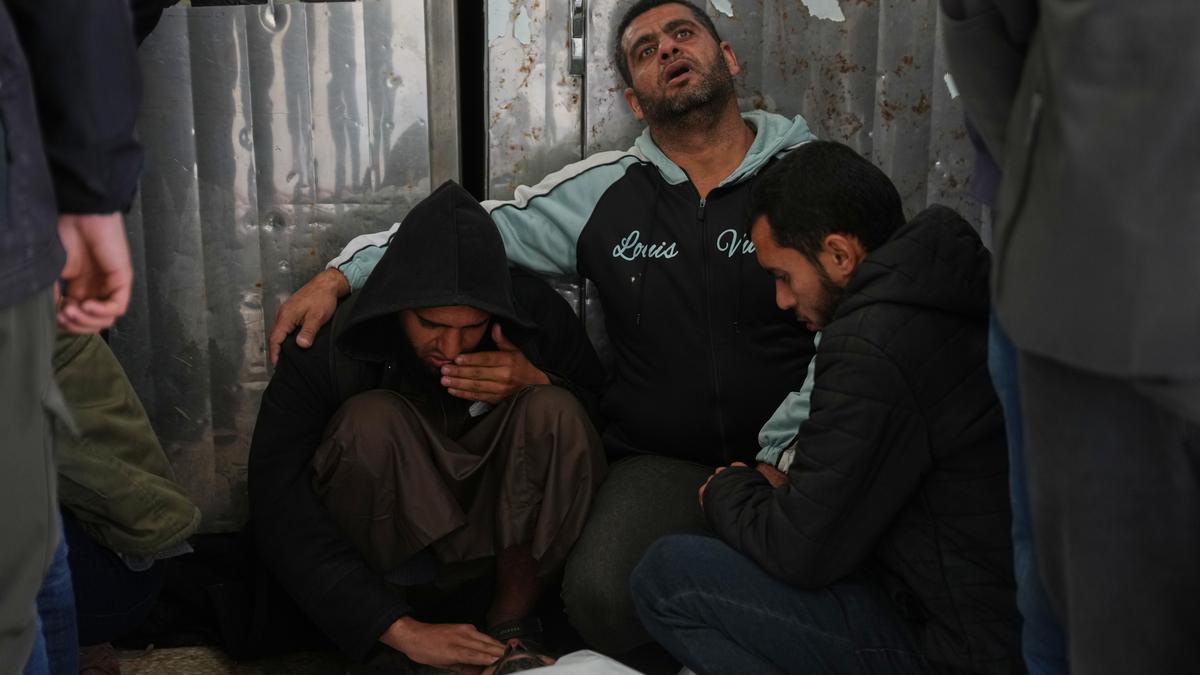
The tactical reality of the ongoing conflict in the Gaza Strip is defined by a high-frequency kinetic exchange where civilian infrastructure serves as the primary theater of operations. Civil defense reports detailing the deaths of seven individuals in northern Gaza—specifically within the Jabalia and Gaza City sectors—are not isolated incidents but rather data points within a broader attrition model. This model operates on the principle of persistent pressure, where the Israeli Defense Forces (IDF) utilize targeted strikes to dismantle localized insurgent networks, while the Civil Defense operates as the primary mitigation layer for non-combatant casualties. The friction between these two operational mandates creates a compounding humanitarian deficit.
The Structural Drivers of Urban Casualty Rates
Urban warfare in densely populated corridors like Jabalia is governed by three primary variables: structural density, proximity of non-combatants to military objectives, and the "yield-to-accuracy" ratio of the munitions deployed. When strikes target specific personnel or hardware within a residential block, the kinetic energy dispersal follows a predictable, if devastating, path.
The Collapse Mechanism
Casualties in these strikes typically result from one of three mechanical failures:
- Primary Blast Injury: The direct pressure wave from the high-explosive payload.
- Secondary Fragmentation: The high-velocity dispersal of casing material and surrounding debris.
- Tertiary Structural Failure: The total or partial collapse of multi-story dwellings not directly hit but structurally compromised by the shockwave.
The reports from Gaza City and Jabalia indicate that the seven fatalities occurred across multiple sites, suggesting a distributed strike pattern rather than a single massive ordnance drop. This distribution points toward a strategy of "node neutralisation," where small-unit targets are engaged within the urban fabric, inevitably catching those in the immediate "kill radius" of the specified structure.
Operational Constraints of the Gaza Civil Defence
The Gaza Civil Defence functions as a reactive emergency management system operating under extreme resource scarcity. Their ability to minimize the death toll is throttled by a degraded logistics chain and the physical destruction of heavy machinery.
The Recovery Bottleneck
When a strike occurs, the "Golden Hour" of emergency medicine is nullified by two specific bottlenecks:
- Access Denied Zones: Persistent drone presence and the risk of "double-tap" strikes (secondary hits on the same location) delay the arrival of first responders.
- Manual Debris Clearance: The absence of fuel for excavators forces teams to use hand tools and manual labor to reach survivors trapped under reinforced concrete.
The report of seven dead often masks a larger number of "unaccounted" individuals. In urban demolition scenarios, the official death toll is a lagging indicator, restricted only to bodies physically recovered and processed. The true casualty count remains an estimate governed by the occupancy data of the targeted structures prior to the strike.
The Geography of Kinetic Density
The concentration of strikes in Northern Gaza, specifically Jabalia, is a function of the IDF's stated objective to prevent the reconstitution of Hamas units in areas previously declared "cleared." This creates a cycle of re-entry and re-engagement.
The Jabalia Displacement Loop
Jabalia is not merely a refugee camp; it is a high-density vertical environment. The logic of the current military posture suggests that any movement detected in these "evacuated" zones is categorized as hostile or auxiliary to hostile forces. Consequently, the threshold for authorizing a strike is lowered. The seven deaths reported by the Civil Defence are the mathematical outcome of this lower threshold applied to a population that either cannot or will not evacuate.
The decision to remain in Northern Gaza, despite evacuation orders, is driven by a lack of viable alternatives in the south, which suffers from its own set of capacity constraints. This results in a static population density in a high-kinetic-activity zone, ensuring that any strike—no matter how precise—will yield civilian fatalities.
Quantification of the Kinetic Environment
To understand the scale of these seven deaths, one must view them through the lens of daily sortie rates and ammunition expenditure. The Gaza conflict lacks a traditional frontline; instead, it features a 360-degree combat environment.
The Cost of Precision
The IDF utilizes a mix of GBU-series precision-guided munitions (PGMs) and smaller, drone-launched missiles. While PGMs reduce "circular error probable" (CEP), they do not eliminate the "collateral damage radius."
$$R_{damage} \propto \sqrt[3]{W}$$
Where $R$ is the damage radius and $W$ is the weight of the explosive yield. Even a "small" 250lb bomb possesses a lethal pressure radius that exceeds the footprint of a standard Gaza apartment. When multiple strikes occur in a single afternoon, the cumulative "lethal footprint" covers significant percentages of residential blocks, making the avoidance of civilian casualties statistically improbable.
The Information Asymmetry Gap
There is a fundamental divergence in the reporting of these events. The Gaza Civil Defence reports raw numbers and locations, focusing on the human cost. The IDF typically reports the "neutralization of terrorists" or the "destruction of infrastructure." This creates an information gap where the identity and intent of those killed remain contested.
The strategic limitation of this data is the lack of independent verification. Because international journalists are largely barred from independent entry into Northern Gaza, the global understanding of these strikes relies on two conflicting narratives:
- The Humanitarian Perspective: Focuses on the civilian status of the deceased and the destruction of the home.
- The Military Perspective: Focuses on the intelligence-led nature of the target and the necessity of the strike for long-term security.
Neither perspective accounts for the "Systemic Error"—the reality that intelligence is often dated or based on signals (SIGINT) that cannot distinguish between a combatant and a civilian occupying the same geographic coordinate.
Tactical Realignment and the Path Forward
The persistence of these strikes indicates that the current "containment" strategy has failed to reach a terminal state. As long as the IDF perceives a threat in the northern ruins, and as long as the Civil Defence remains the only organized body capable of responding to the debris, the friction will continue.
The immediate requirement for any reduction in the mortality rate is not merely a "ceasefire" but a structural change in the rules of engagement (ROE) regarding "empty" or "cleared" zones. If the IDF continues to treat northern Gaza as a free-fire zone based on evacuation orders, the daily toll of five to ten deaths will remain a constant baseline.
Strategic de-escalation requires the establishment of "Safe Recovery Corridors" where the Civil Defence can operate with heavy machinery without the threat of kinetic engagement. Without these corridors, the recovery process remains a manual, slow-motion catastrophe that compounds the initial lethality of the strikes. The focus must shift from counting the dead to modifying the mechanical environment that produces them.



