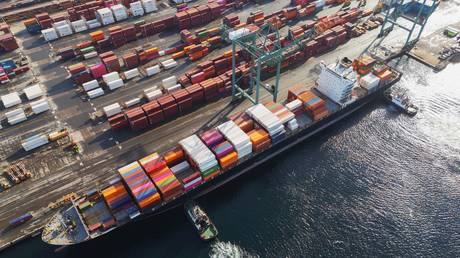
Modern industrial warfare relies on the continuous throughput of energy, raw materials, and finished logistics. When state actors target transportation infrastructure, the objective extends far beyond immediate physical destruction. The strategy centers on degrading network velocity, forcing supply chains into inefficient routing alternatives, and maximizing the operational friction of the opposing side. Recent escalations featuring reciprocal long-range drone and missile campaigns across Eastern Europe illustrate a calculated focus on transshipment hubs, riverine ports, and railway junctions. Deconstructing these operations requires moving past casualty counts and political communiques to analyze the underlying logistical vectors, bottleneck mechanics, and economic trade-offs governing modern transport interdiction.
The Dual-Vector Strategy of Logistics Interdiction
Military planners evaluating contested supply lines focus on two primary operational layers: point-of-origin nodes inside domestic territory and destination-end transshipment points within active operational zones. Recent engagements demonstrate a synchronized dual-vector approach where both belligerents attempt to neutralize the physical capacity of the adversary to accumulate and move materiel.
The first vector targets long-range domestic supply aggregation points. In the context of extended campaigns, high-capacity e-commerce and retail distribution warehouses—such as those operated by major logistics firms within central Russian regions—have increasingly become focal points for asymmetric drone operations. Because modern warehousing networks centralize inventory to optimize commercial efficiency, they inadvertently create high-value, fixed-target vulnerabilities. Disrupting these hubs forces supply chains to decentralize, which increases transport times, burns excess fuel, and degrades delivery reliability.
The second vector focuses on littoral and riverine choke points. Maritime and rail terminals located along strategic export corridors, such as the Baltic Sea oil terminals or the lower Danube river ports, serve as vital arteries for international trade and domestic redistribution. When strikes target these zones, the primary systemic effect is not the immediate loss of static square footage, but the paralysis of intermodal transfer capabilities. Shifting cargo from rail to road, or from river barges to overland transport, introduces severe volumetric constraints.
The Cost Function of Railway and Port Degradation
Evaluating the impact of strikes on transport infrastructure demands an examination of recovery times and redundancy margins. Railways and ports operate on tight scheduling margins where throughput is a function of continuous motion.
When a railway marshalling yard or a port-side loading terminal experiences structural damage, the immediate consequence is queue formation. Network capacity drops instantly to zero in the affected sector, while incoming cargo continues to flow from upstream production centers. This mismatch creates compounding gridlock across the broader national network. Railway networks possess limited alternative routing options due to track gauge standardization, electrification requirements, and bridge capacities. If a primary transit station handling fuel and heavy cargo is disabled, rerouting traffic requires utilizing secondary lines that often feature lower weight thresholds and single-track bottlenecks.
Port infrastructure presents an identical vulnerability profile. Maritime export hubs rely on specialized gantry cranes, deep-draft dredging, and automated grain or liquid transfer systems. Damaging these assets shifts the burden to smaller regional ports or overland rail corridors, which lack the requisite daily tonnage capacity. The resulting reduction in export and import velocity constrains industrial output and restricts state revenue generation, compounding fiscal pressure alongside physical destruction.
Asymmetric Attrition and Air Defense Economics
A critical variable in determining the long-term viability of these interdiction campaigns is the economic asymmetry of the munitions employed. Long-range unmanned aerial vehicles and cruise missiles operate on vastly different cost curves compared to the interceptor missiles required to neutralize them.
Defending vast logistics networks requires a multi-layered air defense grid capable of achieving high interception ratios across hundreds of square kilometers. However, defender stocks of high-end interceptors face finite production limits. When offensive strikes utilize low-cost, long-range drones in high-saturation waves, the defender is forced into an unfavorable expenditure ratio. Even when interception rates exceed eighty percent, the remaining leakage causes structural damage to critical civil-military infrastructure, while the defender exhausts strategic stockpiles that cannot be rapidly replenished.
Conversely, the offensive side faces its own friction metrics. Launch platforms are subject to counter-battery fire, electronic warfare suppression, and long transit vulnerabilities. Maintaining a high operational tempo requires robust internal supply chains for guidance systems, propulsion units, and warheads. As both sides adapt by hardening fixed facilities, burying critical fuel reserves, and deploying localized electronic jamming, the marginal utility of each subsequent strike diminishes. Success increasingly relies on precision intelligence regarding the exact operational status of transformer substations, locomotive maintenance depots, and gantry power supplies rather than generalized area bombardment.
Strategic Realignment of Continental Supply Lines
The persistence of these intermodal strikes forces a permanent structural adaptation in regional supply chain management. Centralized distribution nodes are obsolete in a high-threat environment. Operators must transition toward decentralized micro-warehousing, mobile transshipment teams, and redundant power grids capable of operating off-grid during localized blackouts. The conflict demonstrates that transport infrastructure is no longer a neutral civilian asset but an active operational variable where every kilometer of rail track and every meter of quay wall represents a quantifiable unit of military and economic endurance.
Russia says hit Ukrainian railway and port facilities in new strikes
This coverage provides context on the specific railway and port infrastructure targets involved in recent regional strikes.