Can two nations build a massive strategic partnership when they fundamentally disagree on one of the biggest global conflicts of our time? It sounds like a bad diplomatic joke. Yet, Canberra and New Delhi are proving that you don't need a perfect ideological match to get things done.
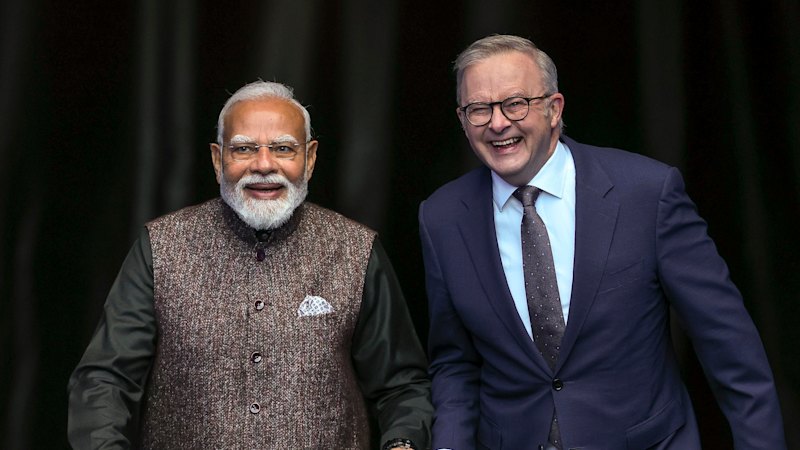
The India-Australia Annual Summit in Melbourne just wrapped up, and the headlines aren't about polite handshakes. They are about a historic, game-changing breakthrough. Prime Minister Anthony Albanese and Prime Minister Narendra Modi just signed a monumental administrative deal that finally allows Australia to export uranium to India for civilian nuclear energy. This moves past a decade-long stalemate rooted in non-proliferation anxieties.
It is proof that the economic and security pull between these two democracies is now too powerful to ignore. But underneath the celebration lies a glaring geopolitical fault line that neither side likes to talk about in public.
The Core Divergence We Cannot Ignore
Let’s be honest. If you look at how Canberra and New Delhi view global security, you'll find a massive rift. It comes down to Russia.
Australia is fiercely anchored to the Western alliance network. When Russia invaded Ukraine, Canberra didn't hesitate. It hit Moscow with sweeping sanctions, sent military aid to Kyiv, and mirrored the strict stance of Washington and London. Australia sees a threat to the rules-based global order anywhere as a threat everywhere.
India takes a completely different path. New Delhi refuses to publicly condemn Moscow. It stepped up its purchases of discounted Russian crude oil and maintains deep, historic military-technical ties with the Kremlin. For India, Russia is an essential strategic hedge. They want to prevent Moscow from falling completely into China’s embrace, and they rely on Russian hardware to keep their military operational along a tense Himalayan border.
In the old days of diplomacy, a disagreement this big would have frozen any chance of a deep partnership. It would have relegated ties to superficial talks about cricket, curry, and the Commonwealth. Not anymore.
Why the China Factor Trumps Everything Else
So, how do both countries look past the Russia issue? The answer is simple. Beijing.
Both nations have faced the sharp end of Chinese economic coercion and military assertion. Australia watched its coal, wine, and barley exports get slapped with heavy Chinese trade restrictions after calling for an independent inquiry into the origins of COVID-19. India watched its soldiers fight lethal hand-to-hand skirmishes with Chinese troops in the Galwan Valley.
These shared experiences changed the calculus. Both countries realized that relying too heavily on a single authoritarian superpower for trade, manufacturing, or supply chains is a fast track to vulnerability.
The Quad—comprising Australia, India, Japan, and the United States—has transformed from a talking shop into a practical framework. Neither Canberra nor New Delhi wants China to dominate the Indo-Pacific. That shared anxiety is a far stronger glue than any disagreement over eastern Europe.
Turning Geopolitics Into Energy Security
The new uranium agreement signed in Melbourne is the ultimate proof of this pragmatic shift. Australia holds nearly a third of the world's known uranium deposits but doesn't use nuclear power domestically. India has a massive, energy-hungry population and a goal to scale its nuclear power capacity from 8 gigawatts to a staggering 100 gigawatts by 2047 to cut carbon emissions.
For years, Australia refused to sell uranium to India because New Delhi isn't a signatory to the Nuclear Non-Proliferation Treaty. India always argued the treaty was discriminatory. It was a classic diplomatic deadlock.
What changed? India passed the Sustainable Harnessing and Advancement of Nuclear Energy for Transforming India (SHANTI) Act, which opened up civilian nuclear projects to private enterprise and foreign equity. Canberra realized that helping India transition to clean energy—while diversifying its own resource export markets away from China—was far more important than clinging to old bureaucratic hesitation.
The government-to-government framework is now locked in. Private Australian mining companies and Indian buyers are free to cut commercial deals directly. It is an absolute win-win that provides India with fuel security and gives Australia a reliable, long-term trade alternative.
Trade is Moving Beyond the Basics
If you think this relationship is just about resources and defense, look at the economic data. The India-Australia Economic Cooperation and Trade Agreement (IndAus ECTA), which kicked off a few years ago, laid the groundwork. Bilateral trade sits at a healthy US$32.6 billion, making India Australia’s sixth-largest trading partner.
While raw merchandise trade numbers can fluctuate based on global commodity prices, the real story is the deep integration happening in other areas. We are seeing a massive push into critical minerals, cross-border investments, advanced manufacturing, and tech supply chains.
Australian universities are setting up actual campuses on Indian soil. Indian tech professionals and students are moving to Australia in record numbers, filling critical skill shortages. This isn't just about politicians signing papers. It's about deep, structural links between businesses, universities, and communities.
Realism Over Rhetoric
The big takeaway here is that modern diplomacy doesn't require total agreement. The idea that countries must share an identical worldview to be close partners is dead.
Australia and India have accepted their differences on Russia. Canberra understands that New Delhi’s geographic reality means it must manage its relationship with Moscow carefully. New Delhi understands that Australia’s fundamental security guarantee relies on its alliance with the United States.
They don't lecture each other. They don't demand total alignment. They just focus on where their interests overlap: securing the Indo-Pacific, stabilizing supply chains, and trading critical energy resources.
For businesses and policymakers, the path forward is clear. Don't wait for perfect political alignment before executing your strategy. Focus heavily on practical, high-value sectors like critical minerals, clean energy tech, and educational partnerships. The bilateral momentum is real, the legal frameworks are clicking into place, and the strategic necessity is only growing. Work around the friction points and double down on the shared economic realities.