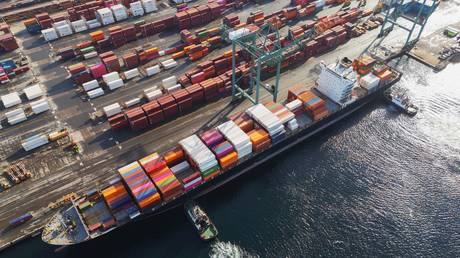
The shipping container smells of salt, stale coffee, and hot rubber.
Inside a dusty warehouse outside of Mumbai, a forklift operator named Rajesh kills the engine. The silence that follows is heavy, broken only by the rhythmic ticking of a cooling diesel manifold. Before him stack rows of plain cardboard boxes. No fancy brand names. No origin badges shouting about where they were born. Just destination codes, handwritten tracking numbers, and an industrial mystery worth billions of dollars.
To the customs inspector sitting three thousand miles away in a sterile Washington office, those boxes represent a statistic. A line item in a White House trade enforcement docket. A regulatory headache. But down here on the concrete floor, beneath the harsh glare of flickering fluorescent tubes, those boxes represent something far more volatile: a carefully engineered detour.
For years, the global trade map was drawn with thick, bold permanent markers. Goods moved from Factory A to Port B through a straight, predictable pipeline. Then came the tariffs. Heavy, punitive walls built of legislative code and executive orders, designed to slow down the relentless march of Chinese manufacturing into Western markets.
Economists drew lines on whiteboards. Politicians promised protection for domestic workers.
And the supply chain did what water always does when it hits a dam. It found a crack.
Consider what happens next in this global game of electronic chess. When a direct route becomes too expensive, a detour isn't just an option. It is an instinct.
(Note: The following scenario is a hypothetical reconstruction based on documented trade routing patterns cited in recent federal oversight reports.)
Picture a circuit board. It starts its life in a sprawling industrial park in Shenzhen. Thousands of identical green wafers, stamped with components that power everything from smart refrigerators to electric vehicle batteries. Under strict tariff laws, bringing that specific wafer directly into American ports triggers a steep tax penalty. A financial wall meant to keep local industries competitive.
So, the wafer takes a vacation.
It crosses a border into a neighboring nation. It enters a secondary assembly plant. A worker screws on a different plastic housing. A new serial number is printed. Papers are stamped. By the time this circuit board is loaded onto a container ship heading west, its birth certificate has been subtly rewritten. It is no longer a product of the East. It is a product of somewhere else. Somewhere clean. Somewhere exempt.
India now finds itself caught dead in the middle of this bureaucratic theater.
A fresh White House report has put the nation right back in the crosshairs, citing countries that inadvertently or intentionally enable tariff evasions. The accusation is structural. Goods flow in, get a light dusting of local transformation, and slip out the back door with a new passport.
To understand why this happens, you have to look past the spreadsheets and stare directly into the mechanics of global survival.
Margins are razor-thin. If a small logistics firm in Gujarat refuses to handle transshipped cargo because of complicated rules of origin, another firm down the road will take the contract. It is business. It is survival. When manufacturing ecosystems are deeply intertwined, pulling them apart is like trying to untangle two balls of yarn that have been tossed into a cement mixer. You do not get clean threads. You get a shredded mess.
Trade policy is written by people who live in drafty marble buildings. Trade reality is lived by people who sweat through their shirts loading trucks in forty-degree heat.
The disconnect is staggering.
Washington sees a deliberate loophole. The factory floor sees a Tuesday.
When tariffs were first dialed up to eleven, the assumption was simple: commerce would reroute back home, or factories would spring up locally overnight. But manufacturing does not work like a light switch. You cannot summon a million skilled technicians, specialized clean rooms, and supply chains of rare earth minerals out of thin air. It takes decades to build an industrial spine.
So, companies improvised. They played the arbitrage game. They found the seams in the global trade architecture. They exploited the administrative lag between what laws say and how customs agencies actually enforce them.
Every time a government builds a higher wall, the market invents a taller ladder. Or, more frequently, a cleverer tunnel.
The recent executive findings are not just about India. They are about a much larger, more uncomfortable truth about globalization. You cannot put the genie back in the bottle once it has been smashed across five continents. Every economy is a joint venture now, whether politicians want to admit it or not. A smartphone in your pocket contains minerals mined in Africa, refined in Asia, designed in California, and assembled through a complex web of sub-contractors whose names nobody outside the logistics department has ever heard of.
Try tracing that ancestry when a customs official asks for a single country of origin. It is a fool's errand.
Yet, the enforcement machine must grind on. Penalties are threatened. Trade delegations fly across oceans to hold tense, closed-door meetings where words like "transshipment," "de minimis," and "compliance" are tossed around like hand grenades.
Back in the warehouse, Rajesh doesn't know any of those words. He just knows that the crane is waiting, the manifest needs to be signed, and the ship tide waits for no bureaucrat.
He hoists the clipboard, signs his initials in ink that is already fading against the humidity, and gives the driver a sharp nod. Another box moves. Another border is blurred. And somewhere in a quiet office across the world, a red flag is pinned to a brand new map, waiting for the next rule to be written, and the next door to be found.