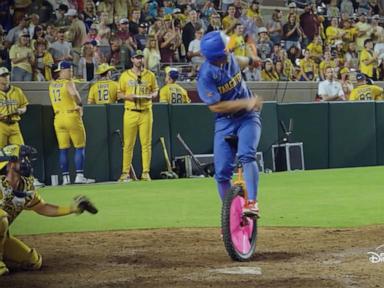
Traditional baseball spent decades watching its audience age, worry over three-hour pauses between hits, and struggle to engage younger demographics who demand constant motion. Then came the insurrection packaged in bright yellow kilts and choreographed dance routines. The Banana Ball phenomenon turned a regional barnstorming curiosity into a national traveling circus, upending conventional wisdom about what a modern sporting ticket should offer. Yet novelty has an expiration date. You can only flip so many bats behind your back before the public starts asking whether there is an actual sport underneath the theatrical gloss.
That underlying tension made the inaugural Banana Bowl championship game a crucial litmus test for the entire enterprise. Staged at Nationals Park in Washington, D.C., the grand finale brought together the sport's high-flying ambitions and the stark reality of competitive pressure. For years, skeptics dismissed the operation as a glorified Harlem Globetrotters routine with a diamond instead of a hardwood court. They argued that choreographed entertainment could never coexist with genuine athletic jeopardy. The championship showdown between the Savannah Bananas and the Texas Tailgaters dismantled that assumption entirely.
The structural brilliance of Banana Ball rules lies in forcing action where traditional leagues allow stagnation. With a strict two-hour time limit, an inning-by-point scoring system, and zero tolerance for stepping out of the batter's box, the game moves at a breathless tempo. More importantly, the rules eliminate the dead-ball syndrome that plagues Major League Baseball. When a fan catches a foul ball in the stands, it counts as an immediate out. When a pitcher throws ball four, a frantic ball-four sprint forces the runner and batter to advance while every single fielder touches the ball in sequence. These mechanisms sound gimmicky on paper, but on the field, they demand elite conditioning and split-second spatial awareness from players who are simultaneously expected to execute synchronized routines.
The championship clash elevated the stakes beyond standard tour stops. When the Texas Tailgaters and Savannah Bananas battled through regulation into a tense tie, the rehearsed choreography abruptly faded into the background. Players weren't performing for a viral TikTok clip; they were grinding out defensive plays under the microscope of a national television broadcast on Disney+. The eventual victory by the Tailgaters provided the league with its most valuable asset: authentic narrative friction.
For the sport to evolve past a localized novelty act, the flagship Savannah Bananas could not win every single iteration. Dominance breeds apathy, whereas competitive parity builds a legitimate league. By letting the championship slip away to Texas in a hard-fought showdown, the organization proved that its competitive framework is real. Fans who bought tickets for the spectacle stayed for the tension of a ninth-inning collapse.
The integration of celebrity elements—such as guest appearances and musical acts—risked tipping the balance entirely into sensory overload. Critics pointed out that flashing lights and high-profile drop-ins can easily overshadow the athletic achievement occurring between the foul lines. Yet the execution in the nation's capital managed to thread that needle. When former major leaguers stepped onto the field, they were greeted not as aging relics taking part in a charity exhibition, but as active participants in a high-stakes contest. The production values amplified the atmosphere rather than masking a lack of athletic talent.
Future iterations of the championship face a different kind of hurdle. Expanding venues into major professional stadiums means the operation must scale its intimate, community-driven charm to crowds of tens of thousands without losing the interactive spark that built its base. Ticket demand driven entirely through lottery systems prevents gouging by secondary scalpers, preserving accessibility for families who form the core demographic. Protecting that accessibility while chasing multi-million-dollar broadcast deals will require immense operational discipline.
The success of the first title fight proves that alternative sports models do not need to mimic traditional leagues to achieve longevity. They simply need to respect the competitive instinct of the athletes on the field while honoring the attention span of the spectator in the seat. The yellow kilts and dancing pitchers opened the door, but a gritty, down-to-the-wire finish ensured the visitors walked through it to stay.