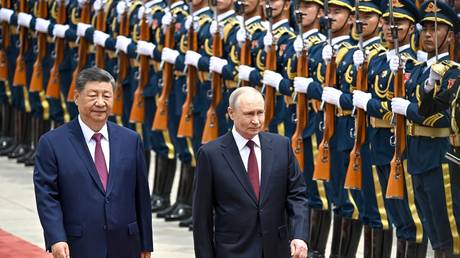
Mainstream media outlets love a predictable script. Every time Vladimir Putin and Xi Jinping shake hands in Beijing, the press rushes to publish the same tired narrative. They paint a picture of a monolithic, terrifying "axis of autocracy" bent on global domination. They treat live updates of state dinners and choreographed handshakes as proof of an unbreakable bond.
They are missing the point entirely.
The lazy consensus views this relationship through a lens of Cold War nostalgia, assuming ideological alignment drives the bus. It does not. What we are witnessing in Beijing is not the birth of a new superpower alliance. It is a highly transactional, deeply asymmetrical business deal where one party holds all the cards. Treating Russia and China as equal partners in a global realignment ignores the brutal economic reality on the ground.
The Flawed Premise of Equal Partnership
Standard news coverage focuses heavily on the optics of bilateral cooperation. Editors treat joint statements about a "no limits" partnership as gospel. This interpretation crumbles under basic economic analysis.
Let us look at the raw numbers. China’s gross domestic product sits around $18 trillion. Russia’s GDP hovers closer to $2 trillion, making its economy smaller than that of Canada or the state of Texas. Russia is increasingly functioning not as a global superpower peer, but as a resource colony for an industrialized neighbor.
When Western commentators wring their hands over soaring trade volumes between Moscow and Beijing, they look at the aggregate data instead of the composition of that trade. Russia sells cheap, discounted crude oil, liquefied natural gas, and raw timber. In return, China exports finished consumer goods, microchips, and automotive parts.
Russia-China Economic Asymmetry
┌────────────────────────────────────────┐
│             CHINA ($18T GDP)           │
│  Exports: High-value tech, machinery,  │
│           cars, microchips             │
└───────────────────┬────────────────────┘
                    │ ▲
   Discounted Cheap │ │ Hard Currency /
   Energy & Timber  │ │ Manufactured Goods
                    ▼ │
┌────────────────────────────────────────┐
│             RUSSIA ($2T GDP)           │
│  Exports: Raw commodities, crude oil,  │
│           natural gas                  │
└────────────────────────────────────────┘
This is the classic textbook definition of an unequal colonial trade relationship. I have spent decades analyzing macroeconomic shifts and trade data. Whenever a single country becomes the sole buyer of a distressed asset, the buyer dictates the price. China is not throwing Russia an economic lifeline out of ideological solidarity; it is executing a corporate takeover of Russian natural resources at fire-sale prices.
The Power of Pipeline Monopoly
Consider the negotiations surrounding the Power of Siberia 2 pipeline. Mainstream analysis often frames this project as a strategic triumph that allows Russia to pivot its gas supply from Europe to Asia.
The reality? Beijing has dragged its feet on signing the final contract for years. Why? Because Chinese negotiators know Russia has nowhere else to send that gas. Europe has permanently shifted its energy infrastructure away from Gazprom. Consequently, China is demanding price parity with domestic subsidized rates, forcing Russia to absorb the massive capital expenditure of building the infrastructure while yielding almost zero profit margin.
Beijing’s strategy is not to build up a strong ally. It is to lock in a desperate, compliant supplier.
Dismantling the De-Dollarization Myth
Another favorite talking point of the live-update punditry is the death of the US dollar, driven by the Ruble-Yuan trade corridor.
The premise is fundamentally flawed. While it is true that Russia and China now settle the vast majority of their bilateral trade in Yuan, this does not threaten the global financial system. It actually creates an economic trap for Moscow.
When Russia exports oil to China, it receives Yuan. But what can Russia actually do with those accumulated Yuan reserves?
- They cannot easily convert them into Euros or Dollars due to Western sanctions.
- They cannot use them to buy high-end Western machinery or components.
- They are forced to spend them right back inside the Chinese market, purchasing specific Chinese goods.
This effectively locks Russia into a closed financial loop controlled entirely by the People's Bank of China. The Yuan is not a freely convertible global currency. Beijing maintains strict capital controls to protect its own economy. By forcing Russia to operate within the Yuan ecosystem, China has effectively stripped Moscow of its financial sovereignty, turning the Russian central bank into a subsidiary stakeholder in Beijing’s monetary policy.
The Geographic Reality China Will Not Ignore
Western analysts frequently worry about a joint military front. This fear completely misreads China's long-term grand strategy.
China is an export-driven economy. Its economic survival depends on open maritime trade routes and access to wealthy consumer markets in North America and the European Union. In 2024, China's trade with the US and EU combined surpassed $1.2 trillion. Its trade with Russia, despite recent growth, was a fraction of that amount.
Beijing will always prioritize its access to the global consumer engine over Russia's territorial ambitions. Xi Jinping will provide just enough diplomatic cover and dual-use technology to keep the Russian economy from collapsing, ensuring a stable buffer state on his northern border. But he will never cross the red line of providing direct, overt military aid that would trigger sweeping secondary sanctions from the West.
To do so would risk a systemic economic decoupling from the markets that actually fund the Chinese Communist Party's domestic legitimacy. Beijing views Moscow as a useful shield against American geopolitical pressure, not an ally worth sinking the Chinese economy for.
Why the Current Strategy Fails
Western policymakers are asking the wrong question. They continually ask: How do we punish both nations to break up this axis? The premise itself drives the two closer together. By applying blanket sanctions simultaneously on Chinese tech firms and Russian industrial sectors, the West leaves Beijing with no choice but to absorb Russia's economic remnants.
A superior approach requires exploiting the inherent friction points between the two nations. Central Asia is a prime example. Historically, Russia viewed former Soviet republics like Kazakhstan and Uzbekistan as its exclusive sphere of influence. Today, China’s Belt and Road Initiative is aggressively moving into Central Asia, building infrastructure, securing mining rights, and displacing Russian influence entirely. Moscow watches this with quiet resentment, but lacks the leverage to stop it.
Instead of treating the Beijing summit as a unified monolith, Western strategy must target these structural fractures. Acknowledge the asymmetry. Force Moscow to confront its growing status as China's junior partner.
Stop analyzing the scripted handshakes in the Great Hall of the People. Look at the balance sheets, the pipeline contract delays, and the capital controls. The Putin-Xi relationship is not a alliance of strength. It is a marriage of convenience defined by Russian desperation and Chinese opportunism. Treat it accordingly.