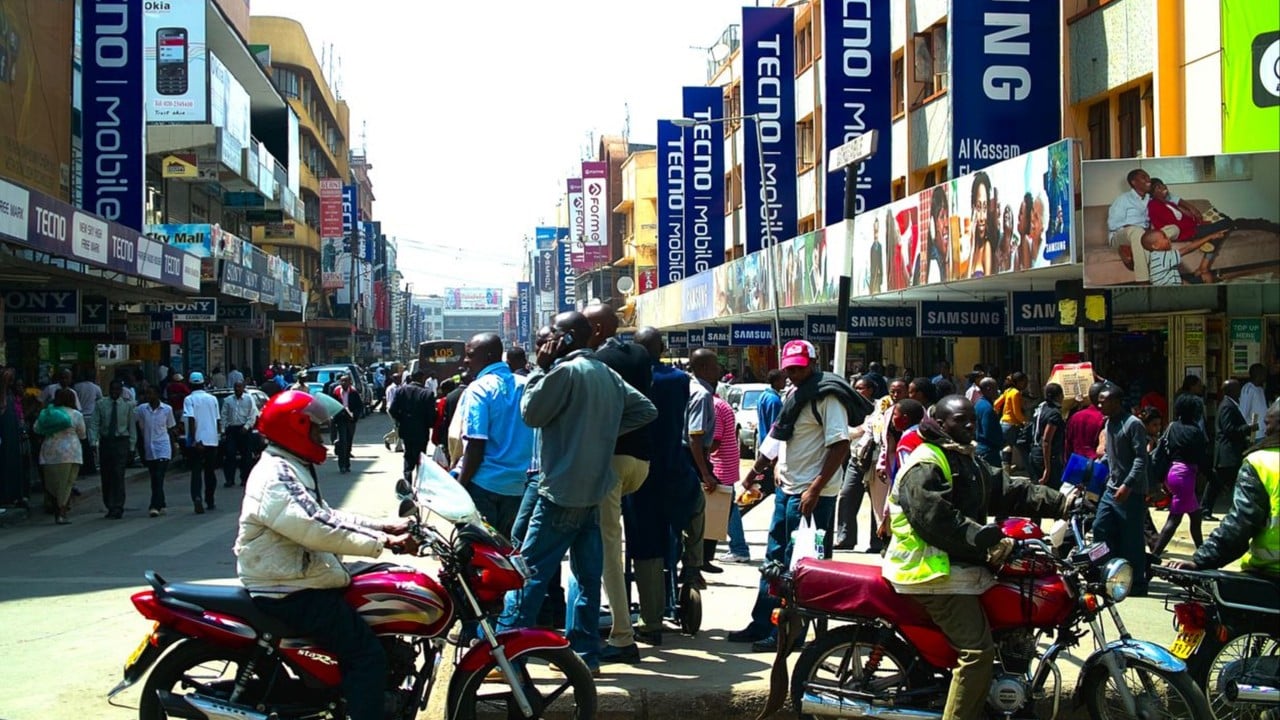
The dirt road outside Kano hums with a specific kind of electricity. It is not the clean, grid-tied voltage of a Manhattan high-rise. It is the raw, diesel-throated pulse of thousands of motorcycles, the chatter of open-air market stalls, and the steady, rhythmic tapping of thumbs against glowing plastic screens.
Down this road, a young man named Ibrahim sits on a wooden stool under a tattered blue umbrella. In his palm rests a device that looks, at a casual glance, like an expensive flagship phone from Seoul or Cupertino. It has a crisp display, a multi-lens camera, and a battery that will outlast the afternoon rolling blackouts. But it cost a fraction of the price. More importantly, it understands Ibrahim. It has physical dual-SIM slots for switching between fickle network providers, a specialized front-facing camera calibrated to capture deep skin tones accurately in low light, and front-facing speakers loud enough to cut through the roar of a Lagos traffic jam.
That phone is a Tecno. Or perhaps an Infinix. Both are forged by a Shenzhen-headquartered titan called Transsion Holdings.
While Wall Street analysts and traditional financial journalists obsess over the quarterly maneuvers of Apple and Samsung in Western markets, Transsion quietly conquered an entire continent. They did not do it by accident. They listened to the dust, the heat, and the economic reality of a billion people who were told they did not matter to the global tech elite because their average disposable income was low. Transsion built hardware for the neglected majority. They mapped the contours of emerging markets not through focus groups in air-conditioned boardrooms, but by embedding engineers in towns like Kano, Nairobi, and Addis Ababa.
By any rational measure of modern commerce, Transsion should be a golden asset in the eyes of international financiers. Their revenue streams are massive. Their market share in Africa is monumental, commanding a dominant slice of the mobile handset pie. Yet, when financial gravity pulled the company toward a high-profile secondary listing on the Hong Kong Stock Exchange, something strange happened.
Silence.
Investors in Hong Kong, seasoned watchers of global equities who eagerly chase the next semiconductor breakthrough or artificial intelligence darling, looked at the prospectus, shrugged, and walked away. The order books were unenthusiastic. The public interest was tepid. To a casual observer, it read like a corporate rejection. Why would a metropolis known for its financial hunger ignore a company printing money off the pockets of a billion emerging consumers?
To answer that, you have to understand the invisible wall that separates the financial hubs of East Asia from the bustling realities of Sub-Saharan Africa.
Consider the perspective of a veteran portfolio manager sitting in a glass tower overlooking Victoria Harbour. Their world is governed by familiar tickers. They understand Tencent, Alibaba, and BYD. They can chart the supply chains of semiconductor foundries in Taiwan and consumer electronics manufacturing in Guangdong. These are geographies they can model on a spreadsheet.
Africa, by contrast, is treated by many traditional Asian investors as a distant abstraction. It is a continent filed under risk, volatility, and currency depreciation. When they look at Transsion, they do not see a triumphant conqueror of a new digital frontier. They see foreign exchange exposure. They see the Nigerian naira fluctuating wildly against the US dollar. They see inflationary pressures eating away at margins. They see logistics headaches that defy standard Western supply chain logic.
In the cold calculus of quantitative finance, familiarity breeds confidence. Unfamiliarity breeds skepticism. The Hong Kong investor base, for all its sophistication, suffers from a profound geographic and psychological myopia. They view Transsion through a lens of fear rather than a lens of opportunity. They see a company deeply exposed to economies they do not understand, operating in regions where political shifts can alter market dynamics overnight.
This disconnect exposes a deeper truth about how global capital actually works. Money is not nearly as adventurous as we pretend it is. Capital prefers the well-trodden path. It loves the predictable curve of a mature market, even when that market is saturated and growth has slowed to a crawl. It trembles at the edges of the map where the real, raw expansion is happening.
Yet, to dismiss Transsion's lukewarm reception in Hong Kong as a failure of the company is to misread the narrative entirely. Transsion does not actually need the validation of traditional Hong Kong retail investors to survive or thrive. Its true power base is already secured where it matters most: in the hands of the people who use its devices every single day.
Step back into Kano. Ibrahim does not know what a stock exchange is, nor does he care about the daily fluctuations of a secondary listing thousands of miles away across the South China Sea. He cares that his phone's battery holds a charge through a two-day blackout. He cares that the dual-SIM card lets him dodge exorbitant data roaming fees when he crosses the border to trade goods. He cares that the software is optimized for local mobile money platforms, transforming his handset into a portable bank account in a region where traditional banking infrastructure is scarce.
That is the moat Transsion built. It is not made of patents or proprietary software ecosystems locked behind walled gardens. It is made of radical localization.
When Western and Asian smartphone giants first attempted to sell devices in Africa, they treated the continent as a dumping ground for older, discontinued models or cheap, stripped-down variants of phones designed for entirely different climates and consumer habits. They assumed that a cheap phone was just a matter of removing features. Transsion realized it was a matter of adding the right ones. They added multiple flashlight settings for areas prone to sudden blackouts. They designed keyboards that could accurately parse local languages and colloquialisms. They even engineered cooling systems capable of handling tropical heat without throttling processor speeds.
This level of granular adaptation is difficult to capture in a sterile financial prospectus. It is hard for an analyst whose primary frame of reference is a polished shopping mall in Central Hong Kong to quantify the emotional resonance of a brand that actually engineered its product for the realities of a dirt road.
The cold shoulder from Hong Kong investors reveals a systemic blind spot in modern investment culture. We have built financial systems that reward proximity to the old centers of gravity while ignoring the seismic shifts occurring at the periphery. We measure success by the standards of Wall Street, London, and Hong Kong, completely missing the fact that the next wave of global economic resilience is writing its own rules in places we rarely bother to look.
The story of Transsion and its cool reception in the East is not a tragedy of corporate rejection. It is a portrait of a market looking backward while the future marches right past the window.
While the trading screens flash red and green with numbers dictated by old anxieties, the real wealth is being unlocked elsewhere. It is humming quietly in the palm of a hand under a blue umbrella in Kano, powered by a battery that refuses to die, connected to a network that is rewriting the story of human potential one transaction at a time. The investors in Hong Kong may have passed on the stock, but the future they are ignoring is already dialed in, charged, and waiting.