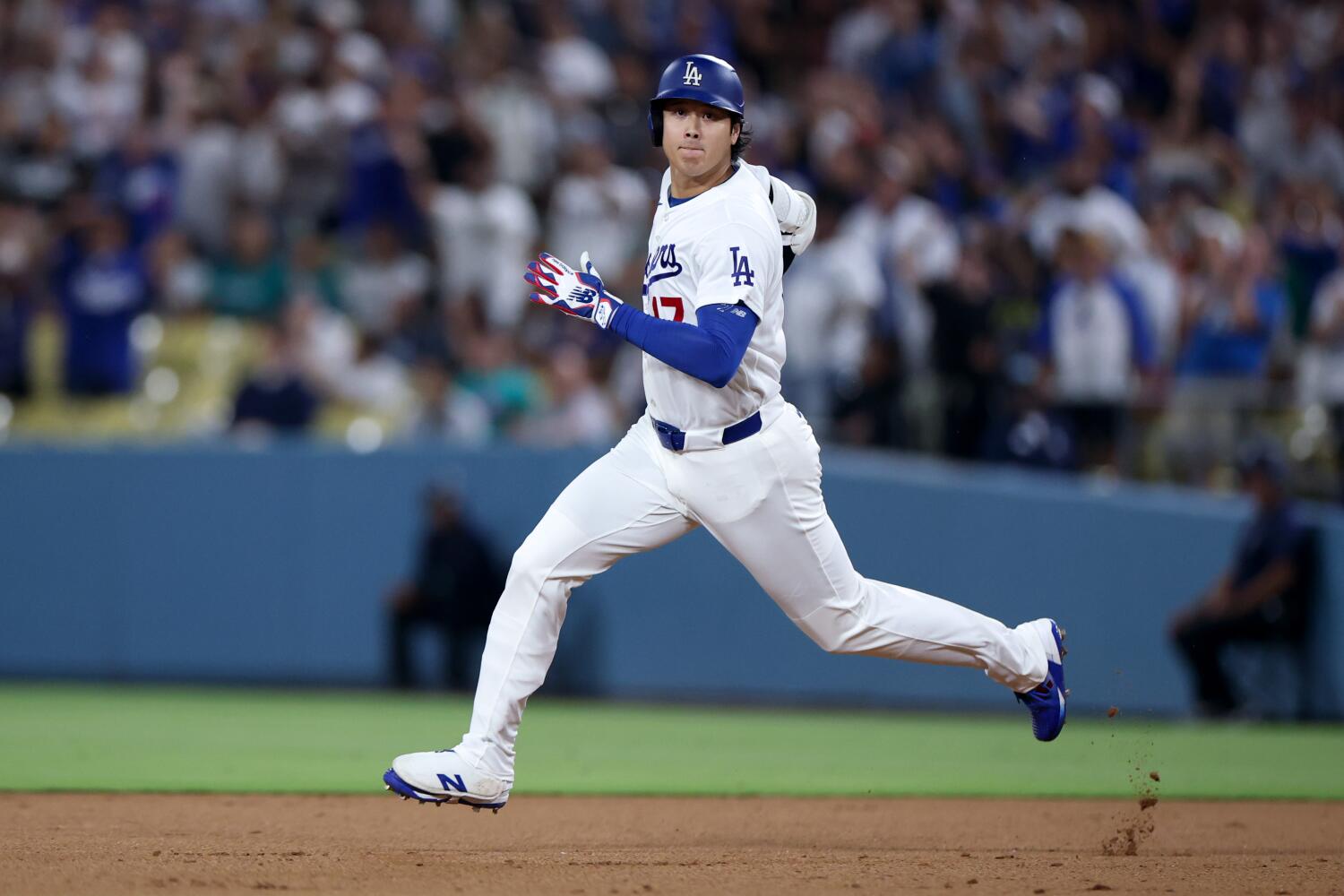
The operational utility of an elite asset degrades non-linearly when subjected to compounding physiological stressors, a reality currently governing the Los Angeles Dodgers roster management strategy. While external analysis consistently frames the indefinite delay of Shohei Ohtani returning to a major league pitching mound as a singular narrative concerning left knee irritation, a rigorous structural deconstruction reveals a dual-variable bottleneck. The operational pause is governed by two distinct mechanical friction points: the decelerative kinetic load absorbed by the front knee during stride landing, and the secondary recovery deficits identified within the throwing arm's musculature, specifically the right biceps. Recognizing why the franchise refuses to force a premature activation requires examining the cost function of two-way asset utilization under pennant race pressures.
The Biomechanical Cost Function of the Front Leg
In right-handed pitching delivery, the lead leg performs a precise decelerative function. Upon foot strike, the lead knee experiences vertical ground reaction forces multiplying several times an athlete's body weight, followed immediately by rapid extension to create a rigid rotational axis. Ohtani throws right-handed, meaning his left leg functions as this landing pillar. If you found value in this post, you might want to check out: this related article.
Conversely, Ohtani bats from the left side, where the identical left leg serves as the back leg during swing rotation, absorbing rotational torque rather than linear deceleration. This explains why the physiological trauma profile differs fundamentally between modalities.
- Linear landing forces incurred during pitching trigger direct micro-trauma in the joint capsule and surrounding tissue of the lead knee.
- Rotational weight-transfer forces incurred during swinging distribute energy differently, allowing offensive production to persist unhindered.
This asymmetry establishes a clear operational constraint. The human body cannot simultaneously accelerate rehabilitation for a high-impact deceleration anchor while subjecting that same tissue to the maximal workloads required for a major league pitching buildup. For another look on this development, check out the latest update from Bleacher Report.
The Multi-Variable Injury Matrix
The analytical oversight in standard sports commentary is the assumption of a single point of failure. Recent disclosures confirm that the pause on bullpen sessions is not solely a product of the patellar region. Secondary kinetic chain inflammation, specifically concerning the right biceps, introduces an upper-extremity variable that complicates the timeline further.
When a pitcher attempts to accelerate a throwing program while managing a lower-extremity deficit, compensatory mechanics invariably occur. To protect a landing knee, an athlete subconsciously alters stride length or hip rotation velocity. These microscopic alterations shift undue shear stress onto the shoulder girdle and elbow complex.
- The primary variable involves the mechanical tolerance of the left knee during deceleration phases.
- The secondary variable tracks the functional capacity of the right upper extremity to absorb throwing stress without compensation patterns.
- The compounding factor dictates that until both variables return to baseline operational parameters, initiating a standard six-week pitching buildup remains an unacceptable risk.
Strategic Allocation of Roster Assets
From an organizational perspective, the risk-reward ratio of pushing Ohtani back onto the mound during the regular season heavily favors preservation. The front office operates on a deterministic timeline where October performance supersedes July urgency. Maintaining Ohtani as an elite designated hitter preserves high offensive value while insulating the pitching arm from catastrophic structural regression.
Adding a frontline starter mid-season via internal recovery mimics the impact of a marquee trade deadline acquisition, yet forcing the sequence invites catastrophic failure. If the baseline metrics of joint stability and muscular output are outside acceptable error margins, accelerating the schedule trades short-term innings for long-term championship equity. The strategic play is unequivocal. Freeze the mound progression, extract maximal value from the designated hitter slot, and let internal rotation depth carry the load until structural integrity permits a clean restart of the throwing program.