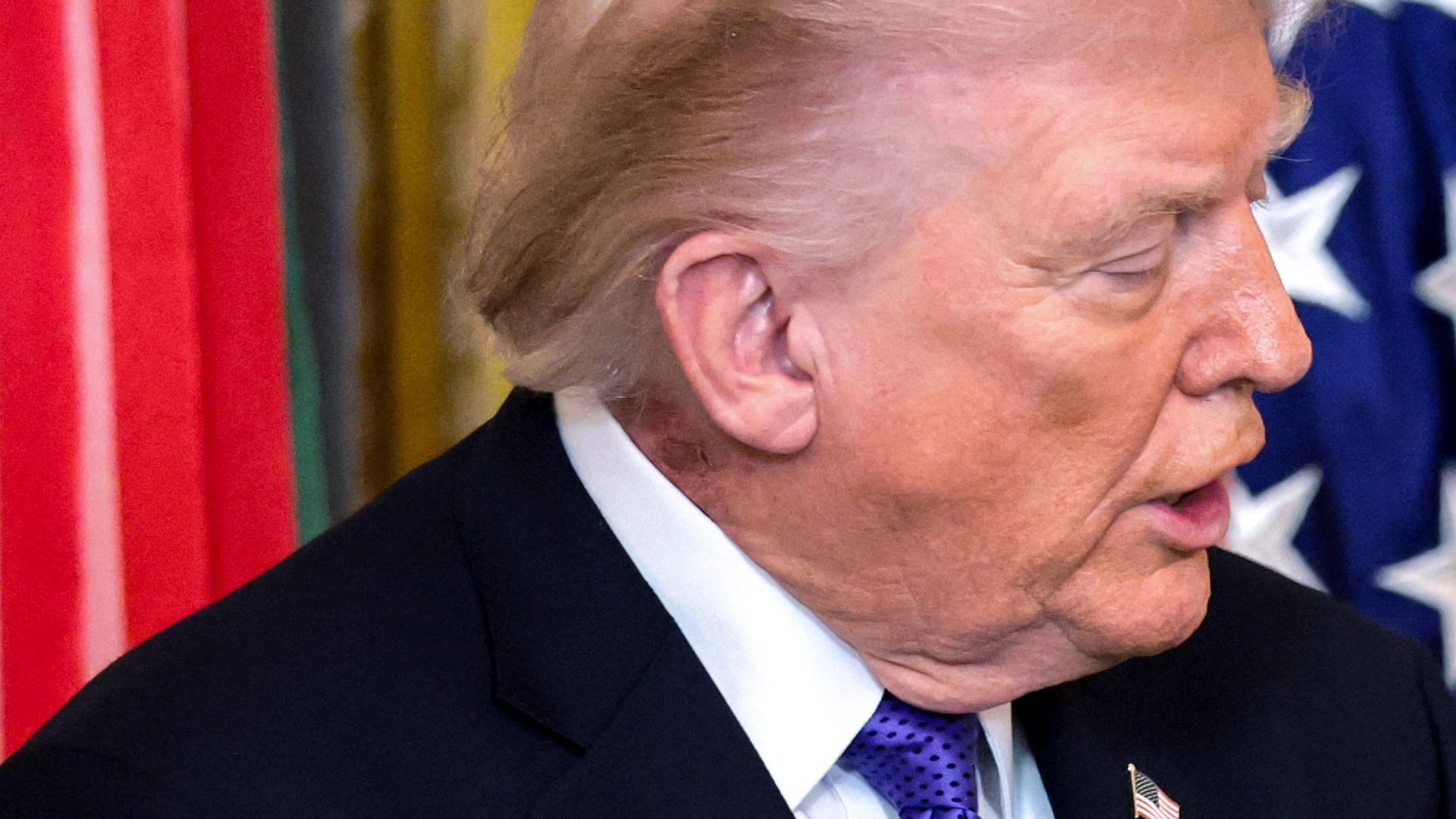
The intersection of political communication and clinical reporting creates a systemic transparency gap where public perception often diverges from physiological reality. When Donald Trump addressed concerns regarding skin lesions on his hand—frequently referred to as a "rash"—by asserting a "perfect" health check, he utilized a rhetorical strategy designed to bypass formal clinical metrics in favor of absolute qualitative claims. Analyzing this event requires a decomposition of three specific domains: the pathology of stress-induced dermatological conditions, the protocols of the Summary Medical Report (SMR), and the strategic utility of the "clean bill of health" narrative in high-stakes leadership environments.
The Dermatological Variable and Environmental Stressors
Clinical scrutiny of the visible red marks on Trump’s hands—observed during his departure from Trump Tower in early 2024—centered on a limited set of diagnostic possibilities. While external commentators speculated on secondary syphilis or internal systemic failure, the physiological mechanisms suggest more probable, though less sensational, origins.
- Mechanical Trauma and Fragility: The aging dermis undergoes a process called solar purpura, where blood vessels lose structural integrity and rupture under minimal pressure. In a high-volume physical interaction environment (handshaking, podium gripping), localized bruising or "senile purpura" often manifests as irregular red patches.
- Contact Dermatitis: The constant use of alcohol-based sanitizers or exposure to specific allergens on campaign trails can trigger localized inflammatory responses.
- Stress-Exacerbated Psoriasis: Under the acute physiological stress of a legal and political schedule, the immune system can trigger rapid skin cell turnover, resulting in visible plaques.
The dismissal of these marks as "perfect" health ignores the reality that the skin is a primary indicator of systemic inflammation. However, from a strategic consulting perspective, the "perfection" claim functions as a binary toggle: either a leader is fit or unfit. By negating the nuance of minor dermatological irritation, the subject successfully steers the narrative back to a baseline of total operational readiness.
The Architecture of Presidential Health Disclosure
The public relies on a fragmented disclosure framework that lacks the rigor of a true clinical audit. Unlike a private sector executive undergoind a "Key Person" insurance physical, a presidential candidate has no constitutional obligation to release comprehensive medical records. This creates an information asymmetry where the public receives a "Summary of Findings" rather than raw data.
The Missing Metrics in Narrative Reporting
A "perfect" health check is a medical impossibility; every human organism at age 77 presents with degenerative markers. A rigorous assessment would prioritize three quantitative pillars over qualitative adjectives:
- Cardiovascular Reserve: Specifically, the results of a high-sensitivity C-reactive protein (hs-CRP) test and a coronary artery calcium (CAC) score. These provide a 10-year risk profile that "perfect" cannot quantify.
- Neurocognitive Baseline: Beyond the Montreal Cognitive Assessment (MoCA)—which screens for gross impairment—a strategic analysis requires longitudinal data on executive function, processing speed, and semantic memory.
- Metabolic Stability: Data on HbA1c levels and lipid profiles determine the sustainability of a 16-hour workday.
The "rash" incident highlights a failure in the current reporting loop. When a visible physical anomaly appears, the absence of a standardized, timely update from a non-partisan medical officer allows speculation to fill the data vacuum. The "perfect" claim acts as a linguistic firewall, but it does nothing to address the underlying physiological volatility inherent in the aging process.
The Operational Cost of Information Asymmetry
In a corporate or geopolitical context, the health of a chief executive is a material risk factor. The "perfect health" narrative is a defensive asset intended to project stability to markets and constituents. However, this strategy carries a significant "Information Tax."
The Feedback Loop of Speculation
When a candidate uses hyperbolic language to describe health, it creates a "devaluation of the word." If a minor skin irritation is ignored or hidden, the market begins to price in the possibility of more significant, hidden comorbidities. This leads to:
- Increased Scrutiny Saturation: Media outlets dedicate disproportionate resources to visual analysis of gait, posture, and skin tone.
- The "Medicalized" Opposition: Opponents leverage every cough or stumble as evidence of systemic decline, forced by the vacuum left by the lack of objective data.
- Voter Heuristics: In the absence of a HIPAA-compliant release, voters use "vibe-based" health assessments, which are prone to cognitive biases and partisan filtering.
Quantifying the "Perfect" Health Narrative
The term "perfect" functions as a mathematical nullifier. In a data-driven environment, health exists on a Gaussian distribution. By claiming a position at the extreme right tail of the curve (100th percentile), the subject removes the possibility of incremental decline.
This creates a high-stakes binary. If a leader admits to a "minor" ailment, it suggests the possibility of "major" ailments. By maintaining the "perfect" stance, the leader ensures that any admission of health issues is seen as a total collapse of the narrative, rather than a manageable reality of aging.
Risk Mitigation for Institutional Stability
To move beyond the cycle of "rash rumors" and "perfect rebuttals," a new framework for leadership health assessment is required. This would involve:
- Independent Medical Boards: A rotating panel of specialists not appointed by the subject, providing a standardized "Fit for Duty" certification.
- Standardized Biomarker Disclosures: Mandating the release of a specific set of non-invasive metrics (Blood Pressure, BMI, Lipid Panel, MoCA score) annually.
- Visual Anomaly Protocols: Pre-empting speculation by providing immediate, low-stakes explanations for visible issues (e.g., "The candidate is treating a minor case of contact dermatitis").
The failure to implement these protocols ensures that the "perfect" claim remains the only viable political defense, even as it erodes long-term trust in the biological viability of the leadership.
The Strategic Shift to Metabolic Health
The true indicator of presidential endurance is not the absence of a rash, but the efficiency of the metabolic system. The rigors of a modern campaign and subsequent governance demand a high degree of mitochondrial efficiency. A strategic audit of a candidate's health must look past the skin and into the "allostatic load"—the cumulative wear and tear on the body due to chronic stress.
High allostatic load manifests as:
- Elevated cortisol levels.
- Decreased sleep quality (REM and Deep Sleep stages).
- Visible dermatological flares (including the aforementioned "rash").
- Fluctuations in cognitive fluidity.
When a candidate dismisses these signs as non-existent, they are essentially claiming immunity to the laws of human physiology. This may be effective for a short-term news cycle, but it creates a fragile long-term strategy.
The move toward a data-driven health standard is the only way to decouple biological reality from political theater. Until then, the "perfect" health check remains a psychological tool rather than a clinical fact, designed to project an image of invulnerability that no human organism can truly sustain. The immediate strategic requirement for any high-level political operation is to transition from defensive, adjective-heavy health reporting to a proactive, metric-based transparency model that preempts visual speculation with physiological data.