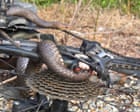
Recreational rail trails represent a structural intersection between human transit corridors and active wildlife habitats. When these two systems collide, the resulting incidents are often analyzed through the lens of sensationalism rather than mechanical and biological reality. The encounter on the Northern Rivers Rail Trail in New South Wales—where a cyclist ran over a two-meter eastern brown snake (Pseudonaja textilis), resulting in mechanical entanglement in the bicycle’s drivetrain and a subsequent bite to the rider’s thigh—serves as a case study in mechanical entrapment, kinetic reaction times, and the physiological variables governing dry bites.
Understanding these events requires moving past sensationalized narratives of lucky escapes. Instead, we must dissect the physics of high-speed mechanical capture, the physiological mechanics of venom metering, and the clinical realities of emergency wilderness medicine.
The Physics of Mechanical Entanglement in Bicycle Drivetrains
The transition of a biological entity from a passive trail occupant to an entangled threat is governed by kinetic forces and mechanical entrapment vectors. When a bicycle wheel moving at average recreational speeds (approximately 15 to 25 kilometers per hour) contacts a elongated reptile, several physical reactions occur in rapid succession.
The Compression Vector
As the front tire rolls over the body of a snake, it compresses the musculoskeletal structure against the trail substrate. This compression does not merely pin the animal; it initiates a violent, reflexive muscular contraction. For a two-meter Pseudonaja textilis, this represents a significant mass—up to several kilograms of highly dense muscle—capable of rapid, lateral, whip-like expansion.
The Drivetrain Capture Mechanism
The primary hazard in bicycle-wildlife interactions is not the initial roll-over, but the trajectory of the animal after displacement. As the front wheel passes, the reptile is often flung upward by the centripetal force of the rotating tire tread or the lateral recoil of its own muscles.
Once elevated into the path of the bottom bracket, chainring, or rear wheel assembly, the snake is subjected to the mechanical intake of the chain-and-sprocket drive system:
- Spokes and Wheel Wells: The rotating spokes act as a low-clearance centrifuge. A long, flexible biological structure is easily swept into this rotational path, wrapping around the hub or binding between the tire and the frame stays.
- Chain-and-Chainring Clearance: The clearance between a bicycle chain and the chainring or rear cassette is minimal. As the chain moves, it creates a pinch point. If the tail or midsection of a snake enters this interface, the rotational torque of the rider's pedaling forces the biological tissue into the sprockets, jamming the drivetrain and anchoring the head of the reptile within striking distance of the rider's lower extremities.
This mechanical anchoring eliminates the reptile’s primary defensive option: flight. Trapped, injured, and subjected to intense vibrational forces from the moving bicycle frame, the animal’s stress response dictates immediate, defensive strike behavior.
The Biophysics of the Strike: Mechanics and Venom Metering
The eastern brown snake (Pseudonaja textilis) possesses the second most toxic venom of any terrestrial snake worldwide, measured by a subcutaneous median lethal dose ($LD_{50}$) of approximately $0.05 \text{ mg/kg}$ in murine models. The venom is a highly complex biological cocktail containing potent pre-synaptic and post-synaptic neurotoxins, cardiotoxins, and powerful procoagulants that initiate venom-induced consumption coagulopathy.
                    [ Mechanical Entanglement ]
                                 │
                                 ▼
                     [ Deflection & Anchoring ]
                                 │
                                 ▼
                    [ Immediate Strike Reflex ]
                                 │
                   ┌─────────────┴─────────────┐
                   ▼                           ▼
             [ Wet Strike ]              [ Dry Strike ]
         (Venom Metered/Injected)     (No Venom Delivered)
                   │                           │
                   ▼                           ▼
        [ Systemic Coagulopathy ]      [ Mechanical Trauma Only ]
Given this extreme toxicity, a bite to the upper thigh from a two-meter specimen carries an exceptionally high mortality rate if untreated. However, the outcome of this specific incident was a clinical "dry bite"—a phenomenon where puncture wounds occur without the systemic introduction of venom.
Understanding why dry bites occur requires analyzing the physiological control mechanisms of the ophidian venom delivery system.
Active vs. Passive Venom Metering
Historically, dry bites were thought to be accidental failures of the delivery mechanism. Modern herpetological research indicates that venom delivery is an active, highly metered cognitive process. Producing venom requires significant metabolic resources; expending it on a non-prey target that cannot be consumed is an evolutionary disadvantage.
The venom apparatus of elapids consists of paired venom glands surrounded by specialized compressor muscles (the adductor mandibulae externus superficialis). When the snake bites, these muscles must contract to squeeze venom out of the gland, through the duct, and down the hollow lumen of the fixed, relatively short fangs (typically 1 to 3 millimeters in Pseudonaja species).
Factors Triggering a Dry Bite
The high frequency of dry bites in defensive encounters—estimated to be between 10% and 50% depending on the species and context—can be attributed to several variables:
- Defensive Stress Profiles: In high-stress, rapid-onset encounters where the snake is physically compressed or entangled, the strike is a rapid, reflexive deterrent rather than a predatory action. The duration of fang contact is often too brief (measured in milliseconds) for the coordinated muscle contractions required to pressurize the venom gland and inject the toxin.
- Inadequate Fang Penetration: Elapids have short, fixed fangs compared to the long, hinged fangs of viperids. Heavy clothing, such as cycling kits, denim, or even thick socks, can act as a physical barrier. The fangs may puncture the skin to cause localized mechanical trauma but fail to penetrate deep enough into the vascularized subdermal layers for effective venom absorption, or the venom may be absorbed entirely by the fabric.
- Glottis and Duct Alignment: For successful envenomation, the duct leading from the venom gland must align perfectly with the basal opening of the fang. In a chaotic, mechanically restricted strike—such as when entangled in a moving bicycle chain—this alignment can be disrupted, causing the venom to discharge externally rather than through the tissue puncture.
Epidemiology and Clinical Management of Elapid Envenomation
When an elapid bite does result in envenomation, the clinical timeline is incredibly compressed. In Australia, the standard of care is defined by strict physiological protocols designed to arrest the spread of toxins before they reach systemic circulation.
The Pressure-Immobilization Bandage (PIB)
The primary systemic transport mechanism for elapid venom is the lymphatic system, not the venous bloodstream. Because lymphatic flow is driven by skeletal muscle movement, immobilization of the limb is the single most critical factor in delaying systemic neurotoxicity and coagulopathy.
- Application Tension: A broad elastic bandage (10–15 cm wide) must be applied over the bite site as quickly as possible. The tension should be comparable to that used for a sprained ankle—firm enough to impede lymphatic flow (approx. 55 to 70 mmHg pressure) but not so tight as to restrict arterial circulation.
- Directional Wrapping: The bandage should wrap from the distal end of the limb (fingers or toes) all the way to the proximal end (shoulder or hip), covering as much of the limb as possible.
- Splinting: The entire limb must be splinted to prevent joint movement. Even minor movement of the ankle or knee can act as a pump, forcing venom into the central lymphatic ducts.
The use of arterial tourniquets, cutting, or suction devices is strictly contraindicated. These historical methods increase localized tissue necrosis, fail to stop lymphatic transport, and can lead to rapid, systemic shock when released.
Hospital Diagnostics and Antivenom Administration
Upon arrival at a tertiary clinical facility, the patient is monitored using a series of diagnostic panels:
- Venom Detection Kits (VDK): Swabs from the bite site are analyzed using enzyme-linked immunosorbent assays (ELISA) to identify the specific genus of snake. This is critical because administering monovalent antivenom is highly preferred over polyvalent antivenom due to lower rates of anaphylaxis and serum sickness.
- Coagulation Profiles: Frequent testing of Activated Partial Thromboplastin Time (aPTT), Prothrombin Time (PT), and fibrinogen levels is conducted to detect the onset of venom-induced consumption coagulopathy. If coagulation profiles degrade, antivenom therapy is initiated immediately.
Infrastructure Design and Risk Mitigation in Ecological Corridors
The Northern Rivers Rail Trail is built on a disused railway corridor. These corridors naturally cut through dense bushland, agricultural fields, and riparian zones. Because they are flat, cleared, and often bordered by dense vegetation, they act as prime thermal regulation zones for ectothermic species like the eastern brown snake.
┌────────────────────────────────────────────────────────┐
│               RAIL TRAIL CROSS-SECTION                 │
└────────────────────────────────────────────────────────┘
          Dense Brush (Shelter)
          ─────────────────────┐
                               │
                               ▼  (Sun-basking Zone)
                          ┌─────────┐
                          │ Asphalt │ <── High Thermal Retention
                          └─────────┘
                               ▲
                               │  (Clear Line of Sight)
          ─────────────────────┘
          Dense Brush (Shelter)
Asphalt and compacted gravel surfaces retain solar heat far longer than the surrounding soil. This creates a highly attractive thermal profile for snakes seeking to regulate their body temperature, particularly in the shoulder seasons of spring and autumn, or during the cooler mornings of summer.
Mitigating the Interface Hazard
To reduce the frequency of high-kinetic human-wildlife encounters on these corridors, managers must deploy structural interventions:
- Vegetation Buffer Zones: Maintaining a cleared, mowed buffer zone of at least 2 to 3 meters on either side of the paved trail increases visibility for both cyclists and pedestrians. This allows riders to detect reptiles from a distance, preventing emergency braking or roll-over incidents.
- Tactile and Thermal Diverters: Placing high-contrast, coarse gravel beds or heavy mulch buffers immediately adjacent to the trail can deter reptiles from resting directly on the asphalt edge. Snakes generally prefer smooth, warm surfaces; introducing uncomfortable tactile barriers can steer them away from high-traffic lanes.
- Cyclist Safety Audits: Trail users must shift their operational profiles. In high-density snake habitats, reducing descent speeds on blind curves and carrying two broad elastic compression bandages must be treated as baseline safety requirements, similar to wearing a helmet.
The incident in Burringbar highlights a rare mechanical convergence, but the biological and physical principles underlying it are predictable. Surviving an encounter with Pseudonaja textilis under these conditions rests entirely on two distinct phases: the biological roll of the dice that determines whether a strike is dry, and the immediate, disciplined execution of first aid protocols if it is wet.
This footage captures a breakdown of the incident where the cyclist's mechanical encounter with the eastern brown snake resulted in a dry bite along the Northern Rivers Rail Trail: Cyclist bitten by eastern brown snake caught in her bike chain.