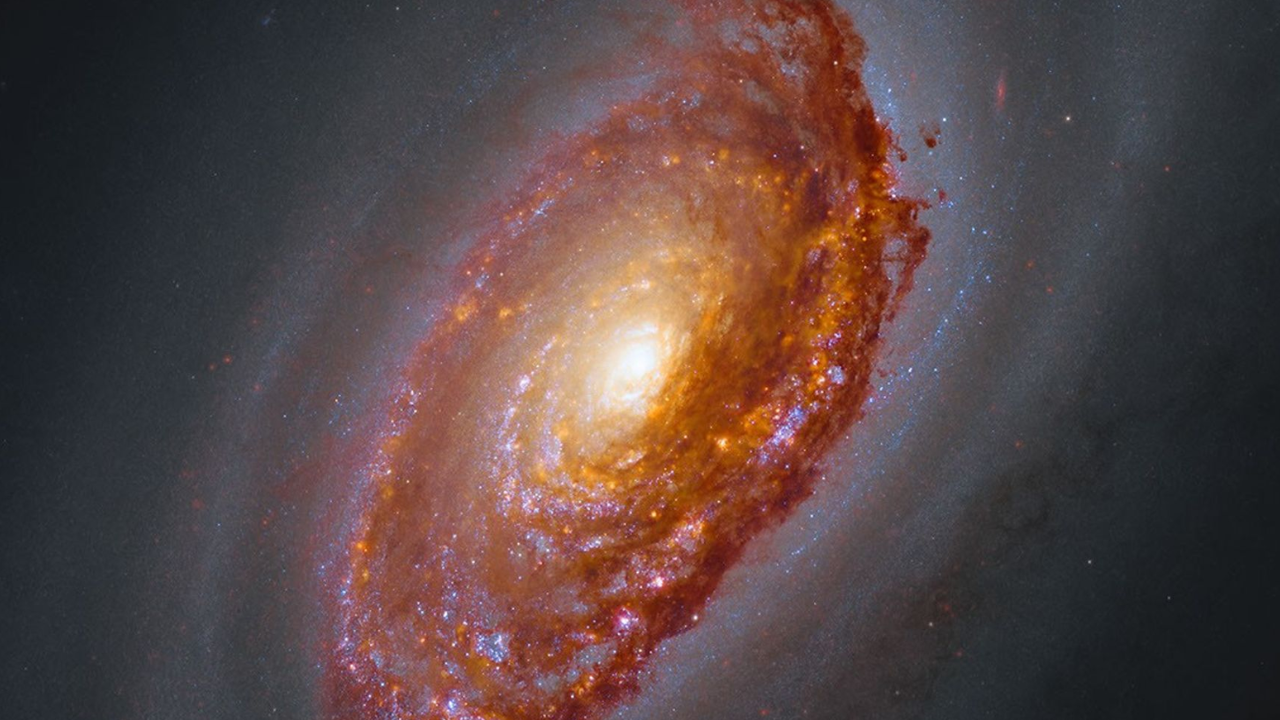
Messier 64 is not behaving the way standard galactic models predict. Located roughly seventeen million light-years away in the constellation Coma Berenices, this spiral system wears a striking, ominous dust band across its bright core, earning it the moniker of the Black Eye Galaxy. Recent observational data synthesized from the Hubble Space Telescope and the James Webb Space Telescope tears past previous assumptions, exposing a violent history of galactic cannibalism that occurred an estimated one billion years ago. Rather than a quiet, orderly island universe, M64 represents a chaotic collision zone where two distinct structures rotate in opposite directions, grinding against each other to fuel relentless stellar birth while quietly erasing the physical evidence of an ancient satellite galaxy.
For decades, astronomers treated spiral galaxies as relatively stable rotating disks governed by straightforward gravitational rules. Stars, gas, and dust circled the galactic center in a uniform direction, maintaining a predictable equilibrium. M64 shattered that tidy textbook picture. Long before space telescopes offered high-resolution imagery, ground-based astronomers noticed that the gas in the inner regions of M64 rotates clockwise, while the gas and stars in the outer envelope rotate counter-clockwise. This counter-rotation is an astronomical anomaly, a smoking gun pointing directly toward a catastrophic past encounter.
The Mechanics of Counter-Rotation
To understand why M64 looks the way it does, one must examine the extreme physics of counter-rotating systems. When two independent galaxies collide and merge, their constituent stars and gas clouds do not simply pass through one another. Gravitational interactions scatter orbits, tear apart spiral arms, and redirect enormous volumes of interstellar material.
In the case of M64, a smaller, gas-rich satellite galaxy drifted too close to a larger host system roughly a billion years ago. The larger galaxy exerted immense tidal forces, stripping the smaller companion of its gas and pulling that material into an orbit opposite to the host's existing rotation. When this foreign gas plunged into the inner regions of the primary galaxy, it established a counter-rotating disk.
Friction in space is not mediated by air resistance, but by gas-cloud collisions and magnetic fields. Where the clockwise inner gas meets the counter-clockwise outer gas, the two flows crash directly into each other. This violent interface creates massive shock waves. Gas is compressed intensely, exceeding the density threshold required for molecular clouds to collapse under their own gravity. The result is a ferocious wave of star formation right along the boundary line.
The newly formed stars are hot, massive, and short-lived. They illuminate the surrounding region with intense ultraviolet radiation, while dense clouds of newly created dust obscure the background starlight. That dark, absorbing lane stretching across the bright nucleus is not a trick of perspective. It is a physical wall of cold dust and gas forged by the friction of a billion-year-old galactic collision.
Piercing the Dust with Infrared Vision
For years, optical telescopes like Hubble could map the silhouette of the dark band with exquisite precision, but they struggled to see what lay hidden beneath the obscuring soot. Optical wavelengths scatter easily off microscopic dust grains. The core of M64 remained partially shrouded behind a veil of carbon-rich particles and silicate dust.
The deployment of the James Webb Space Telescope changed the investigative baseline entirely. Operating primarily in the infrared spectrum, Webb's instruments ignore the scattering effects of dust. Infrared light passes straight through the dense molecular clouds that blind optical mirrors.
When researchers turned Webb toward M64, the veil lifted. The infrared data revealed the distribution of older stellar populations buried deep within the core, tracing how the stellar mass settled after the merger event. It exposed the fine structure of the star-forming clusters nestled inside the dust lane, showing pockets of active stellar nurseries that were previously invisible.
This multi-wavelength approach transformed a pretty picture into a quantitative data set. By combining Hubble's high-resolution optical mapping with Webb's infrared penetration, astrophysicists could measure the exact mass distribution, age gradients, and kinematic properties of the counter-rotating disks. The data confirmed that the merger was not a glancing blow or a minor accretion event. It was a substantial consumption of a companion galaxy, heavy enough to alter the rotational dynamics of an entire stellar system.
The Brutal Reality of Galactic Evolution
The popular imagination often portrays galaxies as majestic, static pinwheels spinning peacefully in the dark. Professional astronomers know better. The universe is a demolition derby of gravitational interactions, and systems like M64 serve as literal autopsy sites for galactic collisions.
Most large spiral galaxies show scars of past mergers if you look closely enough. Stellar streams in the outer halos, warped disks, and anomalous chemical abundances all hint at a history of consuming smaller neighbors. Yet M64 stands out because the merger is still dynamically visible. A billion years is a blink of an eye on cosmic timescales. The system has not had enough time to settle into a single rotational direction. The inner and outer disks are still fighting each other.
This ongoing friction acts as a cosmic brake. Over the next several billion years, the opposing angular momentum will continue to cancel out through turbulent dissipation. The counter-rotating gas will settle into a single unified direction. The sharp, dramatic dust band will disperse as the shock waves subside and the starburst activity exhausts the available gas supply. M64 will eventually look like a normal, unremarkable elliptical or smooth spiral galaxy, erasing the visible record of its violent youth.
Observing M64 right now offers a rare window into a transient evolutionary phase. It demonstrates how galaxies grow not through gentle accretion of diffuse gas, but through violent, disruptive events that reshape their internal architecture.
Unresolved Questions in the Outer Halo
Even with modern space-based observatories, significant gaps remain in our understanding of M64's complete history. While the inner and intermediate zones are well-mapped, the outer stellar halo presents persistent interpretive challenges.
If M64 swallowed a satellite galaxy, models predict that remnants of the victim's stellar population should populate the distant outer halo in asymmetric tidal tails or diffuse shells. Yet finding these faint outer structures requires extreme sensitivity. Scattered starlight from the bright inner disk often washes out the faint signals of ancient debris in ground-based and space-based imaging alike.
Furthermore, the exact mass ratio of the progenitor galaxies remains a subject of active debate among dynamic modelers. Was the victim a dwarf galaxy containing one-tenth the mass of the primary, or was it a more substantial spiral that put up a fierce gravitational fight before succumbing? Running simulations requires precise measurements of velocity dispersions across the entire radial span of the galaxy, figures that push current spectrographic limits.
Researchers are also examining the chemical composition of the stars within the dust band versus those in the surrounding disk. Differences in metallicity elements heavier than hydrogen and helium formed in previous generations of stars provide a chemical fingerprint of the progenitor. If the merged satellite originated from a lower-metallicity environment, its debris should carry a distinct chemical signature. Preliminary findings suggest variations, but definitive confirmation awaits deeper spectroscopic surveys.
The Broader Implications for Cosmology
The lessons learned from the Black Eye Galaxy extend far beyond a single stellar system in Coma Berenices. Standard cosmological models rely on hierarchical clustering, the principle that large structures form through the continuous merger and aggregation of smaller components.
Observing an active, mid-settling merger like M64 validates the mechanical mechanisms driving hierarchical growth. It proves that major kinematic disruptions can occur without completely destroying the host galaxy's disk structure. Many high-redshift galaxies observed in the early universe show disturbed morphologies, thick disks, and complex internal gas motions. M64 acts as a local laboratory, allowing scientists to study processes that were rampant when the universe was young.
By dissecting the interplay between dust absorption, infrared emission, and counter-rotation in M64, astronomers refine the algorithms used to simulate galactic collisions on massive supercomputers. Every discrepancy between the simulation and Webb's observations forces a tighter calibration of how gas behaves under extreme gravitational stress.
The universe does not hand over its secrets easily. Behind the serene beauty of a spiral arm lies a history of gravitational violence, orbital decay, and stellar resurrection. M64 reminds every observer that celestial order is frequently purchased through cosmic chaos.