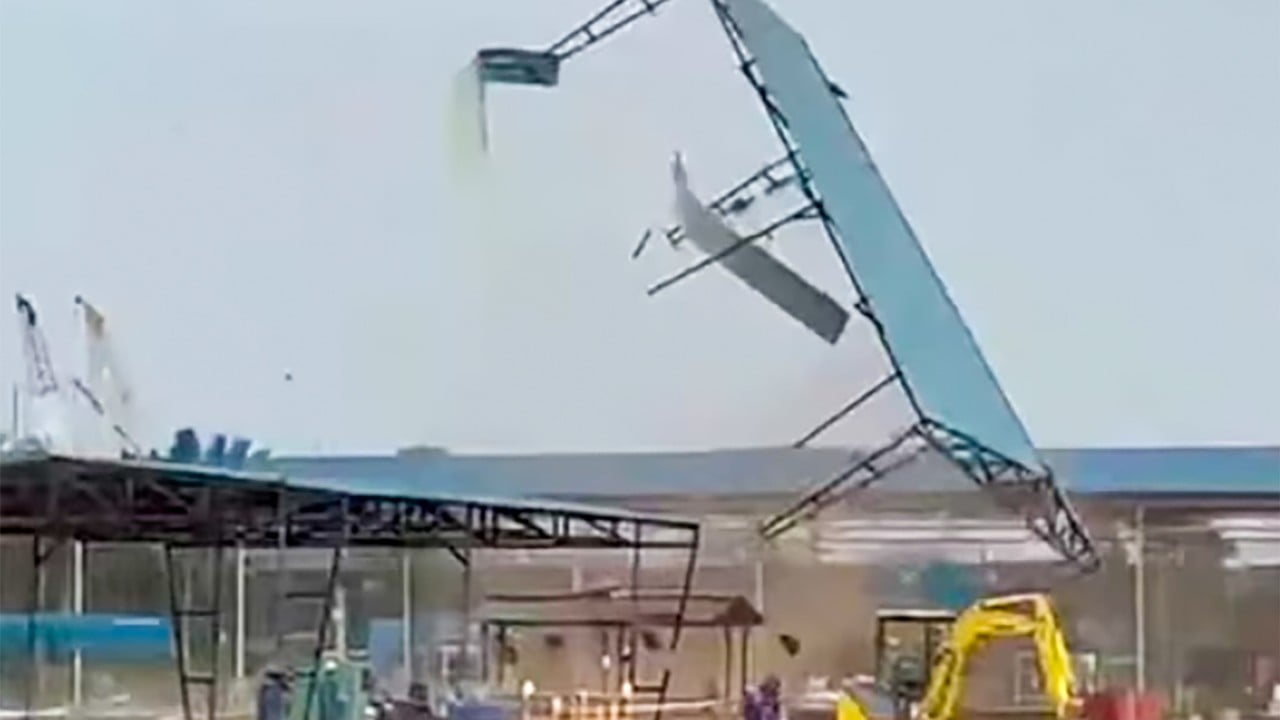
Every time metal cladding peels off a partially built commercial site and goes airborne, the headlines write themselves.
"Freak Tornado Strikes Site." "Workers Flee Extreme Weather." "Unprecedented Twister Causes Devastation."
It is a comfortable narrative. It absolves everyone involved. Site managers get to shrug off millions in damage as an "Act of God." General contractors file insurance claims without changing a single protocol. Regulators nod along because tracking down wind-loading math on temporary structures requires actual work.
I have spent twenty years auditing structural failures across rapidly industrializing job sites. I have walked through destroyed staging areas, sifted through twisted roof trusses, and reviewed site safety logs from Southeast Asia to the American Midwest.
Here is the truth nobody in project management wants to say out loud: these viral videos of flying metal sheets and fleeing crews do not show natural disasters. They show structural negligence disguised as extreme weather.
When corrugated roofing sheets tear off an Indonesian construction site like paper in a breeze, the storm did not beat the design. Bad planning beat elementary physics.
The Aerodynamic Lie Of The Unfinished Shell
Watch any video of a mini-tornado or small vortex ripping through an active build site. The storm itself is rarely a massive F5 monster. In equatorial climates, these localized microbursts and small tornadoes—often called angin putung beliung in Indonesia—frequently pack winds between 40 and 60 miles per hour.
A standard built-to-code roof on a completed structure handles 90 to 110 mph wind loads without blinking.
So why does temporary roofing fail at half that speed?
Because general contractors treat an active construction site like a completed building that just needs a few more screws. They forget Bernoullis principle the second a hard hat goes on.
When wind hits a closed building, it flows around the envelope. When wind hits an open or partially completed building, it drives inside, hits a solid back wall, and creates positive internal pressure pushing upward. At the same time, fast-moving air passing over the open roof creates negative suction pressure above.
This creates a massive pressure differential.
                  FAST-MOVING AIR (LOW PRESSURE ABOVE)
                 -------------------------------------->
                      [ Temporary Roof Panel ]  <-- Sucked Upward
========================================================================
                      ^
                      |   Internal Air Stagnates & Builds Pressure
                      |   (Positive Pressure Push)
                 ======================================
                 [ Unsealed Building Walls / Open Frames ]
When workers lay temporary metal decking or lightweight sheeting without full mechanical anchoring, they are building an airplane wing. They have engineered a structure designed to generate lift.
When a 50 mph gust hits that half-open shell, the suction forces do not just blow the panels sideways. They explode them upward. The failure was baked into the schedule the morning crew laid the sheets without completing the edge-seal tie-downs.
The Spreadsheet Trap
If the math behind wind uplift is taught in every sophomore structural engineering course, why do sites keep blowing apart?
Follow the money.
Construction margins are razor thin. General contractors operate on tight contingency buffers, and site supervisors are penalized heavily for schedule slip.
When a crew receives a shipment of metal roof deck panels or temporary corrugated cladding, they face a choice:
- Lay the panels, run basic tack welds or temporary screws, and move to the next bay to keep pace with the Gantt chart.
- Fully anchor, brace, and seal every individual panel bay at the end of every single shift, regardless of whether the permanent structure behind it is ready.
Option two costs hours of labor and slows down progress. Option one relies on a dangerous roll of the dice: hoping the weather stays calm until the structural frame is completely closed out.
When that gamble fails, managers run straight to local media to talk about "unpredictable climate events."
Imagine a scenario where an airline skipped pre-flight exterior checks because the plane was on a tight schedule, then blamed a sudden crosswind when an unlatched hatch tore loose over the runway. They would be grounded by regulatory bodies before the sun went down.
Yet in construction, leaving thousands of square feet of unsecured metal panels hovering 40 feet in the air above active worker zones is treated as standard practice.
Weather Monitoring On Modern Sites Is Broken
The lazy defense always comes down to timing: "The twister appeared out of nowhere. We had no warning."
That argument belonged in 1985. It has zero validity today.
Most international construction operations rely on regional weather forecasts delivered via standard phone apps or basic morning safety meetings. If the local weather report says "partly cloudy," supervisors assume they have a green light for high-rise steel work and roof decking.
This is a complete failure of risk management. Localized twisters and microbursts do not register on regional forecasts because they operate on hyper-local meso-scale weather patterns.
An active project site covering acres of concrete and steel creates its own microclimate. Thermal updrafts from sun-baked concrete slabs meeting cool coastal or river air routinely generate sudden shear winds.
Instead of deploying basic, low-cost micro-weather stations equipped with real-time pressure transducers and localized Doppler radar integration—systems that cost less than a single day of site crane rental—companies rely on a foreman looking up at the sky.
If your worker safety plan relies on someone spotting a funnel cloud with the naked eye while operating a hoist, you do not have a safety plan. You have a legal liability waitlist.
How To End The Airborne Sheeting Hazard
If the industry actually wants to stop workers from fleeing flying metal debris, it needs to burn the current temporary-works handbook and implement non-negotiable structural rules on active sites.
1. Mechanical Tie-Down Enforcement By Shift End
No panel, sheet, or temporary deck plate is left on a roof grid without terminal anchoring. If the crew stops work for lunch, the open edge is tied down. If the shift ends, the perimeter is locked. "Tack-welded for now" must be classified as a critical safety violation.
2. Mandatory Internal Venting Pathways
When building open-envelope structures, temporary wind-deflection netting and pressure-relief gaps must be engineered into the upper walls. Stop forcing air to accumulate under the roof panels. Give internal positive pressure an engineered escape route.
3. Automatic Work Stoppage Triggers
Install site-level anemometers linked directly to warning sirens. The moment localized gusts cross 25 mph, all elevated panel handling stops immediately, and crews transition to securing existing structures. No waiting for management approval. No checking the radar app. The sensor trips, the site locks down.
Stop Tolerating Predictable Failures
The next time a video clips across your feed showing workers running for their lives as metal roof panels peel off a building frame like dry leaves, do not marvel at the power of nature.
Look closely at the edges of the structure. Look at the missing edge trims, the unanchored purlins, and the open wall cavities that turned a routine weather event into a missile launch pad.
Nature did not break that construction site. Laziness did.
Until the industry starts treating temporary wind loads with the same respect as permanent structural calculations, workers will keep running, roofs will keep flying, and project managers will keep blaming the sky for their own structural shortcuts.