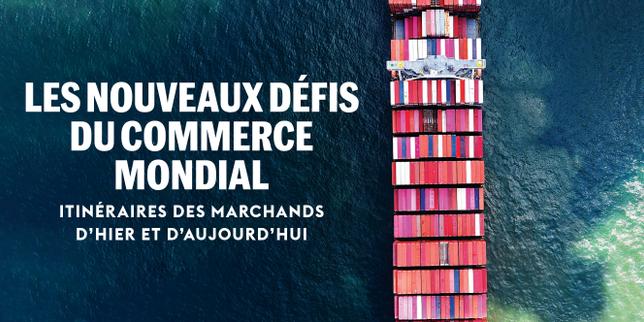
Every October, the intellectual tourism machine decamps to Blois for the Rendez-vous de l’histoire. Academics, curators, and trade historians sit in damp Loire Valley auditoriums, nodding solemnly at panels dedicated to the new planetary geography of commerce. The lazy consensus of these gatherings is as predictable as it is comforting: merchants are back at the center of the global stage, shaping planetary networks, stitching together fragmented worlds through the heroic, cosmopolitan flow of goods.
It is a gorgeous, soothing narrative. It is also completely backwards.
I have spent two decades watching supply chains fracture, boardrooms panic, and geopolitical lines redraw themselves in real-time. I have seen companies blow millions trying to map global trade routes as if we are still living in a Renaissance merchant republic where a clever trader in Blois or Venice dictates the rhythm of the earth.
Here is the inconvenient reality the history festival crowd refuses to face. Modern trade is no longer run by merchants. It is run by bureaucrats, algorithmic risk models, and sovereign choke points. The romantic merchant class celebrated in French cultural seminars is a ghost. Today's commercial actor is less a daring explorer and more a compliance officer with a spreadsheet.
Stop romanticizing the wandering trader. The geography of global commerce is not expanding outward into a harmonious planetary network; it is violently contracting behind walls, sanctions, and state-backed monopolies.
The Myth of the Borderless Bazaar
Let us dismantle the core premise coming out of Blois. The prevailing academic theory insists that merchants are pioneering a fresh planetary geography, bypassing traditional nation-states through decentralized digital networks and agile logistics.
Imagine a scenario where a mid-tier textile merchant in Lyon attempts to reroute a shipment across three continents using decentralized maritime contracts. Within forty-eight hours, customs compliance flags, secondary sanctions on insurance underwriters, currency controls, and algorithmic port congestion will choke that shipment to a standstill.
The planetary marketplace is not a free-flowing river. It is a series of heavily armed tollbooths.
When historians look at the historical merchant, they see autonomy. When I look at modern commerce, I see dependency. The modern supply chain operates under the iron grip of state sovereignty. If you think a merchant dictates terms to a Beijing bureaucrat or a Washington trade representative, you are reading fairy tales. The state writes the rules of engagement; the merchant merely pays for the privilege of running the gauntlet.
Commerce follows power, not the other way around. To pretend that merchants are forging an independent planetary geography is to mistake the shadow on the cave wall for the sun.
What People Get Wrong About Global Supply Lines
People love to ask why modern logistics are so fragile. They point to labor strikes, container shortages, or sudden spikes in consumer demand. They treat these disruptions as anomalies, bugs in an otherwise magnificent global machine.
That premise is fundamentally flawed. These are not bugs. They are features of a system built on extreme, fragile efficiency rather than resilience.
For thirty years, corporate boardrooms worshipped the altar of just-in-time delivery. Consultants preached lean inventories. They told us that holding stock was a sin and that global logistics would always self-correct. I watched executives strip their balance sheets of redundancy to satisfy quarterly earnings calls.
Then reality hit. A single stuck ship in the Suez Canal or a minor regional conflict crippled manufacturing hubs from Stuttgart to Shenzhen. The lesson was brutal: our vaunted global trade geography was a house of cards built on the assumption of permanent geopolitical peace.
Now, the pendulum is swinging violently in the opposite direction. Companies are scrambling for near-shoring and friend-shoring. They are pulling back from the global expanse that the festival-goers in Blois are busy celebrating. The merchants aren't expanding their horizons; they are retreating behind regional moats because the cost of planetary exposure has become catastrophic.
The Downside of the Contrarian Play
I must be entirely candid about the flaw in my own argument. Advocating for hyper-localized, state-controlled, heavily fortified supply chains sounds efficient on paper, but it comes with a crushing price tag.
When you prioritize resilience over open-market efficiency, inflation becomes structural. Goods cost more because redundancy is expensive. The consumer pays for every wall built, every domestic factory subsidized, and every compliance layer added. If we abandon the borderless merchant ideal, we trade cheap consumer abundance for geopolitical security.
That is a trade-off most economists are terrified to admit out loud. They want the frictionless margins of globalized trade combined with the safety of national protectionism. You cannot have both. Every time a nation secures its supply chain, it makes life harder and more expensive for the people living inside it.
How to Navigate the New Commercial Reality
If you are running a business or analyzing market trends today, you need to throw out your old strategy decks. Stop planning for a smooth, expanding planetary map.
First, master regulatory navigation before you master logistics. The most successful commercial players today are not the ones with the fastest ships; they are the ones with the deepest understanding of jurisdictional arbitrage and legal compliance.
Second, treat your supply chain as a defense budget, not a cost center. Build in redundancy, even when it hurts your margins. If your entire business model relies on a peaceful, frictionless global commons, your business model has an expiration date.
The historians in Blois can keep celebrating the romantic march of the global merchant. Enjoy the panel discussions. Savor the vintage wine.
Just don't bet your capital on their map.


