The stench hits you three blocks before you see the color. It is an aggressive, physical entity that creeps down the narrow, sun-bleached stone alleys of the Fez medina, wrapping around your throat and stinging the back of your eyes. It smells of ammonia, decaying flesh, sharp vinegar, and ancient dust. To the uninitiated tourist clinging to a sprig of fresh mint thrust into their hand by a sympathetic guide, it feels like a warning to turn back.
But if you keep walking, following the narrow labyrinth of 12th-century walls, the alley suddenly fractures into an explosion of blinding light and impossible color. Meanwhile, you can explore other stories here: Why Emergency Travel Bans Are Just Bureaucratic Theater That Punishes the Prepared.
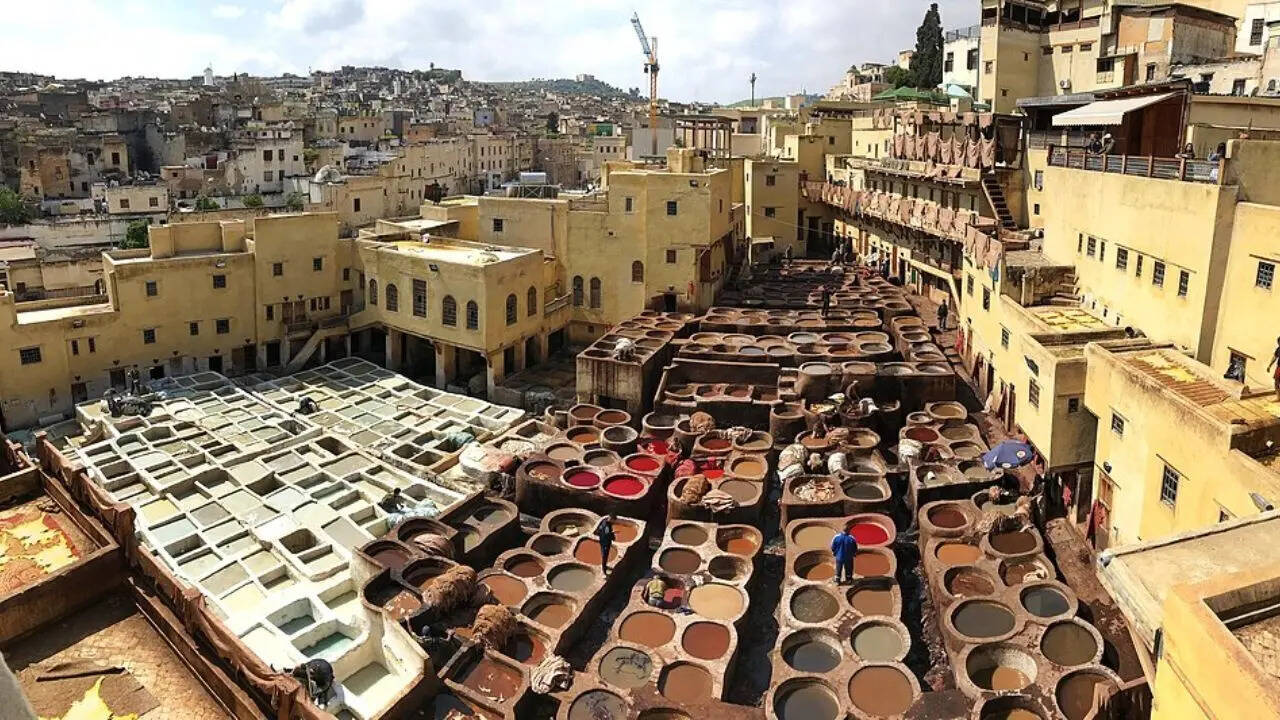
Below you lies the Chouara Tannery.
From a rooftop terrace, the view is hypnotic. Hundreds of massive stone vessels, resembling a giant, subterranean honeycomb, are filled with white, brown, and brilliantly colored liquids. Men stand waist-deep in these vats, glistening with sweat under the Moroccan sun, rising and falling like human pistons. They are treading, pulling, and twisting heavy skins. It is a scene that has remained virtually unchanged since the founding of the city over a thousand years ago. To see the full picture, check out the recent article by Lonely Planet.
Western travel blogs often focus on the spectacle. They call it exotic. They warn you about the smell. They tell you where to buy the best leather jacket at a discount. But they miss the entire point of Chouara. This place is not a living museum kept alive for postcard photography. It is a grueling, beautiful, and brutal battleground where human endurance wrestles raw nature into luxury commerce.
To understand the leather resting on your shoulder or wrapped around your wrist, you have to look past the stone vats and look at the hands of the men inside them.
The White Vats and the Alchemy of Pigeon Droppings
Consider a young man named Youssef. He is a hypothetical composite of the third-generation artisans who inhabit this space, but his daily reality is entirely factual. Youssef begins his workday before the African sun clears the minarets of the old city. His workspace is divided into two distinct zones: the white vats and the colored vats.
The white vats are where the romance of the craft dies and the harsh science begins.
Before a cow, sheep, or goat skin can take on a vibrant red or deep indigo hue, it must be stripped of its past. The raw hides arrive stiff, caked in salt, dirt, and remnants of hair. To soften them, they are submerged in a caustic cocktail of water, limestone, and—most crucially—pigeon droppings.
This is not a primitive placeholder for modern chemicals; it is a deliberate choice of organic chemistry. Pigeon droppings are naturally rich in ammonia. In an era before synthetic laboratories, the artisans of Fez discovered that this specific biological waste possessed the exact enzymatic properties needed to break down the rigid proteins of animal hides. The ammonia relaxes the collagen fibers, transforming a stiff, unyielding skin into something supple, malleable, and ready to absorb pigment.
For hours, Youssef stands inside these white vats. His bare legs are immersed in the milky, alkaline fluid. There are no rubber boots here; the men claim that boots cause them to slip on the smooth, submerged stone surfaces, risking catastrophic falls. Instead, their skin absorbs the mixture. Over years of labor, the ammonia and lime callouse the legs, bleaching the skin and eating away at the fingernails.
The work is a rhythmic, exhausting dance. The tanners use their weight to stomp the hides, forcing the lime and pigeon enzymes deep into the pores of the leather. The physical toll is immense. The hide of a single cow, saturated with water, can weigh upwards of fifty pounds. Imagine lifting, twisting, and stomping dozens of these every single day in waist-high fluid that smells of concentrated waste.
But without this grueling initiation, the leather would remain uselessly rigid. The luxury we consume in the West is built entirely on this foundational discomfort.
A Palette Bored from the Earth
Once the hides are softened, they are transferred to the clean water channels of the Oued Fès to wash away the lime and debris. Only then are they ready for the transformation that draws travelers from across the globe: the dyeing vats.
Walking among the colored vats is like walking through an artist’s watercolor palette, scaled up to industrial proportions. But there are no synthetic dyes here. Chouara prides itself on a strict adherence to natural pigments derived directly from the earth and the surrounding Moroccan landscape.
The brilliant saffron yellows are derived from pomegranate skins and expensive crocus stamens. The deep, rich browns come from crushed walnut shells. Indigo plants provide the blues, while poppy flowers and cedar wood yield the iconic Moroccan reds.
To lock these natural colors into the leather, the artisans use another ancient fixer: olive oil. The oil gives the dyed skins that distinctive, subtle sheen and ensures that the color penetrates deep into the grain rather than just sitting on the surface.
This is where the true expertise of the master tanner shines. There are no digital thermometers, no chemical test strips, and no automated timers. The master tanner judges the readiness of a batch by the precise shade of the liquid, the texture of the hide between his thumb and forefinger, and the ambient temperature of the morning air. It is an intuitive, sensory science passed down through a lineage of whispers and shared labor.
But the process is incredibly slow. Hides must soak in these natural dyes for weeks, constantly turned and massaged to ensure an even coat. If a worker gets careless, a batch of twenty hides can be ruined by a single streak of uneven saturation, representing weeks of lost wages and wasted materials.
The Invisible Stakes of a Dying Trade
It is easy to romanticize this dedication to antiquity, but the reality of Chouara is balanced on a knife-edge. The tanners are caught between two opposing forces: the relentless march of modern industrial efficiency and the desperate need to preserve cultural heritage.
A modern chemical tannery in Europe or Asia can process thousands of hides in a fraction of the time using chromium salts and automated drums. They can produce perfectly uniform leather at a fraction of the cost. Chouara cannot compete on speed, volume, or price.
But modern industrial leather comes with a massive environmental deficit, poisoning local waterways with heavy metals. Chouara, despite its sensory assault, relies on biodegradable, organic components that have cycled through the local ecosystem for a millennium.
The real danger to Chouara is human.
The younger generation of Fez is looking out at a globalized world. They see comfortable office jobs, tourism management degrees, and tech careers. Standing waist-deep in pigeon droppings and animal fat for modest daily wages is becoming a harder sell. The lineage is fraying. Many of the older tanners fear that when their knees finally give out, there will be no one left to step into the stone honeycombs.
When you purchase a piece of leather from the souks surrounding Chouara, you are not buying a consumer good. You are paying for the preservation of an endangered human art form. You are paying for Youssef's aching back, his bleached skin, and the generational knowledge locked inside his hands.
The Unbroken Thread
The sun begins its descent over the medina, casting long, dramatic shadows across the terraces of Chouara. The intense heat of the day breaks, replaced by a cool evening breeze that carries the scent of mint and roasting lamb from the nearby food stalls, briefly overriding the pungent aroma of the vats.
Up on the terraces, workers are beginning the final stage of the daily cycle. They haul the freshly dyed, heavy hides up steep wooden ladders to the flat roofs of the surrounding buildings. They spread them out under the open sky, pinning them down with heavy stones to dry in the Mediterranean breeze. From above, the rooftops look like a sprawling patchwork quilt of crimson, ochre, and chocolate brown.
Tomorrow, these dried skins will be scraped, softened one final time with oil, and handed over to the cobblers, tailors, and artisans who will fashion them into bags, poufs, and slippers.
Visitors often leave Chouara quickly, eager to wash the smell from their clothes and retreat to the air-conditioned sanctuary of their hotels. They remember the tannery as a bizarre, sensory curiosity—a relic of a harsher past.
But if you linger just a moment longer as the call to prayer echoes across the valley, you realize something profound. In a world increasingly dominated by synthetic uniformity, automated manufacturing, and disposable fast fashion, Chouara remains stubbornly, beautifully real. It is a place where human hands, working with nothing but earth, water, and time, still hold the power to create something that lasts forever.

/i.s3.glbimg.com/v1/AUTH_51f0194726ca4cae994c33379977582d/internal_photos/bs/2025/i/r/awbO2yQqaKlcaE88EbfQ/saveinsta.to-487450509-18505253173001043-4348954377809315877-n.jpg)