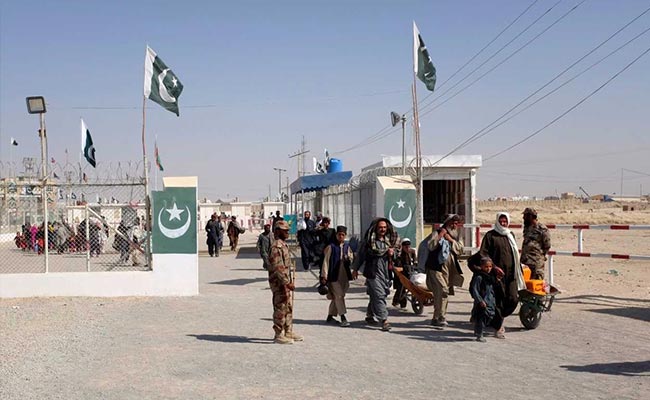
The smell of burning plastic and dust stays in your throat for days. It is the signature scent of Torkham, the border crossing where Pakistan meets Afghanistan, a place where geopolitical posturing dissolves into the brutal reality of the gravel beneath your feet.
On a Tuesday afternoon, the line of trucks stretches back into the horizon like a rusted iron spine. Under the unrelenting sun, a family sits on a single turned-over wooden crate. The father, a man whose hands are calloused from thirty years of brick-making in Islamabad, stares at his boots. His children do not cry. They are too tired for tears. They have spent their entire lives in Pakistan, speaking Urdu, rooting for the Pakistani cricket team, and paying rent to Pakistani landlords. Today, they are being told they belong somewhere else. You might also find this similar story interesting: The Architecture of Electoral Friction: Structural Redistribution and Auditing the American Electorate.
This is the quiet tragedy of the mass deportations. It is a story of a sudden, sharp betrayal wrapped in the language of national security.
For decades, Pakistan positioned itself as the ultimate sanctuary. When Soviet tanks rolled into Kabul in 1979, Islamabad opened its arms. Millions of Afghans crossed the Hindu Kush, fleeing a scorched-earth war. Pakistani leaders took to international podiums, proudly declaring that their nation was hosting the largest refugee population on earth. They spoke of Ansar—the Islamic concept of the citizens of Medina who welcomed the Prophet and his companions with open hearts and shared wealth. It was a narrative of grand, unbreakable brotherhood. As highlighted in detailed reports by The Washington Post, the implications are significant.
But brotherhood, it turns out, has an expiration date.
The Midnight Knock
To understand how a grand narrative crumbles, look at a hypothetical composite of the thousands of families caught in this dragnet. Let us call him Gul Khan. He is forty-two. He has never seen Kabul. His business is a modest vegetable stall in Rawalpindi, built rupee by rupee over two decades. He has a valid Afghan Citizen Card, a document issued by the Pakistani government itself to regularize the status of millions who fled later waves of violence.
Then came October 2023.
The caretaker government in Islamabad issued a sudden, sweeping ultimatum: all undocumented foreigners must leave the country within thirty days, or face arrest and forced deportation. On paper, it sounded like a bureaucratic housekeeping measure. On the streets, it felt like an earthquake.
The policy did not just target those who sneaked across the border yesterday. It swept up people like Gul. The nuance of documentation got lost in the panic. Landlords, terrified of heavy fines from local police, gave Afghan tenants hours to pack. Schools turned away children mid-semester. The police began conducting night raids in neighborhoods like Afghan Basti.
Imagine waking up at 3:00 AM to the sound of heavy boots on your porch. You are told you have until dawn to pack forty years of life into three nylon bags. If you own a house, you cannot sell it in three hours. If you have savings in a local bank, you cannot withdraw them after hours. You leave with what you can carry. Everything else—your life’s work, your savings, your dignity—stays behind, absorbed into the local economy by predatory buyers who know you have no leverage.
The Math of Scapegoating
Why now? Why would a country that wore its generosity like a badge of honor suddenly reverse course with such ferocity?
The answers given by officials are neat, polished, and statistical. They point to a terrifying spike in domestic terrorism. They note that the Pakistani Taliban (TTP) has found safe haven across the border since the Taliban regained power in Kabul in 2021. They cite dozens of suicide bombings, claiming a significant number involved Afghan nationals.
National security is a legitimate concern. No country can be asked to tolerate terror on its soil. But look closer at the execution, and the logic fractures.
Terrorism is carried out by highly organized, armed networks, not by the elderly women selling embroidered shawls in Peshawar, or the five-year-olds born in the refugee camps of Balochistan. By expelling hundreds of thousands of impoverished laborers, the state did not dismantle the TTP. It simply found an easy target to signal toughness to an increasingly frustrated domestic public.
Pakistan's economy is in agony. Inflation has broken the backs of the middle class, electricity bills have sparked nationwide protests, and the country has been surviving on a financial drip-feed from the International Monetary Fund. When a state cannot provide electricity, jobs, or basic safety to its people, it needs a distraction. It needs a visible, powerless entity to blame for the crumbling infrastructure and rising crime rates.
The Afghans became that entity. They were blamed for smuggling dollars, for driving up real estate prices, for taking jobs from locals. It is a textbook maneuver seen globally, from parts of Europe to North America, but executed here with a unique sting of hypocrisy given the decades of "brotherhood" rhetoric.
The Cold Equation of Return
Crossing the border at Chaman or Torkham is not just a change of geography; it is a step backward in time.
The country these families are being pushed into is experiencing one of the worst humanitarian crises on earth. The Taliban government has systematically erased women from public life, banning girls from schools past the sixth grade and barring women from most employment. The economy there is shattered, heavily sanctioned, and heavily reliant on dwindling international aid.
Consider what happens next for a family that has only known Pakistan. A teenage girl who was studying to be a nurse in Peshawar is suddenly dropped into a village in Nangarhar where she cannot leave the house without a male guardian and a full face covering. Her education is over. Her aspirations are contraband.
The human cost is not tracked in the official government press releases, which prefer to list the number of trucks crossed and the "voluntary" nature of the returns. There is nothing voluntary about a departure when the alternative is a squalid detention cell in a high-security prison.
Human rights organizations have documented instances of bribery, harassment, and physical abuse at temporary holding centers. Families have been stripped of their livestock and cash by corrupt border officials before being pushed across the line into the dust.
The Damage to the Soul of a Nation
The tragedy is twofold. It destroys the lives of the expelled, but it also erodes something vital within Pakistan itself.
Generations of Pakistanis grew up alongside Afghans. They shared meals, intermarried, built businesses together, and created a vibrant, blended cultural landscape in cities like Quetta and Karachi. The current policy forces ordinary citizens to look at their neighbors through the cold lens of state suspicion. It rewards suspicion and penalizes empathy.
It also leaves a legacy of deep, generational resentment across the border. The children currently sitting in makeshift tents in the freezing winters of Kabul or Kandahar will remember who cast them out. They will remember that when the political winds shifted, the decades of shared faith and culture meant nothing next to a bureaucratic directive.
The trucks keep rolling. The dust keeps rising. On the Pakistani side of the gate, an official sign still proclaims the historical ties between the two nations. Beneath it, a line of soldiers ushers another group of crying children toward the no-man's-land. The grand experiment in regional solidarity did not end because it failed; it ended because it was no longer politically useful.