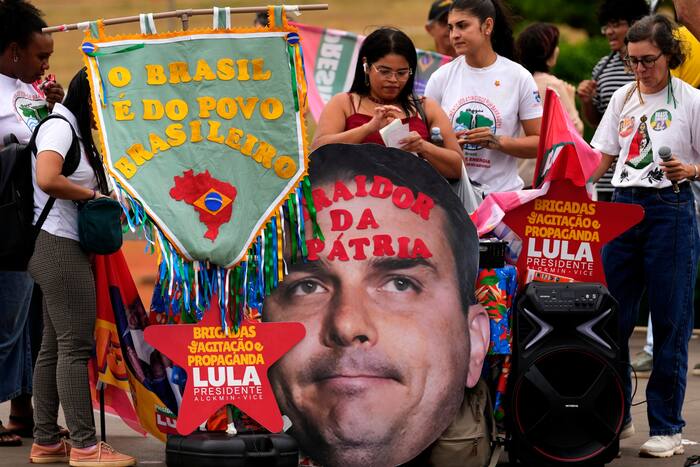
The lazy media consensus on Brazil is that the nation is locked in an eternal, flat-footed tug-of-war between two immutable political tribes. Turn on any international broadcast, and you will hear the same tired script about Luiz Inácio Lula da Silva and the Bolsonaro machine fighting over a deeply fractured soul. It is clean, it is dramatic, and it is entirely wrong.
Treating Brazilian politics as a simple clash of personalities misses the structural machinery running underneath. I have watched analysts misread Latin American fiscal and institutional data for decades, projecting Western European frameworks onto an economy that operates by an entirely different set of rules. The real story of Brazil is not about left versus right. It is about a system choking on its own math while the political class performs theater for the masses.
The Myth of the Unmovable Electorate
Conventional commentary loves to frame Brazilian voters as entrenched zealots who never change their minds. The data tells a sharper story. Look at how the numbers actually shifted between rounds. Millions of citizens do not bounce back and forth because they are ideologically fluid; they move because of basic economic survival and baseline revulsion toward institutional overreach.
When political scientists point to high polarization, they often confuse noisy social media echo chambers with actual structural rigidity. In reality, voter mobilization in Brazil functions more like a high-stakes emergency response. People show up to block an outcome they fear more than they evaluate the technocratic competence of the candidate on the ballot.
Consider the mechanics of the recent runoff. The narrative claimed a massive ideological swing, but the ground-level reality was a desperate scramble for turnout among disillusioned abstainers. The winner did not capture hearts and minds through inspiring policy papers; they mobilized an anti-coalition by default.
The Fiscal Reality Nobody Wants to Print
While pundits fixate on rally sizes and congressional posturing, Brazil faces a concrete mathematical wall that no amount of political charisma can talk away. Public debt sits above 80 percent of gross domestic product, and fiscal deficits continue to drain market confidence.
Here is what the mainstream coverage leaves out: the government's budget is effectively locked down before the fiscal year even begins. Mandatory expenditures consume the vast majority of public funds, leaving virtually zero room for discretionary investment or genuine social expansion.
Imagine a household where eighty cents of every earned dollar goes strictly toward servicing past credit card debt and mandatory utility bills. Now imagine the homeowner promising to renovate the kitchen, buy a new car, and hand out cash to the neighbors. That is the exact fiscal trap of Brasília.
Politicians on all sides promise increased spending to secure their base, while technocrats quietly panic over inflation and interest rates. The real battle in Brazil is not between left-wing social policy and right-wing market conservatism. It is a desperate race against insolvency, fought by leaders who pretend the budget constraint does not exist until the bond markets remind them.
The Congressional Maze
Another lazy trope is that a stronger right-wing presence in Congress spells total gridlock or an impending constitutional crisis. This misunderstands how Brazilian legislative trading actually functions.
Brazil's Congress is famously fragmented, split across dozens of parties driven less by party platforms and more by regional pragmatism and budgetary allocations. When outsiders look at the National Congress, they see an ideological war zone. Insiders see a marketplace.
Bills pass and coalitions form not through grand philosophical alignment, but through the hard currency of amendments, ministerial appointments, and targeted local funding. A president with a hostile legislature does not necessarily face paralysis; they face a higher cost of doing business. The institutional system is designed to absorb extremism and dilute it into transactional negotiations.
The Unspoken Danger Ahead
The most dangerous delusion in modern Brazilian political analysis is the belief that stability is restored simply because an election has concluded and a victor has taken the oath.
Electoral victories do not fix structurally low productivity, nor do they solve systemic corruption or shield the currency from external shocks. When the applause fades, the debt metrics remain. The true vulnerability of the nation lies in the exhaustion of its institutional patience.
Stop treating Brazilian politics like a soap opera and start looking at the balance sheets. Until someone addresses the structural deficit at the heart of the state, every election is just rearranging deck chairs on a heavily leveraged ship.
The numbers do not care who is standing at the podium.