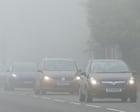
Silence.
That is the first thing you notice when the atmosphere decides to erase the world outside your bedroom window, a heavy, cotton-wool stillness that swallows the distant hum of the motorway and turns a familiar street into an uncharted coastline. Most of us treat a Met Office yellow weather warning for fog as an administrative footnote, a polite nudge to grab an extra jacket or leave five minutes early for the school run. We glance at the map, see the sprawling amber polygons stretching across England and Wales, and go back to buttering our toast.
We are wrong to be so casual.
To understand why a seemingly passive weather event can paralyze a modern nation, consider a hypothetical commuter named Arthur. Let us place Arthur on the M4 corridor at 5:30 AM on a Tuesday morning, driving a sensible hatchback toward an airport terminal where his daughter is waiting to fly home for the holidays. Yesterday, the afternoon was crisp, bright, and deceivingly pleasant, the kind of high-pressure autumn clarity that makes you grateful to live on an island. Arthur checked the forecast before bed, saw no gales, no torrential rain, and no black ice, and assumed his morning drive would be effortless.
He did not account for the invisible architecture of the night sky.
The Physics of a Disappearing World
When the Met Office warns of a "perfect recipe" for fog, meteorologists are describing a quiet, relentless thermodynamic trap. During the day, the British soil absorbs what little warmth the low sun can offer, while high atmospheric pressure acts like a heavy lid over the country, suppressing the winds that normally scrub the air clean. Then the sun sets, and without a blanket of clouds to trap that heat, the ground radiates its warmth straight back into space at an alarming rate.
Think of the atmosphere right above a cold field as a sponge being slowly squeezed by an unseen hand. Warm air can hold a surprising amount of invisible water vapor, much like a dry, expanded sponge holds water without dripping. As the ground cools rapidly through the night, it chills the layer of air resting directly on top of it, shrinking that atmospheric sponge until it reaches its saturation point—the dew point. Once the temperature drops to that threshold, the air can no longer hold its moisture as an invisible gas, forcing trillions of microscopic water droplets to condense around tiny specks of dust, pollen, and exhaust soot suspended near the earth.
That is radiation fog, and it does not roll in like a theatrical pirate ship; it simply materializes out of nothingness right where you are standing.
I still remember my own baptism into this phenomenon on a rural stretch of the A303 in Wiltshire several years ago, a night that stripped away any romantic notions I held about misty British mornings. One second, the red taillights of the lorry ahead of me were crisp beacons cutting through the dark, and the next, it felt as though someone had thrown a wet grey sheet directly over my windscreen. My high beams, which I instinctively flicked on in a moment of panic, did not pierce the gloom; instead, they bounced off millions of suspended water droplets and threw a blinding wall of white glare straight back into my eyes. My heart hammered against my ribs while my hands locked onto the steering wheel at ten and two, suddenly realizing that at sixty miles per hour, I was driving completely blind into a space I could not even see three car lengths ahead.
Why Our Senses Betray Us in the Grey
Back on our hypothetical M4 journey, Arthur is experiencing that exact sensory deprivation, though his brain is actively working against him to downplay the danger. Human vision evolved to judge speed and distance by tracking stationary reference points—trees, hedges, road signs, the texture of the asphalt flashing past our peripheral vision. When dense fog drops visibility below one hundred meters, the official threshold where the Met Office issues severe warnings, those peripheral cues vanish entirely.
Psychologists who study driving behavior have long documented a terrifying illusion known as "speed adaptation" in low-visibility conditions. Without visual markers rushing past the side windows, your brain loses its speedometer, tricking you into believing you are crawling along at a safe pace when you are actually hurtling forward at motorway speeds. You stare intently at the faint glow of the car in front of you, subconsciously tethering your survival to a stranger's brake lights, unaware that the driver ahead is just as lost and anxious as you are.
The numbers behind this illusion are sobering. According to road safety statistics compiled across the UK, crashes that occur in fog are significantly more likely to involve multiple vehicles and result in serious injuries than accidents in clear weather, precisely because drivers fail to adjust their following distances until it is too late. When visibility shrinks to fifty meters, a car traveling at seventy miles per hour covers that entire visible distance in roughly one and a half seconds—barely enough time for your foot to move from the accelerator to the brake pedal, let alone bring two tons of metal to a halt on damp tarmac.
Yet the disruption ripples far beyond the white lines of the motorway network.
At Heathrow, Gatwick, and Manchester, air traffic controllers must immediately enforce "low visibility procedures" the moment the cloud base drops or horizontal visibility shrinks along the runways. Even though modern commercial airliners possess sophisticated Instrument Landing Systems capable of guiding a jet onto the tarmac in near-zero visibility, the ground operations cannot move at normal speed. Controllers must double or triple the spacing between landing aircraft to ensure that a plane rolling down the runway does not interfere with the delicate radio beams guiding the next jet in line, a bottleneck that cascades across departure boards from London to New York within hours.
The Architecture of a Fog-Bound Morning
How do you prepare for an adversary that makes no sound and leaves no footprint until it swallows your driveway? You have to respect the conditions before you turn the ignition key, treating dense fog with the same defensive seriousness you would reserve for a blizzard or a gale.
Consider what happens when you shift your mindset from rushing through the weather to navigating inside it:
- Trust the dipped beam, never the full glare: High-beam headlights act like a flashlight shone into a bathroom mirror, scattering light back into your cabin and destroying whatever night vision you have left. Keep your headlights on dipped beam so the light angles downward toward the road surface, where it can actually illuminate the painted markings.
- Remember the switch you rarely touch: Rear fog lights are brilliantly bright red beacons designed to punch through thick grey air, yet thousands of drivers either forget to turn them on in dense mist or leave them blazing days later under clear skies, dazzling everyone behind them. Use them when visibility drops below one hundred meters, and make a conscious habit of switching them off the moment the air clears.
- Listen as hard as you look: In thick fog, your ears become secondary sensors. Crack your window open an inch or two at junctions and roundabouts, turn down the radio, and listen for the low rumble of approaching engines or the hiss of wet tires long before headlights appear out of the gloom.
- Abandon the herd mentality: Following the taillights ahead feels comforting, like holding someone's hand in a dark hallway, yet it is the primary cause of motorway pile-ups. Drop back until you can count at least four full seconds between the vehicle ahead passing a fixed marker and your own bumper reaching that same spot.
Living Inside the Pause
There is a strange, reluctant grace to a country forced to slow down by its own atmosphere. By mid-morning, as the sun climbs higher and begins to warm the top of the fog bank, the grey veil does not lift all at once; it shreds into ribbons that cling stubbornly to river valleys, canal towpaths, and low-lying pastures while the hilltops bask in pale gold sunlight.
For Arthur, waiting out the worst of the delay at a service station with a lukewarm cup of tea while his daughter's flight circles patiently above the clouds, the frustration eventually gives way to a quiet acceptance. Weather warnings are often framed as battles against the elements, yet fog asks for nothing more heroic than patience, humility, and the willingness to admit that we cannot always see what lies around the next bend.
Step outside onto a quiet lane just before the mist burns away, when the damp air tastes faintly of woodsmoke and wet earth, and watch how the world returns to you one tree, one fence post, and one breath at a time.


