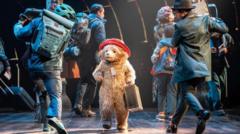
The theater industry is chasing a ghost.
The recent announcement that a musical adaptation of Paddington is marching toward Broadway has the usual suspects in theatrical producing clapping like trained seals. They see a beloved global brand. They see multi-generational appeal. They see the next Matilda or The Lion King. Recently making news lately: Why Honoring Queer Icons Like Barbara Hammer With Safe Biographies Betrays Their Work.
They are completely blind to the economic and artistic reality of modern commercial theater.
In the rush to intellectual property (IP) syndication, producers are fundamentally misdiagnosing why certain stories succeed on stage while others collapse under the weight of their own expectations. Paddington Bear is a masterpiece of quiet, localized, miniature stakes. Broadway is an engine powered by high-octane spectacle, escalating tension, and soaring, belt-heavy vocal scores. Additional information regarding the matter are detailed by The Hollywood Reporter.
Forcing London's favorite bear into the brutal machinery of a $20 million Midtown musical is not a guaranteed license to print money. It is a textbook example of brand mismatch that ignores the harsh math of 45th Street.
The IP Trap: Why Familiarity Breeds Financial Failure
Theater executives have developed a dangerous addiction to pre-existing brands. The logic seems foolproof on paper: if audiences already love the character, you do not have to spend millions educating them on who the character is.
I have watched production companies blow eight figures on this exact assumption. They treat a famous title like a shield against financial risk. The data tells a wildly different story. For every Wicked or The Lion King, the Broadway graveyard is filled with the expensive corpses of King Kong, Amélie, Big, Tarzan, and Charlie and the Chocolate Factory.
Brand recognition creates an immediate, highly rigid set of expectations.
When an audience buys a ticket to a brand they know, they are not buying a ticket to a creative reinterpretation. They are buying a ticket to a specific feeling they experienced in childhood or in a movie theater. If the stage version deviates by even five degrees from that nostalgic memory, the word of mouth turns toxic instantly.
Paddington relies on an intimate, gentle charm. The stakes of a classic Paddington story involve a ruined cake, a ruined brougham, or a misunderstanding with a neighborhood bureaucrat.
Now look at the economics of a modern Broadway musical. To recoup a $15 million to $20 million capitalization in a theater with an average of 1,300 seats, a show needs to command a premium ticket price. To justify a $170 ticket to a tourist family from Ohio, a show must deliver scale. It needs the kinetic energy of Newsies, the visual wizardry of Harry Potter and the Cursed Child, or the emotional devastation of Les Misérables.
How do you scale up a bear whose entire appeal is that he is small, polite, and likes marmalade?
You can't. Not without breaking the character.
To make Paddington fill a Broadway house, you have to inflate the conflict. You have to give him an eleven o'clock number where he belts to the rafters. You have to surround him with high-kicking ensemble dancers. The moment you do that, you kill the very essence of why people love the character in the first place. You are left with a mutant product: too loud for the purists, too boring for the spectacle-hunters.
The Puppet Problem and the Illusion of Intimacy
The creative team faces an immediate, binary choice that has tanked dozens of shows before them: how do you put the bear on stage?
There are only two viable paths, and both are creative landmines.
Path A: The Person in a Suit
This approach reduces a high-end Broadway production to the level of a theme park character meet-and-greet. It instantly kills any hope of genuine emotional nuance. If the actor's face is hidden behind a fiberglass mask or a plush head, the audience cannot connect with the character's internal life. The performance becomes purely pantomime, which wears thin after exactly twelve minutes.
Path B: The Handspring/Puppetry Route
This is the War Horse or The Lion King approach, where visible puppeteers manipulate a beautifully crafted object. While artistically superior, it introduces an entirely new set of problems. Michael Morpurgo’s War Horse worked because the horse was an animal, a symbol of silent suffering in wartime. Avenue Q worked because the puppets were subverting the form.
Paddington is different. He speaks perfect English. He interacts with humans on an equal social footing. Watching a human actor on stage pretend to be shocked by a talking bear, while we can clearly see three puppeteers in gray spandex operating his limbs, creates a cognitive dissonance that shatters the fragile, cozy realism required for this specific story.
The theatrical medium demands heightened stakes. Film can rely on the extreme close-up to show the quiver of a wet nose or the tilt of a hat. On stage, if you are sitting in Row M of the balcony, that nuance is completely invisible. The scale of Broadway explicitly wars against the scale of Paddington.
Dismantling the Myth of the "Unfailing" Family Market
If you ask a Broadway producer why this show is a safe bet, they will point to the family demographic. They will tell you that parents are desperate for clean, wholesome entertainment to take their kids to during school holidays.
This is a lazy consensus based on an outdated view of the market.
The family market on Broadway is highly consolidated and notoriously unforgiving. Disney Theatrical Productions owns a massive market share because they have spent three decades perfecting a very specific formula of hyper-polished, cinematic stagecraft. They can sustain a show through lean months because they have a global corporate apparatus keeping the brand alive.
An independent production trying to compete in that same sandbox is bringing a knife to a rocket launcher fight.
Let's look at the actual numbers. The average Broadway ticket buyer is a 40-something woman with an income well into the six figures. Tourists make up roughly 65% of the total audience. When a family from outside New York plans their one Broadway outing for the year, they do not take risks. They choose the definitive, bulletproof options: The Lion King, Aladdin, or Wicked.
A new family musical without the Disney engine behind it faces a brutal uphill battle. It cannot rely on the school-trip market that sustains straight plays, and it cannot attract the late-night, adult-drink-buying crowd that keeps shows like Chicago or Book of Mormon profitable for decades. It is stuck in a demographic dead zone: too childish for teenagers, too expensive for parents with toddlers who might have a meltdown in Act I.
The Creative Friction: Can You Sing a Hard Stare?
The fundamental question of any musical adaptation must be: Why do these characters need to sing?
In great musicals, characters sing when their emotions become too intense for spoken words. When words fail, music takes over.
- In Gypsy, Mama Rose sings because her monstrous ambition can no longer be contained by normal conversation.
- In Hamilton, Aaron Burr sings because his jealousy and calculation require a complex, rhythmic internal monologue.
When does Paddington Bear experience that level of operatic, boundary-breaking emotion? He doesn't. His entire brand is emotional restraint. He is the embodiment of British politeness, quiet resilience, and the "hard stare."
[Traditional Musical Character] ---> Explosive Emotion ---> Soaring Song
[Paddington Bear]                ---> Minor Inconvenience ---> Polite Apology
Injecting a musical score into this world forces an unnatural emotional vocabulary onto the characters. Imagine the Browns singing a three-part contrapuntal harmony about their household budget, or Mr. Curry delivering a villain song about a borrowed lawnmower. It borders on the absurd, but not in a way that serves the material.
To fix this, the composers will inevitably be forced to inject synthetic drama into the book. They will invent a tragic backstory, raise the threat level of the antagonist, or introduce a ticking-clock mechanism that doesn't belong. The moment you introduce synthetic high stakes to a low-stakes world, the charm evaporates.
The Alternative Blueprint for Literary IP
Am I saying that classic children's literature should never be adapted for the stage? Absolutely not. But the current Broadway model is the worst possible vehicle for it.
Look at how the Royal Shakespeare Company handled Matilda. They did not hire a pop songwriter to write generic, feel-good anthems. They hired Tim Minchin, a brilliant, cynical satirist, who leaned heavily into the dark, grotesque, and uncomfortable elements of Roald Dahl's universe. They embraced the cruelty of Miss Trunchbull and the genuine neglect of the Wormwoods. They created a show that felt sharp, dangerous, and visually inventive.
Look at Peter Pinkerton or the various off-Broadway adaptations of The Lightning Thief before it was bloated into a Broadway run. They succeeded because their production values matched their artistic scale.
If you want to adapt Paddington successfully, you do not put it in a 1,500-seat house with a premium ticket price and a 14-piece orchestra. You create an intimate, highly imaginative piece of environmental theater. You put it in a 400-seat house where the audience is close enough to see the texture of the coat. You use acoustic instruments, folk-infused storytelling, and you don't try to compete with the spectacle of a Disney theme park.
But that is not what is happening here. The announcements are clear: this is aimed squarely at the big leagues. It is designed to be a massive commercial property exported to replica productions across the globe.
Stop Asking if People Love the Brand
The industry needs to stop asking, "Is this brand popular?" and start asking, "Does this brand possess the inherent theatrical architecture to survive on Broadway?"
Paddington Bear is a magnificent piece of literature and a triumph of modern cinema. The films succeeded because the medium of film allows for hyper-realistic CGI integration against a real-world London backdrop, creating a beautiful contrast between the extraordinary and the ordinary.
The stage possesses none of those structural advantages. On stage, everything is a metaphor. Everything is heightened. Everything is loud.
By bringing Paddington to Broadway, the producers are betting that the sheer momentum of a multi-million-dollar brand can overcome the fundamental laws of theatrical physics. It won't. The history of commercial theater is a long, bloody ledger of massive IPs that thought they were too big to fail, only to find out that Broadway audiences can smell a cynical corporate cash-in from a mile away.
The smart money isn't betting on the bear. It's betting on the meat grinder that waits for him in New York.