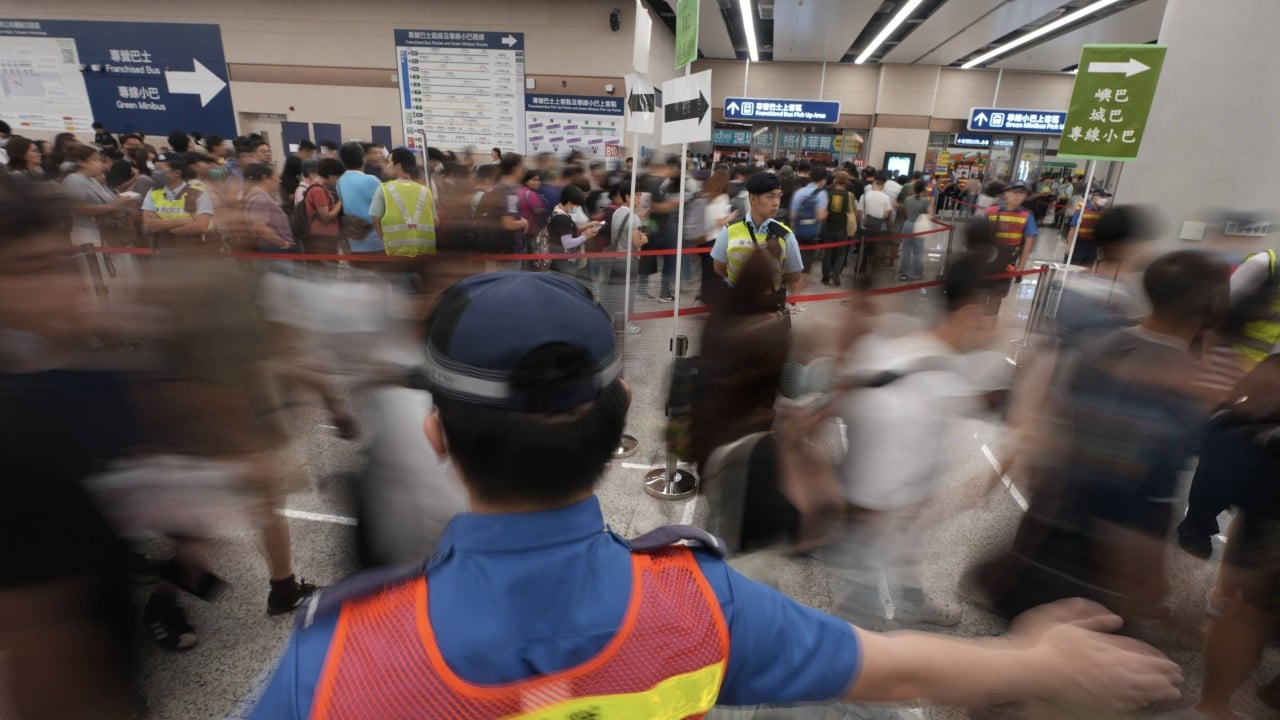
For years, the concrete at Huanggang Port smelled of damp paper, anxiety, and the particular sweat of a Tuesday morning commute gone wrong.
You stand in the queue. You shuffle forward two inches. You check your pocket for the third time, fingers desperate for the cool metal of your smart identity card, only to remember a bureaucratic rule whispered across coffee shop tables: No, today you need the Home Return Permit. Or was it the ID? The line behind you heaves a collective, exhausted sigh. A mother shifts a crying toddler on her hip. A businessman glares at his watch, watching millions dissolve in real time because two pieces of plastic in his wallet refuse to speak the same language. You might also find this connected article insightful: Why Screaming Racism Over Hotel Dress Codes Destroys Real Advocacy.
Borders are supposed to be lines on a map. Instead, they have historically been friction factories.
We built them out of paper forms, ink stamps, and an underlying suspicion that everyone standing in line was trying to sneak past something sacred. For millions of Hongkongers whose lives span the narrow artery of the Shenzhen River, crossing the boundary meant carrying a small library of documents. You needed the Hong Kong identity card for this turnstile, the Mainland Travel Permit for Hong Kong and Macau residents—universally known as the Home Return Permit—for that biometric gate, and a bottomless well of patience for the inevitable error code blinking in crimson light. As reported in recent coverage by Condé Nast Traveler, the effects are significant.
It was an architecture of division masquerading as security.
Consider what happens next at the newly revamped Huanggang Port.
The concrete is cleaner now. The glass panels catch the morning glare of the Guangdong sun without wincing. But the true architecture is invisible. It lives in the server racks and the updated software logic that finally understands a fundamental human truth: a person does not change who they are simply because they pull a different document from their leather wallet.
Travelers moving through this modernized portal no longer have to play a high-stakes guessing game with their credentials. The system has learned flexibility. Hongkongers can now use either their standard Hong Kong identity card or their Home Return Permit at the revamped Huanggang Port checkpoints.
That is not just an infrastructure upgrade. It is an apology for thirty years of friction.
To understand why this matters, you have to look past the logistics and stare directly into the lives of the people who live bi-city existences. Take Marcus, a hypothetical graphic designer whose mother lives in Futian and whose studio sits in Sheung Wan. For a decade, Marcus’s life was dictated by the tyranny of the misplaced document. If he grabbed his ID card out of habit but the lane required his Home Return Permit, he was sent back to the end of the queue. Twenty minutes turned into an hour. An hour turned into a missed family dinner.
Multiply Marcus by the hundreds of thousands who cross this boundary every single day. You begin to see the invisible tax we pay on bad design. Every moment spent fumbling for the right card is a moment stolen from a life lived across two cities that were always meant to breathe together.
The mechanics behind the relief at Huanggang are deceptively simple, yet they required a monumental shift in cross-jurisdictional cooperation. Traditionally, different verification systems operated in silos. Hong Kong identity data lived in one secure digital ecosystem, while mainland travel permits resided in another. Making them interchangeable required building a digital bridge that could securely cross jurisdictions in milliseconds.
When you slide your ID card into the scanner at the newly renovated port, the terminal doesn't just read a chip; it performs a high-speed diplomatic handshake. It verifies your identity against the parameters accepted by the port's updated dual-system architecture, clearing you through the gate before your eyes can even adjust to the fluorescent lights of the arrival hall.
It is seamless. Not because technology is magic, but because engineers finally stopped treating the traveler as a security threat and started treating them as a user.
There is a quiet poetry in a port that works.
When borders dissolve their own redundancies, the psychology of travel shifts. You leave home with a lighter step. You stop treating the journey as an endurance test. The distance between Hong Kong and Shenzhen has always been geographically trivial—a short hop across the water, a brief hum of train tracks underneath your feet. Yet for decades, the psychological distance was measured in the dread of the checkpoint queue.
We are entering an era where infrastructure is finally catching up with human ambition. The revamp at Huanggang Port proves that modernization does not always have to mean taller glass towers or faster trains. Sometimes, the most radical innovation is simply getting out of the way.
The next time you walk through those gates, pay attention to the silence. Notice the absence of the frantic pat-down for missing permits. Watch the lines flow like water finding its own level down a smooth incline.
That is what progress sounds like. Nothing at all.