Granite does not bruise easily. It remembers the weight of footsteps from a century ago, the stamp of boots during marches, the silent prayers whispered by tourists resting their tired feet on warm summer afternoons. When you walk the stone paths flanking the Lincoln Memorial Reflecting Pool, you are walking on history hardened into mineral.
Then came the digital whisper.
It started as a ripple on a screen, small and jagged, traveling outward at the speed of an electronic pulse. The claim arrived with the loud certainty that modern discourse demands: vandalism. The water feature, a mirror for the heavens and our national monuments, had allegedly been defaced. Shattered. Ruined by malicious hands.
Phones buzzed in pockets across the capital. Eyebrows furrowed in television studios. The narrative was simple, clean, and terrifyingly easy to consume. Someone had broken our shared space. Someone had struck at the heart of the national mall.
Except.
Truth has a stubborn habit of waiting out the noise.
The Anatomy of a Phantom Fracture
Consider the modern information ecosystem as a dry forest during a drought. A single spark does not need oxygen to catch; it only needs a receptive audience holding a match. When the word spread that the Reflecting Pool was broken, the response was immediate outrage. People did not ask for coordinates or time stamps. They felt the sting first.
Jeanine Pirro knows the weight of an accusation. As a former judge and prosecutor, her entire professional life was built on the grueling architecture of evidence. Hearsay does not hold up in a courtroom. Rumor is inadmissible.
So when the claim reached the highest levels—originating from a former president who weaponized his social media megaphone to decry the state of the capital—the friction began. Donald Trump insisted the vandals had left their mark. He blasted Pirro publicly after she, relying on on-the-ground reality and direct refutations, pushed back against the narrative.
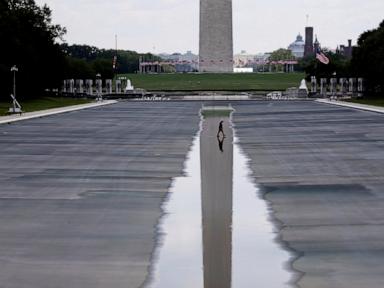
Silence from the stone. The pool remained clear. The water reflected the marble columns of the Lincoln Memorial without distortion, save for the natural ripples of a passing breeze.
There was no shattered concrete. There were no spray-painted slogans screaming into the night. There was only the quiet irony of an imaginary crime taking up real estate in the public consciousness.
When the Mirror Lies
Why do we want our monuments to be under attack?
That is the question no algorithm asks, yet it is the only one that truly matters. When a society is fractured internally, every external surface begins to look like it is cracking. We project our anxieties onto our architecture. If the country feels broken, surely the stones must be chipped. If our politics are vandalized by daily outrage, surely the national landmarks must bear physical witness to that decay.
Stand by the edge of the pool at dusk. The air smells of wet earth and exhaust from the endless stream of tour buses idling on Constitution Avenue. The air is heavy, humid, suffocating in July. Watch the way the light hits the shallow water. It is an artificial creation, engineered by the Army Corps of Engineers decades ago, yet it feels ancient.
Imagine standing there, holding a glowing smartphone that insists the very ground beneath your sneakers is desecrated. You look down. Your shoes are dry. The granite is whole. The water is calm.
Cognitive dissonance is a heavy cloak.
For the former president, the urge to paint Washington as a decaying wasteland is not merely political strategy; it is a worldview. A city under siege requires a strongman to reclaim it. If the capital is clean, functional, and whole, the narrative of apocalyptic decline loses its footing. Therefore, the scratch on the surface—even an imaginary one—must be amplified into a gash.
The Cost of Cheap Fiction
When a public figure with tens of millions of followers broadcasts a falsehood about national property, the shockwaves are real, even if the damage is fake. Park police officers receive frantic calls. Maintenance crews waste precious hours inspecting empty perimeters. Taxpayer-funded resources are diverted from actual upkeep to chase digital ghosts.
Meanwhile, the people who actually tend to the National Mall go about their work in silence.
They are the ones who rake the leaves, skim the debris from the water's edge, and scrub away the occasional stray piece of chewing gum left by a distracted tourist. They know every inch of that concrete. They know its real vulnerabilities—the slow erosion of time, the shifting soil, the relentless expansion and contraction of winter freezes.
Those are boring enemies. Real infrastructure decay does not trend on social media. Pavement settling by a fraction of an inch does not generate outrage retweets.
Outrage requires a villain with a hammer.
The Breaking Point
The clash between Trump and Pirro over a nonexistent act of vandalism is a symptom of a deeper malaise. It highlights how quickly loyalty and political alignment are tested not by moral failures, but by disagreements over basic, verifiable reality.
When a television host—historically aligned with the populist movement—dares to utter the word "false" in response to a powerful ally, the reaction is swift and merciless. The punishment for telling the truth in an environment addicted to fiction is excommunication from the narrative.
Think of the exhaustion carried by everyday observers. We are tired of fact-checking our own breakfast news. We are weary of wondering whether the picture on the screen was taken yesterday or ten years ago, whether the headline describes an event that happened or an event that a strategist wished would happen.
The water in the Reflecting Pool stays still.
It does not care about the tweets. It does not care about the public reprimands broadcasted to millions. It simply holds the reflection of a giant marble president sitting in his chair, staring out across the mall, looking over a country that spends half its energy arguing about whether it is already falling apart.
The real danger was never a vandal with a hammer.
The real danger is a culture that has grown so accustomed to illusions that when someone points out the glass is unbroken, we get angry at them for ruining a good story.
The sun dips below the horizon. The lights click on, casting a brilliant, amber glow against the white marble of the Lincoln Memorial. The water stretches out, a long strip of dark glass cutting through the heart of the capital.
Whole. Untouched. Silent.
Waiting for the next lie to ripple across the surface.