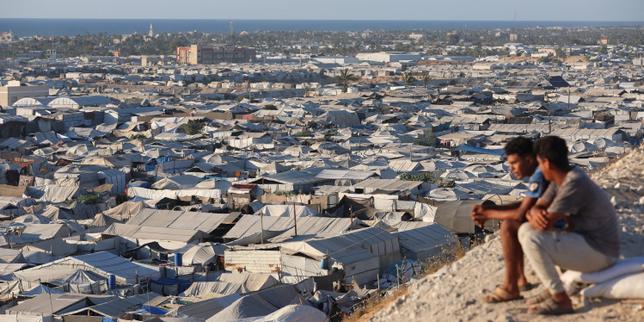
The United Nations’ recent declaration that Palestinians in Gaza remain entirely cut off from the absolute bare essentials of survival is not just a tragedy. It is a systemic logistics failure. When the UN Under-Secretary-General for Humanitarian Affairs publicly deplores the gridlock blocking food, clean water, and medical supplies, observers tend to blame the immediate politics of the border crossings. But a deeper investigation into the supply chains reveals a far more complex and troubling mechanism. The international aid apparatus is failing because it relies on outdated protocols, fractured communication channels, and a complete mismatch between field reality and bureaucratic compliance.
The immediate crisis is stark. Tens of thousands of tons of critical provisions sit rotting in warehouses or parked in miles-long truck convoys just outside the border gates. Meanwhile, the internal distribution networks within Gaza have completely broken down under the weight of active hostilities and destroyed infrastructure. The primary bottleneck is no longer just getting supplies to the gates, but managing the labyrinth of security screenings and local security vacuums once inside. For an alternative view, consider: this related article.
The Friction in the Inspection Pipeline
To understand why a pallet of high-energy biscuits or water purification tablets takes weeks to move a few miles, one must look at the dual-use vetting process. Security protocols require exhaustive inspections to ensure no cargo can be diverted for military infrastructure. This is a legitimate security concern, yet the execution has turned into a bureaucratic quagmire.
Every single item faces an unpredictable evaluation. A shipment can be rejected in its entirety because a single component—such as a water pump, a solar-powered light, or a specific medical tool—is flagged as potentially dual-use. When a rejection occurs, there is no rapid appeals process. The entire truckload is often turned back to the point of origin, forcing aid agencies to completely repackage, re-manifest, and re-queue the cargo. This repetitive cycle destroys the predictability needed to run a functional emergency logistics network. Similar reporting on the subject has been published by BBC News.
Furthermore, the inspection infrastructure itself is severely supply-constrained. Operating with limited scanning equipment and restricted operating hours, the checkpoints create an artificial funnel. Even when political agreements open additional entry points, the physical throughput remains dictated by these slow, manual inspection regimes.
The Myth of Safe Distribution
Getting through the gate is only the first hurdle. The internal reality of Gaza presents an even more treacherous barrier to basic survival needs. The international community often speaks of aid delivery as if it terminates at the border. In reality, a delivery is meaningless unless it reaches an actual family.
Right now, internal distribution is functionally unmanaged. Years of conflict have decimated local administrative bodies and law enforcement structures. When an aid truck enters, it immediately moves through a lawless landscape. Convoys face desperate crowds, organized criminal syndicates, and direct crossfire. Without armed escorts or a recognized local authority to secure the routes, humanitarian drivers face immense personal risk. Many logistics firms simply refuse to operate under these conditions.
The destruction of the physical terrain compounds this insecurity. Roads are heavily cratered, littered with unexploded ordnance, and blocked by the rubble of collapsed buildings. Standard commercial semi-trucks cannot navigate these paths. The operation requires specialized, all-terrain transport vehicles, which are in critically short supply within the enclave due to import restrictions.
The Failure of Decentralized Funding
Well-meaning global donors continue to pour billions of dollars into fragmented aid appeals. This decentralized financial model creates an unintended competitive environment. Dozens of different non-governmental organizations (NGOs) and international bodies compete for the exact same limited logistical resources. They bid against one another for available trucks, warehousing space, and local staff.
This competition drives up operational costs while doing absolutely nothing to increase the actual volume of aid entering the territory. A centralized logistics command—a single, unified authority managing procurement, transport, and distribution—is desperately needed. Instead, the current framework features fragmented communication where one agency is unaware that another has a surplus of the exact items they are struggling to import.
The Clean Water Paradox
The lack of clean water remains the most acute threat to public health, directly driving outbreaks of waterborne diseases. The underlying mechanism of this shortage highlights the structural flaws of the current response. Before the escalation, Gaza relied heavily on a mixture of local aquifer pumping, desalination plants, and direct pipelines. Today, most of these systems are offline due to a lack of fuel and spare parts.
The international response has focused heavily on trucking bottled water into the region. This is an incredibly inefficient use of cargo space. One truck carrying water purification chemicals and heavy-duty repair parts for a desalination plant can generate millions of liters of clean water locally. Conversely, a truck filled with plastic water bottles provides only a temporary, single-day supply for a fraction of a neighborhood. The insistence on delivering finished goods rather than supporting core infrastructure maintenance keeps the population completely dependent on an intermittent, external lifeline.
Redefining the Humanitarian Corridor
Resolving this gridlock requires moving beyond empty political statements and fundamentally restructuring the logistics framework. The current model of ad-hoc convoys and manual cross-docking is fundamentally incapable of meeting the baseline caloric and medical needs of two million people.
First, the inspection framework must transition to a pre-clearance model. Cargo should be sealed and digitally tracked from major regional transit hubs far from the border. Utilizing smart-locking mechanisms and continuous GPS monitoring can verify cargo integrity without requiring destructive, ground-up inspections at the immediate point of entry.
Second, the international community must establish secured logistical hubs inside Gaza that are managed by neutral, third-party contractors specialized in high-risk distribution. These hubs must operate independently of local political factions and be explicitly protected by enforceable non-targeting agreements.
The starvation and deprivation observed today are not inevitable consequences of geography. They are the predictable outcomes of a broken administrative process that treats an acute, industrial-scale logistics crisis with the tools of static bureaucracy. Without a hard pivot toward a centralized, technocratic, and infrastructure-first supply chain strategy, the declarations from global officials will remain nothing more than white noise against a backdrop of preventable human collapse.