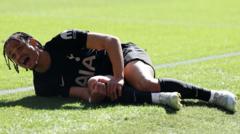
Tottenham Hotspur finally found a win on Saturday, but they may have lost their future in the process. The 1-0 victory over Wolverhampton Wanderers was supposed to be the moment the clouds parted for a club suffocating under the weight of a 15-game winless streak and the very real prospect of a first relegation in 49 years. Instead, the sight of Xavi Simons clutching his right knee at Molineux has become the defining image of a season that has spiraled from ambitious to apocalyptic.
The diagnosis confirmed on Monday morning is as clinical as it is devastating. A ruptured anterior cruciate ligament (ACL). The 23-year-old Dutchman is not just out for the remaining four matches of Tottenham’s desperate survival bid; he is out of the 2026 World Cup and, according to early medical projections, unlikely to see a competitive pitch again until 2027.
For a player who was just beginning to find his rhythm under Roberto De Zerbi, the timing is a masterclass in sporting cruelty. Simons had spent the better part of the season as a passenger in a dysfunctional system, first under Thomas Frank and then during a bizarre exile by Igor Tudor. His wonder strike in the 2-2 draw against Brighton just a week ago felt like a reclamation. Now, that momentum has been buried under a surgeon's blade.
The Anatomy of a Collapse
The incident in the 58th minute against Wolves appeared innocuous at first, the kind of coming-together with defender Hugo Bueno that happens a dozen times a match. Simons attempted to run off the initial shock—a testament to the adrenaline of a relegation scrap—before his knee simply gave way. He collapsed in front of the Spurs bench, and the immediate reaction of the medical staff signaled that this was no mere sprain.
Football is often a game of fine margins, but the margin for error at Tottenham has now evaporated. De Zerbi, only weeks into his tenure, is attempting to implement a high-intensity, possession-based philosophy with a squad that is physically and mentally frayed. To lose your primary creative spark when you are two points adrift of safety is a blow that transcends tactical adjustment.
It is a disaster of compounding proportions.
- Dominic Solanke left the same match with a muscular injury, leaving the frontline toothless.
- Cristian Romero and Mohammed Kudus are already confirmed absentees for the run-in.
- Pape Matar Sarr remains sidelined with a shoulder issue.
Tottenham are not just fighting a battle against the league table; they are fighting an unprecedented medical crisis. With 36 recorded injuries this term, the recruitment and sports science departments must face a reckoning. Is this a fluke of bad luck, or the result of a squad pushed beyond its breaking point by three different managerial regimes in a single calendar year?
The World Cup Vacuum
Beyond the borders of North London, the impact ripples toward the Netherlands. Ronald Koeman was expected to build his World Cup midfield around Simons’ versatility. The 23-year-old offers a profile the Dutch squad lacks: a hybrid of a traditional number ten and a modern high-volume winger who can progress the ball through elite-level carries.
The Oranje are scheduled to open their campaign against Japan on June 14. They will now do so without the player many touted as a potential breakout star of the tournament. For Simons, the psychological toll is evident. His social media post late Sunday night was devoid of the usual PR-sanitized optimism. "None of it makes sense," he wrote. He is right. At his age, missing a World Cup in the prime of his physical development is a gap in a career CV that can never truly be filled.
The Financial and Tactical Fallout
From a business perspective, the Simons injury is a catastrophe for a club already staring at the £100 million-plus revenue drop associated with the Championship. Simons was the centerpiece of a £52 million investment. If Tottenham go down, their ability to retain him—or sell him to balance the books—is severely compromised by a year-long rehabilitation period. No elite club is going to trigger a release clause for a player who cannot pass a medical until the mid-point of next season.
Tactically, De Zerbi now has to find a way to manufacture goals from a squad that has forgotten how to score them. Without Simons to bridge the gap between the holding midfielders and the strikers, Spurs are likely to retreat into a shell. Expect a return to the pragmatic, soul-crushing "low block" football that the fans have spent the last three years protesting.
The road ahead for Xavi Simons is a long, solitary one involving isometric holds, swimming pools, and the slow, grinding work of rebuilding a joint. The road for Tottenham is much shorter, consisting of 360 minutes of football that will determine the club's status for the next decade.
They may have won the battle at Molineux, but the cost of that victory might have just cost them the war. Recovery is a word that will be used often in the coming months, both in the medical room and the boardroom. Whether either the player or the club can truly achieve it remains the most uncomfortable question in English football.
The fight for safety continues at Villa Park, but the light has undoubtedly dimmed. Support and faith are the only currencies left in North London, and even those are beginning to run dry. Luck, it seems, has officially left the building.
The recovery starts now. For everyone.