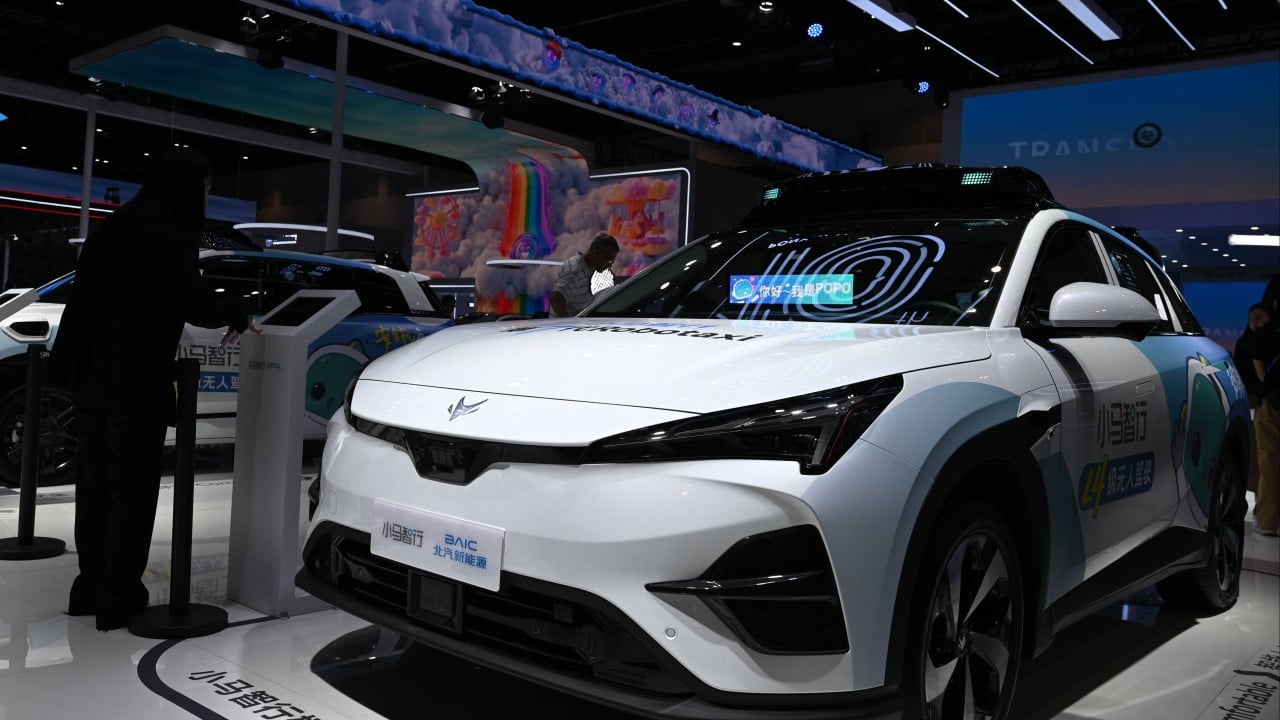
The global race for autonomous dominance has shifted from a battle of software code to a war of industrial attrition. While Western tech giants are slowing down or pivoting toward driver-assist features, Chinese firms like Apollo Go, Pony.ai, and WeRide are aggressively exporting their driverless fleets. This expansion is not fueled by a sudden breakthrough in artificial intelligence. It is driven by a massive cost advantage and a manufacturing ecosystem that has turned high-tech sensors into cheap commodities. These companies are betting they can outlast the competition by flooding international markets with hardware that costs a fraction of what Silicon Valley can produce.
The economics are simple but devastating. A few years ago, a Level 4 autonomous vehicle cost nearly $150,000 to build. Today, Baidu’s sixth-generation robotaxi is rolling off the assembly line at roughly $35,000. That is the price of a mid-sized sedan, not a supercomputer on wheels. This collapse in hardware costs allows Chinese operators to treat global expansion as a volume play rather than a boutique experiment. They are moving into the Middle East, Southeast Asia, and Europe not just to test the roads, but to colonize the infrastructure of urban transport before local regulations can catch up.
The Supply Chain Weapon
Most analysts focus on the algorithms, but the real story is in the lidar. China has effectively broken the monopoly on high-end sensing equipment. By vertically integrating the production of laser sensors, cameras, and chips, firms in Shenzhen and Shanghai have stripped out the premium margins that Western suppliers once enjoyed. This is the same playbook used in the solar panel and electric vehicle markets.
The strategy is clear. Lower the entry barrier so significantly that local governments in places like Abu Dhabi or Singapore find it fiscally irresponsible to choose any other partner. When a Chinese firm offers a full-stack autonomous solution for half the price of a US-based competitor, the technical nuances of the software matter less than the bottom line on the procurement contract. We are seeing a structural shift where autonomous driving is becoming a utility rather than a luxury.
Domestic Saturation and the Push Abroad
Why the sudden rush for the exits? The Chinese domestic market is becoming crowded. In cities like Wuhan and Beijing, robotaxis are already a common sight, but the competition is driving profit margins into the dirt. To survive, these companies must find markets where the cost of labor is high and the appetite for smart city infrastructure is growing.
The Middle East has become a primary target. Countries like the United Arab Emirates are not just customers; they are active investors. By establishing regional headquarters in Dubai, firms like WeRide gain a neutral ground to operate, bypassing some of the geopolitical friction that dogs them in Washington or Brussels. This provides a sanctuary for growth away from the trade wars that threaten to stall their progress in the West.
The Ghost of Regulatory Friction
Data remains the biggest hurdle. Every mile driven by a robotaxi is a mile of data collected, and Western governments are increasingly nervous about where that data lives. The primary concern is not just about privacy, but about mapping. High-definition maps are a matter of national security. When a fleet of foreign-owned vehicles spends 24 hours a day scanning every street, alleyway, and government building with high-precision sensors, it creates a digital twin of the city that can be accessed remotely.
This tension creates a bifurcated world. We are likely to see a "Silicon Curtain" where Chinese autonomous tech dominates the Global South and parts of Europe, while North America remains a fortress for domestic players like Waymo and Zoox. The problem for the West is that while they are perfecting the software in a few selected zip codes, the Chinese firms are gaining millions of miles of diverse operational experience in varied climates and regulatory environments.
Labor Displacement and the Public Backlash
Cheap hardware does not solve the human problem. In every city where these fleets arrive, they face resistance from the taxi and ride-hailing unions. The cost edge of a $35,000 robotaxi is an existential threat to the millions of people who drive for a living. Unlike the gradual shift to electric vehicles, the shift to autonomous fleets removes the human variable entirely.
In Wuhan, we have already seen reports of "job-stealing" protests. As these firms move into Southeast Asia, they will encounter the same friction. The difference is that Chinese firms, backed by state-aligned capital, are better positioned to absorb the short-term losses caused by protests or temporary bans. They are playing a decades-long game while Western publicly traded companies are often beholden to the next quarterly earnings report.
The Software Parity Myth
There is a common belief in Silicon Valley that American AI is fundamentally superior. This might have been true five years ago. Today, the gap has narrowed to the point of irrelevance for most commercial applications. Autonomous driving at Level 4 is increasingly becoming a "solved" problem in specific geofenced areas. Once you reach a certain threshold of safety, the winner is no longer the one with the smartest code, but the one who can scale the fastest.
Chinese firms have been forced to innovate under more chaotic driving conditions. Navigating the dense, unpredictable traffic of a Tier-1 Chinese city is a much harder problem than cruising the wide, predictable boulevards of Phoenix or Mountain View. This "hard mode" training has resulted in software that is remarkably resilient when exported to other high-density urban centers.
Hardware is the New Software
The real innovation is in the manufacturing process itself. By treating the robotaxi as an industrial product rather than a tech project, China has achieved economies of scale that are currently impossible in the United States. They aren't just building cars; they are building the machines that build the cars.
- Modular sensor suites that can be swapped in minutes.
- Solid-state lidar integrated directly into the bodywork to reduce drag and cost.
- Redundant braking and steering systems produced at a tenth of the previous cost through mass-market automotive supply chains.
Geopolitical Realities and the Path Forward
We cannot ignore the role of state subsidies. The Chinese government has designated "New Quality Productive Forces" as a national priority. This means robotaxi firms have access to low-interest loans, land for factories, and a regulatory environment that prioritizes speed over caution. In the West, a single accident can sideline a fleet for months due to litigation and public outcry. In China, the response is often a quiet software update and a push to keep moving.
This difference in risk tolerance is a competitive advantage. It allows for a faster iteration cycle. By the time a Western firm has cleared the legal hurdles to expand into a new city, their Chinese counterpart has likely already mapped the area and started picking up passengers.
The Infrastructure Play
The final piece of the puzzle is "Vehicle-to-Everything" (V2X) communication. China is not just betting on the cars being smart; they are making the roads smart. By installing sensors and transmitters in traffic lights and poles, the burden on the vehicle’s onboard computer is reduced. This further lowers the cost of the car. When these firms export their taxis, they often try to export the infrastructure as well, offering a complete "smart city" package to developing nations.
This creates a "vendor lock-in" effect. Once a city integrates its traffic management system with a specific provider's technology, switching to a competitor becomes prohibitively expensive. The goal is not just to sell a ride, but to own the operating system of the city itself.
The Economic Cliff
Western firms are currently trapped in a high-margin, low-volume cycle. They build incredibly sophisticated, expensive vehicles and deploy them sparingly to protect their brand and capital. Chinese firms have taken the opposite approach. They are embracing a low-margin, high-volume strategy, betting that the data and market share they gain now will be worth more than the billions they are currently burning.
The math is brutal because it suggests that the "best" technology might lose to the "cheapest good enough" technology. History is full of examples where a superior technical standard was crushed by a cheaper, more widely available alternative. In the world of autonomous transport, the winner will be the one who can afford to lose the most money while scaling at breakneck speed.
The expansion we see today is just the first wave. As the hardware costs continue to drop, the pressure on Western operators will become unbearable. They will either have to find a way to slash their own manufacturing costs or concede the global market to the firms that have already turned autonomy into an assembly-line product. The battle for the future of the street is being won on the factory floor, and right now, there is only one side showing up to the fight.
The era of the experimental, high-priced autonomous vehicle is over. We have entered the era of the commodity robotaxi, where the only metric that matters is the cost per mile and the speed of the roll-out. The firms that realize this first will be the ones that survive the coming shakeout. Those who don't will find themselves relegated to the history books, remembered as the pioneers who paved the way for someone else to take the profit.