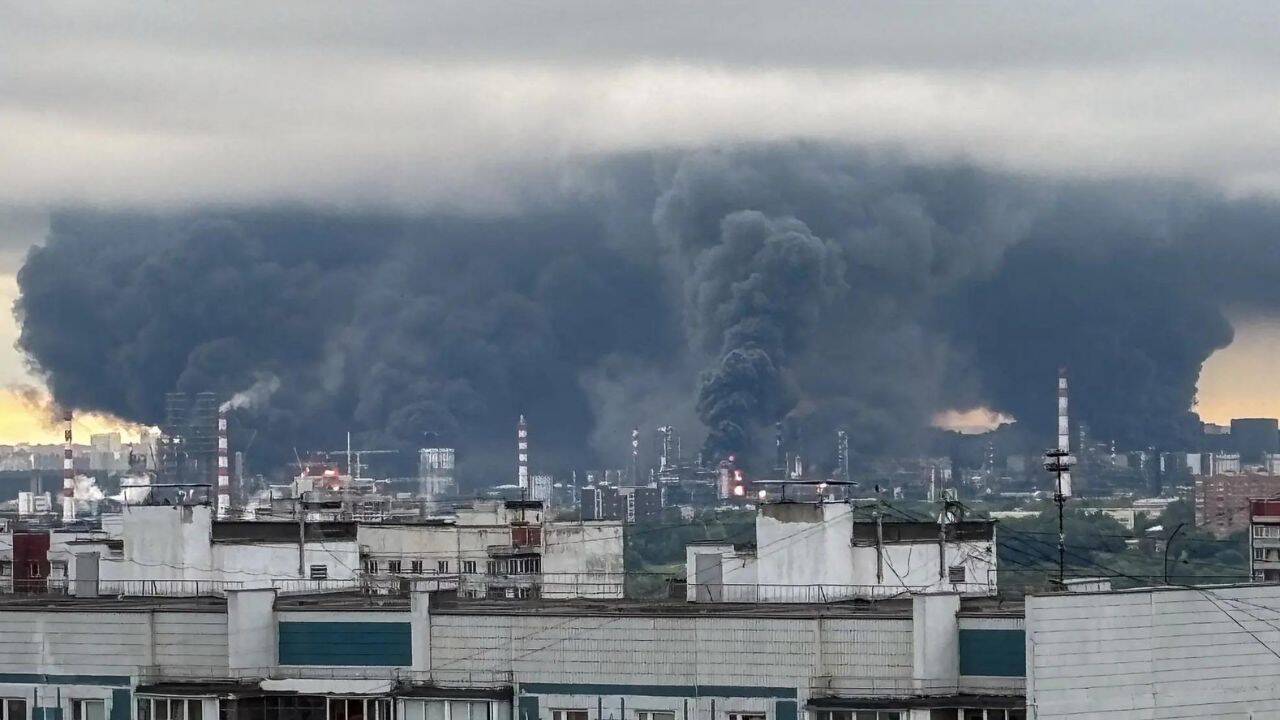
Ukraine long-range drone strikes have transformed from desperate asymmetric retaliations into a cold, systematic economic war designed to choke Russia's refined fuel production. While immediate headlines focus on local casualties and dramatic fireballs, the real damage is measured in columns of specialized steel and the hard realities of Western supply chains. By targeting the highly complex distillation towers of major refineries deep inside Russian territory, Kyiv is exploiting a profound industrial vulnerability. Russia can easily replace crude oil pipelines, but it cannot easily replace the multi-million-dollar fractional distillation units that turn that crude into diesel, gasoline, and aviation fuel.
This is not a temporary tactical disruption. It is a calculated strategy to force the Kremlin into an impossible choice between fueling its military machine or maintaining domestic economic stability.
Target Fractionation
To understand why these strikes hurt, you have to look past the smoke and look at the blueprints of a refinery. A refinery is a sprawling complex of storage tanks, pipes, and cracking units, but the absolute heart of the operation is the atmospheric residue distillation column, often called an AVT unit.
Crude oil is useless until it is heated and separated into different components based on boiling points. The AVT units do exactly this. They are massive, highly engineered towers packed with specialized internal trays and metallurgy designed to withstand extreme heat and corrosive environments. They are also immense targets.
Ukraine's long-range strike drones, flying hundreds of miles inside Russian airspace, are not aiming randomly at fuel farms. They are targeting these specific towers. When a 50-pound explosive payload detours through the outer shell of a fractionation column, it does not just cause a fire. It warps the internal structural integrity, destroys the delicate tray systems, and renders the entire refining train useless.
Replacing an AVT unit is a monumental task under perfect conditions. In a sanctioned economy, it becomes an industrial nightmare. Most of Russia's modern refining capacity was built or heavily modernized during the 2000s and 2010s using Western engineering, procurement, and construction firms. The specialized control systems, high-grade alloy components, and large-scale precision engineering required to build these towers came directly from companies in Europe and the United States.
Because of strict export controls, Moscow cannot simply order replacement parts from Houston or Frankfurt. They are forced to rely on domestic replication, backchannel smuggling, or Chinese substitutes that may not match the precise technical specifications of the original Western designs. A repair job that would normally take a few months in a peacetime economy now drags out for a year or more. Every week a tower remains offline represents millions of gallons of unrefined fuel that never reaches the market.
The Diesel Dilemma
The immediate consequence of this systematic degradation is a tightening squeeze on Russia's domestic fuel supply, with diesel being the most critical point of failure. The Russian military runs on diesel. Tanks, armored personnel carriers, logistics trucks, and supply trains all consume massive quantities of the fuel daily.
At the same time, the Russian economy is profoundly dependent on diesel for its agricultural sector. The vast farming belts that produce Russia's grain exports require thousands of tractors and combine harvesters to operate simultaneously during planting and harvest seasons. If the refineries cannot produce enough diesel, the state faces an agonizing logistical puzzle.
They must prioritize.
[Crude Input] ---> [Damaged AVT Tower] ---> [Production Drop]
                                                   |
                         +-------------------------+-------------------------+
                         |                                                   |
        [Priority 1: Military Logistics]                    [Priority 2: Domestic Economy]
        - Tanks, supply trucks, trains                      - Agriculture & harvest machinery
        - Guaranteed supply allocations                     - Squeezed volumes, rising prices
If the Kremlin routes the remaining diesel production exclusively to the front lines in Ukraine, domestic fuel prices skyrocket, leading to inflation and hoarding in civilian regions. If they cap prices and force fuel to stay in the civilian market to prevent public unrest, military logistics trains begin to stall. The state has already resorted to temporary bans on gasoline and diesel exports to stabilize internal markets, a clear admission that the drone campaign is striking a raw nerve.
Export bans come with a massive financial penalty. Russia relies on the revenues from refined petroleum product exports to fund its federal budget and sustain its currency. Selling raw crude oil is a backup option, but crude fetches a lower profit margin than refined diesel or gasoline. Furthermore, global crude markets are subject to strict price caps and shipping sanctions, making it far harder to monetize raw barrels than laundered refined products. By forcing Russia to export less fuel and more crude, Ukraine is effectively draining the Kremlin's treasury while simultaneously driving up internal operational costs.
Air Defense Fragmentation
The expanding geography of the drone strikes highlights an even deeper structural crisis for Russian military planners. Russia possesses one of the most sophisticated, multi-layered air defense networks in the world on paper. Systems like the S-400, Pantsir-S1, and Tor-M2 are highly capable. However, they were designed to defend concentrated military targets, major cities, and specific frontline sectors against conventional air forces.
They were never intended to blanket an entire continent-sized industrial infrastructure against low-flying, low-radar-cross-section plastic drones.
Ukraine is exploiting this geographic vastness. By launching strikes against refineries located 500, 700, or even 1,000 miles from the Ukrainian border, Kyiv forces Moscow to spread its air defense assets incredibly thin. A Pantsir system deployed to protect an oil refinery in Nizhny Novgorod is a Pantsir system that cannot be used to defend a command post in occupied Crimea or an ammunition depot near the Donbas front lines.
                  [Ukrainian Drone Production Facilities]
                                     |
         +---------------------------+---------------------------+
         |                           |                           |
[Frontline Sectors]        [Border Infrastructure]     [Deep Rear Refineries]
(Donbas / Crimea)          (Belgorod / Bryansk)        (1,000+ miles deep)
         |                           |                           |
  [Russian S-400/Pantsir Dilemma: Where do you deploy the limited batteries?]
The math favors the attacker. A long-range attack drone can be assembled in a small workshop using commercial carbon fiber, a basic gasoline engine, and an off-the-shelf satellite navigation guidance system. The total cost often sits well under $50,000. The interceptor missiles fired by Russian air defense systems cost hundreds of thousands, sometimes millions, of dollars per shot.
Even if Russian air defenses successfully shoot down nine out of ten incoming drones, the tenth drone that slips through and strikes a distillation tower achieves a massive return on investment. The economic damage to the refinery, combined with the lost production revenue, completely dwarfs the cost of the entire drone fleet used in the attack.
The Grey Market Countermeasure
Faced with this relentless attrition, Russia has turned to an intricate web of grey-market supply routes and engineering workarounds to keep its facilities running. This is where the conflict moves from the physical battlefield to the shadow worlds of global logistics and corporate shell games.
When a Western-made valve, compressor, or programmable logic controller breaks down under the stress of a drone-induced fire, Russian procurement agents do not look to domestic factories, which lack the tooling to replicate high-end Western electronics. Instead, they activate networks of intermediary companies operating in countries that have not signed on to Western sanctions.
A replacement part might be ordered by a dummy corporation registered in Dubai. From there, it is shipped to a logistics hub in Central Asia, transferred to a secondary distributor in Turkey, and finally trucked across the border into Russia. The serial numbers are frequently filed off, and the paperwork is systematically falsified to list the end-user as a harmless civilian manufacturing plant rather than a state-linked oil refinery.
This process works, but it functions at a fraction of the speed of normal commerce. It adds massive layers of friction, bureaucratic delays, and exorbitant middleman fees. A component that once cost $10,000 and took three days to arrive now costs $80,000 and takes four months to clear multiple international borders.
This hyper-inflation of maintenance costs acts as a hidden tax on the Russian energy sector, steadily eating away at the profitability of the state's most vital industry.
Washington Anxieties
The true complexity of this drone campaign lies in its geopolitical blowback, specifically the friction it creates between Kyiv and its most critical backer, the United States. Washington's primary fear throughout this conflict has been global energy price shocks.
The global economy is hyper-sensitive to changes in energy supplies. While Russia's export bans primarily affect refined products rather than the global crude supply, any major disruption to Russian energy infrastructure sends ripples through international oil markets. If traders panic and assume that Russian oil production is entering a period of permanent decline, global oil prices jump across the board.
For an American administration, higher prices at the gas pump are political poison.
This has led to a bizarre diplomatic dynamic where US officials have openly cautioned Ukraine against targeting Russian energy infrastructure, urging them to focus instead on strictly military objectives like airfields and logistics hubs. Kyiv, however, views this through a fundamentally different lens. For Ukraine, the refineries are the financial engine driving the entire invasion. Asking Ukraine to spare the industry that funds the missiles raining down on its cities is a non-starter.
Kyiv has countered Western anxiety by refining its drone targeting telemetry to focus almost exclusively on internal processing units rather than crude export terminals. By crippling Russia's ability to process its own oil while leaving the infrastructure that exports raw crude to global markets relatively intact, Ukraine attempts to minimize the shock to global crude prices while maximizing the internal economic pain inflicted on Moscow. It is a razor-thin line to walk, and it demonstrates that the drone war is as much a chess game of international diplomacy as it is a military operation.
Industrial Realities
There are no easy fixes for Russia in this war of attrition. You cannot build a dome over an area the size of Western Europe to protect every piece of industrial pipe. As long as Ukraine retains the domestic capacity to manufacture long-range drones, the threat to Russia's refining base remains permanent.
The long-term trajectory points toward a forced regionalization of the Russian fuel market. Refineries located near the Ukrainian border or within easy flight range of drone launch sites will gradually be degraded into irrelevance or forced to operate at severely reduced capacities. Russia will have to rely more heavily on its remote Siberian refineries, which are safer from drone attacks but located thousands of miles away from the primary consumption centers and the frontline military forces.
This geographical shift introduces immense logistical strain on an already overburdened railway network. Moving millions of gallons of fuel across a continent via rail cars is vastly more expensive and vulnerable to disruption than moving it through regional pipeline networks.
Every distillation tower that burns pushes Russia further away from a modern, efficient industrial economy and closer to a fragile, heavily managed wartime state struggling to keep its basic machinery moving.