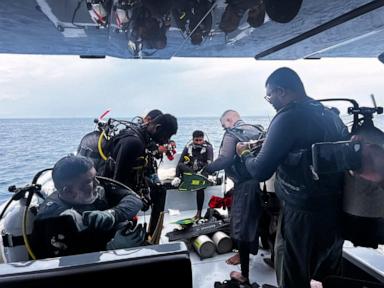
The arrival of three elite Finnish technical divers in the Maldives marks a desperate, highly specialized attempt to resolve one of the Indian Ocean's most agonizing maritime mysteries. Four Italian recreational divers vanished into the treacherous currents of a remote atoll, leaving families without answers and local authorities facing the stark limitations of standard search and rescue frameworks. The incoming team faces an unforgiving underwater environment where standard diving rules no longer apply. This operation is not a standard recovery effort. It is a high-stakes recalculation of a mapping error that has kept four families waiting for closure.
The specialized team plans to completely overhaul the existing search grid, utilizing advanced sonar and closed-circuit rebreather technology to push past depths previously deemed inaccessible by local recovery teams.
The Convergence of Extreme Geography and Human Error
The Maldives evokes images of shallow turquoise lagoons and pristine coral reefs, but this postcard geography masks a violent underwater topography. The archipelago sits atop a vast submarine mountain range. Between the atolls lie deep, narrow channels through which massive volumes of ocean water must force their way during tidal shifts. These currents do not just move horizontally; they downdraft, pulling divers down into the abyss within seconds.
Recreational diving deep-sea limits are generally capped at 40 meters. Beyond this point, nitrogen narcosis clouds judgment, and air consumption accelerates exponentially. The missing Italian group reportedly encountered a washing-machine current, a phenomenon where conflicting thermal layers and tidal movements trap divers in a vertical vortex. When a group is caught in a downdraft, traditional surface-level search patterns become entirely useless.
Local coast guard resources are designed for surface rescues and shallow-water operations. They lack the mixed-gas infrastructure required to sustain search operations at depths exceeding 60 meters. This gap in capability explains why weeks passed before a specialized international team could be mobilized. The Finnish team is not here to swim the same lines; they are here to map the deep trenches where the currents inevitably deposit whatever they claim.
The Mechanics of a Deep Water Remapping
Recovery at extreme depths relies entirely on data modeling before a single diver enters the water. The Finnish specialists are deploying side-scan sonar arrays capable of rendering high-resolution three-dimensional profiles of the seabed, separating biological anomalies from human remains.
Advanced Drift Modeling
Standard search grids rely on linear drift calculations based on surface winds and tidal charts. The incoming team uses acoustic Doppler current profilers to measure water velocity at various depths simultaneously.
- The Surface Layer: Influenced by monsoon winds, often moving in direct opposition to deeper water.
- The Thermocline: A sharp temperature drop where water density changes, frequently deflecting debris and bodies.
- The Benthic Current: The slow, heavy movement of water along the ocean floor that dictates where objects finally settle.
By inputting this layered data into predictive software, the team can pinpoint high-probability containment zones along the submerged outer walls of the atoll.
The Rebreather Advantage
To physically investigate these targets, the divers utilize closed-circuit rebreathers (CCRs). Traditional scuba gear vents exhaled gas into the water, wasting precious oxygen and limiting bottom time to mere minutes at great depth. CCR systems chemically scrub carbon dioxide from the diver’s breath and enrich it with a precise mix of helium and oxygen, known as trimix.
This technology extends bottom times to hours rather than minutes, but it introduces extreme physiological risk. A minor calculation error in the gas mix at 90 meters can cause instant seizure or unconsciousness. The margin for error is non-existent.
The Tourism Industrial Complex Versus Safety Realities
The incident exposes a friction point between the Maldives’ lucrative tourism industry and the realities of remote maritime safety. The country relies heavily on its reputation as an accessible tropical paradise. Admitting that large swathes of its diving waters lack adequate deep-recovery infrastructure is economically inconvenient.
Many liveaboard dive boats operate at the absolute edge of communication networks, miles away from the country’s few hyperbaric chambers. When high-paying tourists demand access to the most thrilling, current-heavy dive sites, operators face intense pressure to comply, sometimes downplaying the physical conditioning and discipline required to survive these waters.
The Italian divers were experienced, but experience can breed a dangerous overconfidence when facing the sheer physics of an ocean channel during a spring tide. Survival in those conditions is not about skill. It is about luck, and when that runs out, the ocean keeps its secrets until someone with the right technology comes to look for them.
The Logistics of Closure
The Finnish team faces a ticking clock. As time passes, the likelihood of finding intact remains decreases significantly due to marine life and high-energy current degradation. The primary objective is the recovery of dive gear, heavy steel tanks, and high-density weight belts, which do not drift and remain anchored to the final location of the divers.
Finding the equipment is the key to finding the individuals. The families of the victims are funding a significant portion of this private initiative, highlighting a grim reality in international travel. When a citizen disappears in deep water abroad, foreign embassies can offer diplomatic support, but they rarely deploy tactical military assets for civilian recovery.
The team has established a temporary base on a nearby local island, away from the luxury resorts, converting a fishing vessel into a technical diving platform. High-pressure compressors, helium racks, and emergency medical oxygen tanks now crowd a deck usually reserved for tuna lines.
The coming days will determine whether the recalculated search grid holds true, or if the deep channels of the southern atolls have moved the target beyond the reach of human technology. The divers understand that success in this environment is measured in inches, and failure is defined by the silence of an empty sonar screen.