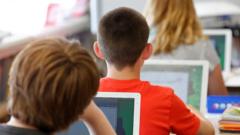
Los Angeles Unified School District has officially declared the digital honeymoon over. By moving to restrict classroom screen time, the nation’s second-largest school district isn't just tweaking a policy; it is admitting a decade-long experiment on children’s brains has failed to deliver the promised academic utopia. This decision forces every other major American district to confront a harsh reality. For years, the push for one-to-one device ratios was sold as the ultimate equalizer for equity and modern learning, but the data now suggests these devices often act as high-priced barriers to actual literacy and social development.
The billion dollar failure of the digital promise
The history of technology in LAUSD is a scarred one. People still remember the 2013 iPad rollout, a $1.3 billion catastrophe that ended in FBI investigations and the resignation of a superintendent. Back then, the dream was a tablet in every hand. The reality was a logistical nightmare where students bypassed security filters within hours and the curriculum was barely functional. This latest pivot toward limiting screen time is the final burial of that tech-first ideology.
This shift isn't a retreat into Luddism. It is a desperate attempt to reclaim the attention spans of a generation that has grown up in a constant feedback loop of notifications and blue light. Educators across the district report that the "engagement" promised by educational software is often just a thin veil for passive clicking. When a child stares at a screen for six hours a day, the brain’s ability to process deep, narrative text begins to atrophy. LAUSD is acknowledging that the physical classroom must be a sanctuary from the digital noise that dominates every other hour of a student's life.
The hidden biological cost of the glowing rectangle
The science behind this policy shift is becoming impossible to ignore. Neurological research indicates that the tactile act of writing by hand and the physical sensation of turning pages in a book engage different neural pathways than typing or scrolling. These pathways are essential for long-term memory retention and conceptual understanding. When schools replaced paper with pixels, they inadvertently slowed down the cognitive development of their most vulnerable students.
We are seeing a rise in "digital exhaustion" among elementary students. This isn't just about eye strain. It is about the mental fatigue that comes from navigating complex interfaces instead of focusing on the underlying lesson. Teachers in Los Angeles have documented a significant drop in stamina for independent reading. Students who are used to the instant gratification of an educational game struggle to get through a single chapter of a novel without a "break." By limiting screen time, the district hopes to rebuild that lost cognitive endurance.
The equity trap of the digital divide
For years, the loudest argument for constant screen access was equity. The logic seemed sound. If wealthy kids have laptops at home, the school must provide them to low-income students to bridge the gap. However, an ugly paradox emerged. In elite private schools in Silicon Valley, tech executives often pay premium tuition for "low-tech" environments where wooden blocks and chalkboards take center stage. They know what the data shows. Excessive screen time correlates more strongly with lower test scores in low-income communities where digital devices are often the primary babysitters.
The "digital divide" has flipped. It is no longer about who has a device, but who has the luxury of being disconnected. By mandating limits, LAUSD is attempting to provide its students with the same high-touch, human-centric education that the wealthy have been buying for years. The district is finally realizing that giving a struggling student a laptop without a highly trained teacher to mediate that technology is not a gift. It is an abandonment.
Implementation hurdles and the tech lobby
The logistics of this rollback are daunting. Millions of dollars have been poured into digital-only curricula and subscription-based learning platforms. Entire departments within the district are dedicated to "instructional technology." These entities will not go quietly. The educational technology lobby is a multi-billion dollar industry that relies on schools being "all-in" on hardware and software.
Teachers now face the monumental task of pivoting back to analog resources that may have been discarded or neglected for years. There is a generation of younger teachers who have never taught without a smartboard or a classroom set of Chromebooks. They will need to relearn the art of leading a discussion that doesn't rely on a slide deck. This is a cultural shift as much as a policy one. The district must provide physical books, paper, and art supplies at a scale they haven't touched in a decade.
The parent rebellion and the mental health crisis
Parents are increasingly the driving force behind these changes. The post-pandemic years revealed the dark side of remote and hybrid learning. Parents saw firsthand how their children became irritable, withdrawn, and physically sedentary when tethered to school-issued devices. The link between high screen usage and the soaring rates of youth anxiety and depression is now a central pillar of the district’s reasoning.
Social media access on school devices remains a primary concern. Despite the best efforts of IT departments, students are incredibly resourceful at finding ways to access TikTok, Instagram, and Discord during school hours. This creates a constant undercurrent of social pressure and cyberbullying that follows them from the hallway into the middle of a math lesson. By removing the screen, the district removes the portal to those distractions, forcing students to interact with the person sitting next to them.
A new standard for the American classroom
Los Angeles is the bellwether. When a district this size moves, the ripples are felt in New York, Chicago, and Miami. We are entering an era of "intentional technology." This does not mean the complete removal of computers. Coding, digital literacy, and technical research remain vital skills. But the days of the "digital crutch"—where a screen is used simply to keep a class quiet or to fill time—are numbered.
The focus is returning to the teacher-student relationship. No algorithm can replace the intuition of a veteran educator who sees a student's confusion in their eyes before they even realize they are lost. No software can replicate the collective energy of a classroom debate. The "personalized learning" promised by AI and adaptive software has largely turned out to be "isolated learning." LAUSD is betting that the future of education looks a lot more like its past: focused, social, and decidedly analog.
The true test will be in the coming years' data. If literacy rates and mental health markers improve in Los Angeles, the tech-heavy model of the 2010s will be viewed as a historical aberration. The district is gambling that by turning off the screens, they will finally turn on the lights for their students. This move signals a hard pivot toward valuing human attention as the most precious resource in the building. It is a necessary correction for a system that lost its way in a forest of fiber-optic cables.
Every administrator in the country should be watching the Los Angeles classroom right now to see if the silence of a powered-down laptop leads to the sound of a child finally learning to think.