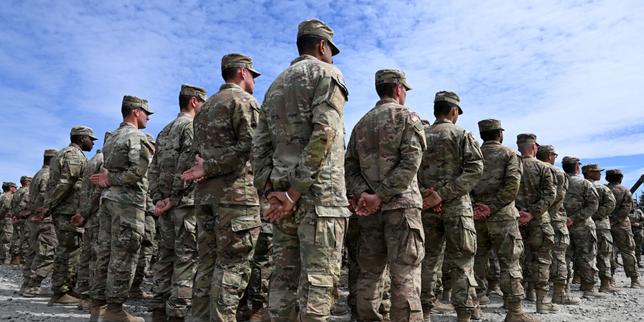
The Pentagon is moving 5,000 troops out of Germany. While the official line focuses on "strategic flexibility" and "operational readiness," the reality is a jagged fracture in the post-WWII security architecture. This is not a simple logistical reshuffle. It is a calculated geopolitical slap that signals a fundamental shift in how Washington views its oldest allies. For decades, Germany served as the unsinkable aircraft carrier for American interests in the Atlantic. That era is ending.
The decision to pull these forces and potentially slash numbers in Italy and Spain exposes a deep-seated frustration within the U.S. defense establishment. It targets the heart of European complacency. By thinning the lines in Stuttgart and Vilseck, the United States is effectively telling Europe that the days of the "security free-rider" are over. Recently making news lately: The Middle East Arms Surge Why Washington Just Fast Tracked 8 Billion Dollars in Munitions.
The German Anchor Breaks
For over seventy years, the presence of American boots on German soil was a given. It was the physical manifestation of the NATO treaty. But the bond has frayed. The current administration views the heavy concentration of troops in Germany as an anachronism—a relic of a Cold War that ended thirty years ago.
Washington’s grievance is largely financial but deeply political. Germany, the wealthiest economy in Europe, has consistently failed to meet the NATO target of spending 2% of GDP on defense. To the analysts in the Pentagon, this isn’t just a budget dispute. It is a breach of contract. By withdrawing 5,000 personnel, the U.S. is withdrawing its endorsement of Germany as the primary hub for European stability. More details regarding the matter are detailed by The New York Times.
The logistics of this move are punishing. Moving thousands of troops, their families, and the massive support infrastructure that follows them costs billions. Yet, the White House is willing to eat that cost to make a point. This is about leverage. It is a warning shot fired across the bow of the Bundestag, suggesting that American protection is a service that can be cancelled if the subscription fees aren't paid.
Pressure on the Mediterranean Flank
Italy and Spain are now caught in the crossfire. The threat to reduce numbers in Vicenza, Aviano, and Rota is a strategic expansion of the German "punishment." These bases are critical for operations in Africa and the Middle East. If the U.S. follows through on these threats, the entire Southern Flank of NATO becomes porous.
The Rota Vulnerability
The Naval Station Rota in Spain is perhaps the most sensitive piece on the board. It hosts American destroyers equipped with the Aegis ballistic missile defense system. It is the shield for Europe. Threatening a drawdown here isn't just about troop counts; it’s about the very technology that prevents a missile from reaching London or Paris. Spain’s government, currently navigating its own internal political minefields, now faces a choice: find the money for defense or watch their primary security partner pack their bags.
The Italian Equation
Italy hosts the U.S. Army’s 173rd Airborne Brigade and the 6th Fleet. These assets are the "first responders" for any crisis in the Mediterranean. A reduction here would leave Italy to manage the migration and security challenges of the North African coast largely on its own. The Italian defense ministry knows this. The American threat is designed to create a sense of urgency that diplomatic cables have failed to produce for years.
The Poland Alternative
While Germany loses, Poland is waiting in the wings. The U.S. is not simply bringing these 5,000 troops back to Fort Bragg or Killeen. A significant portion is expected to rotate into Eastern Europe, closer to the Russian border. This is a pivot toward nations that are actually hitting their 2% targets and, more importantly, nations that show a more visceral appreciation for American hardware.
Warsaw has been lobbying for a permanent U.S. presence for years. They are willing to pay for it. They are willing to build the infrastructure. For a U.S. administration tired of arguing with Berlin over gas pipelines and defense budgets, the Polish offer is incredibly seductive. It moves the "tripwire" of American involvement several hundred miles to the east, directly into the face of Moscow.
The Economic Gut Punch
Beyond the tanks and the uniforms, this move is a disaster for local German economies. Towns like Kaiserslautern and Grafenwöhr exist in a symbiotic relationship with American bases. Thousands of local jobs depend on these soldiers.
- Retail and Housing: Local landlords and shop owners face a total collapse of their customer base.
- Civilian Employment: Thousands of German nationals work on these bases in administrative and maintenance roles.
- Infrastructure: The German government has invested millions in roads and schools specifically to support the American presence.
When the 5,000 leave, they take their wallets with them. This is the "how" of the punishment. It hits the German voter directly, pressuring local politicians to demand a change in the national defense stance. It is a high-stakes game of economic chicken.
The Risk of Miscalculation
There is a dark side to this "America First" restructuring. By hollowing out the bases in Germany and threatening the Mediterranean, the U.S. risks creating a vacuum. History shows that power vacuums in Europe do not remain empty for long.
If the U.S. presence becomes seen as unreliable or purely transactional, European powers may move toward "Strategic Autonomy." On paper, this sounds good for Europe. In practice, it means a fragmented defense policy where France, Germany, and Poland all pull in different directions. A divided Europe is a playground for external influence, particularly from the East.
The Kremlin is watching this drawdown with quiet satisfaction. Every American soldier that boards a plane headed west is a win for Russian long-term strategy. The goal of Russian foreign policy for seventy years has been the decoupling of the U.S. from Europe. Washington is now doing the work for them, driven by a desire for better accounting.
A New Definition of Alliance
We are witnessing the death of the "security blanket" model of foreign policy. The Pentagon is moving toward a "plug-and-play" military presence—rotating forces in and out rather than keeping them stationed in one place for decades. It's cheaper, it's more unpredictable for adversaries, and it keeps host nations on their toes.
But military strength is built on more than just "flexibility." It is built on the certainty that your partner will be there when the sun goes down. By uprooting 5,000 troops from Germany and dangling the axe over Italy and Spain, the United States has introduced an element of doubt into the alliance that may never be fully erased.
The message is clear: the U.S. is no longer interested in being the permanent warden of Europe. If the Europeans want the shield, they must hold the handle. The withdrawal from Germany is not the end of the process; it is the first chapter in a total rewrite of the global order.
Stop looking at the troop numbers and start looking at the map. The center of gravity is moving.