The era of the $60,000 German sedan is ending, replaced by a trade war that has moved from rhetoric to a hard 25 percent tax. President Donald Trump’s announcement on May 1, 2026, that he will hike tariffs on European Union cars and trucks is not just a bargaining chip. It is a fundamental dismantling of the Turnberry Agreement, the very trade framework signed just last July. By next week, the 15 percent ceiling established in that deal will be a memory, replaced by a levy designed to force a radical choice upon European manufacturers: move the factories to South Carolina and Alabama or lose the American consumer to domestic brands.
This move strikes at the heart of the European industrial engine, particularly Germany, where the automotive sector accounts for nearly a quarter of all exports. While the White House frames this as a response to the EU "not complying" with trade terms, the timing suggests a deeper, more cynical geopolitical play. As the world economy staggers under the weight of the ongoing conflict with Iran and rising energy costs, this tariff hike serves as both an economic hammer and a political lightning rod ahead of the November midterm elections.
The Death of the Turnberry Framework
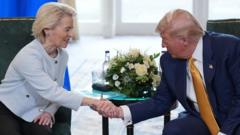
Last July, a handshake at Trump’s Scottish golf course was supposed to bring "peace for our time" in the transatlantic trade relationship. The Turnberry Agreement set a 15 percent tariff cap on most goods, a compromise that offered European automakers some breathing room. However, the legal foundation of that peace was shaky from the start. Earlier this year, the Supreme Court ruled 6-3 that the President lacked the authority to impose broad tariffs under the International Emergency Economic Powers Act (IEEPA).
Rather than backing down, the administration has pivoted. By utilizing substitute authorities—specifically Section 232 national security investigations—the White House is circumventing the court’s ruling. The logic is simple: if the tariffs cannot be "emergency" measures, they will be "security" measures. This administrative gymnastics has left Brussels in a state of paralysis. European Commission President Ursula von der Leyen now faces an American administration that views signed agreements not as settled law, but as temporary pauses in an ongoing offensive.
Why the German Auto Giants are Bleeding
For BMW, Mercedes-Benz, and Volkswagen, the math is becoming impossible. In 2025 alone, these three giants faced combined losses of $6 billion due to previous tariff iterations. A jump to 25 percent creates a price gap that cannot be bridged by mere cost-cutting or currency hedging.
Consider a high-end SUV manufactured in Stuttgart with an MSRP of $80,000. Under the new regime, the import duty alone could add $20,000 to the cost before it even hits a dealer lot. While German parent companies have been quietly subsidizing their American subsidiaries to keep prices stable, those reserves are not infinite. We are reaching the "break-even" point where it becomes more profitable to stop exporting specific models to the U.S. entirely.
The President’s social media posts make the objective clear: "if they produce Cars and Trucks in U.S.A. Plants, there will be NO TARIFF." This is an ultimatum aimed at the boardrooms in Munich and Wolfsburg. The administration is betting that the fear of losing the U.S. market—which remains the world's most lucrative for luxury vehicles—will outweigh the massive capital expenditure required to build new assembly lines on American soil.
The Iran Subtext and Geopolitical Leverage
There is a growing consensus among trade analysts that this tariff hike isn't just about cars; it's about the Strait of Hormuz. Since the U.S. and Israel began strikes in late February, the global economy has been squeezed by skyrocketing oil prices. European leaders, particularly in France and Germany, have been hesitant to fully align with Washington’s military posture in the Middle East.
In this context, the 25 percent car tariff looks less like a trade dispute and more like a "loyalty tax." By threatening the crown jewel of the European economy, the White House is signaling that trade cooperation is contingent on military and diplomatic alignment. It is a brutal form of 21st-century statecraft where the price of a Porsche is tied to the price of Brent Crude.
The Domestic Fallout and the Inflation Trap
The irony of this policy is the "friendly fire" it inflicts on the American consumer. Trump returned to office on a promise to tame the post-pandemic inflation that plagued his predecessor. However, by March 2026, annual inflation hit 3.3 percent, driven largely by energy costs and the ripple effects of existing tariffs on steel and aluminum.
Adding a 25 percent tax to imported vehicles—and the inevitable retaliatory taxes the EU will likely place on American exports—is inherently inflationary. Even "domestic" vehicles aren't safe; most American-made cars rely on a global supply chain for sensors, specialized alloys, and electronics. When the cost of these components rises, the MSRP of a Ford or a Chevy follows suit. Kelley Blue Book data already shows a 10.4 percent increase in average vehicle prices over the last year. This tariff hike will almost certainly push that number higher, right as voters head to the polls.
The Coming Retaliation
Brussels has spent months "monitoring" the situation, but the time for observation is over. The EU's Anti-Coercion Instrument, a tool designed specifically for this type of trade pressure, is now on the table. Expect the EU to target politically sensitive American industries. This usually means bourbon from Kentucky, Harley-Davidsons from Wisconsin, and agricultural products from the Midwest—states that are critical to the Republican coalition.
However, Europe is in a weaker position than it was during the first trade wars of 2018. Energy costs in the EU remain volatile, and the loss of the Russian market has already thinned their margins. A full-scale trade war with the United States could be the catalyst that pushes the Eurozone into a deep recession.
The Bottom Line for the Industry
The automotive industry is no longer a world of "just-in-time" logistics; it is a world of "just-in-case" survival. Manufacturers are already diversifying. Toyota and Stellantis have moved billions into U.S. facilities, but those transitions take years, not weeks. For the smaller European players and the luxury brands that rely on the prestige of "Made in Germany" or "Made in Italy" labels, there is no easy escape.
The 25 percent tariff wall is being built, and the gate is closing. Companies that fail to adapt to this localized manufacturing model will find themselves priced out of the American dream. The consumer will pay the bill, the manufacturers will take the hit, and the map of global industry will be redrawn by tweet and executive order.
This video provides the immediate reaction from European finance ministers regarding the escalating trade tensions and their plans for potential countermeasures against U.S. tariffs.


