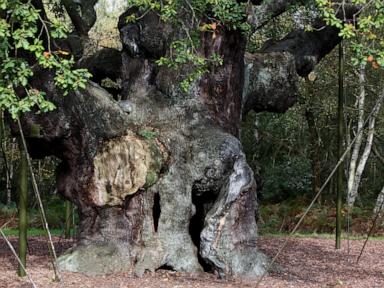
The Collapse of a Living Legend
An ancient oak tree deep within the historic heart of Nottinghamshire, long celebrated in local folklore as a canopy that once sheltered Robin Hood and his outlaws, has officially been pronounced dead. For centuries, this physical monument stood against the elements, surviving fires, political upheaval, and industrial revolutions. Yet its final demise was not caused by a sudden storm or an act of vandalism. It died slowly, suffocated by the very forces supposedly tasked with its protection.
The loss of this legendary oak exposes a critical failure in how we manage our ancient woodland ecosystems. Across the country, heritage trees are quietly failing due to a toxic mix of soil compaction, climate stress, and bureaucratic negligence. We treat these ancient organisms as static tourist attractions rather than dynamic, fragile biological structures. When a medieval tree dies, we lose more than just a historical marker. We lose a complex habitat that took upwards of eight centuries to form, and one that cannot be replaced by planting a million saplings.
The Hidden Killers in the Soil
To understand why this ancient oak died, one must look beneath the surface. Tourism boards and conservation charities love to build pathways, fences, and visitor centers around famous trees. They want to maximize foot traffic. This creates a hidden ecological disaster.
Every year, hundreds of thousands of tourists march around the base of these ancient giants. Their boots pack the earth tight. Over decades, this process creates an impermeable layer of soil known as compaction.
Healthy soil is porous. It resembles a sponge, filled with tiny pockets of air and water that allow roots to breathe and absorb nutrients. When soil is compacted, those vital air pockets vanish. The roots are effectively choked. Without oxygen, the tree cannot maintain the massive hydraulic pressure required to pump water hundreds of feet into the upper canopy. The top branches die first, a condition arborists call dieback. It is a slow, agonizing starvation.
Furthermore, artificial barriers often disrupt the delicate fungal networks beneath the forest floor. These mycorrhizal fungi form a symbiotic relationship with the oak roots, trading essential minerals for tree sugars. When we disturb the soil chemistry with heavy foot traffic or synthetic fertilizers used to keep visitor lawns green, we kill these fungal allies. The tree is left isolated, stripped of its underground support system.
The Bureaucracy of Decay
When a heritage tree begins to show signs of distress, the response from management organizations is often painfully slow and weighed down by red tape. Committees argue over budgets. Consultants draft endless reports. Meanwhile, the organism continues to deteriorate.
In the case of this historic oak, local arborists warned management officials years ago that the tree was showing severe symptoms of acute oak decline. This condition is triggered by a combination of environmental stress, boring beetles, and opportunistic bacterial pathogens. The solution required immediate, aggressive intervention. Experts recommended radical soil de-compaction, the application of organic mulch, and the creation of a wide exclusion zone to keep the public away from the root system entirely.
Instead, the governing bodies opted for half-measures. They feared that a larger exclusion zone would hurt visitor numbers and reduce gift shop revenue. They installed a few wooden props to support the heaviest limbs and put up a small informational sign. They chose aesthetics and commerce over biological survival.
By the time they approved a more comprehensive conservation plan, it was far too late. The vascular system of the oak had collapsed. The props held up dead wood.
The Illusion of Offset Conservation
Politicians and corporate developers frequently use the promise of tree planting to justify the destruction or neglect of older woodlands. They claim that planting ten new saplings offsets the loss of one ancient giant. This is a scientific lie.
An ancient oak is an entire ecosystem in itself. A single tree can support over two thousand distinct species of birds, mammals, insects, fungi, and lichens. Many of these species are highly specialized and can only survive on decaying wood that has been aging for at least three centuries. A sapling cannot provide this.
- Insects: Hundreds of rare beetle species rely exclusively on the hollow heartwood of ancient trees.
- Lichens: Many slow-growing lichens require the stable, rough bark of an old oak to establish colonies over generations.
- Birds and Bats: The natural cavities formed by dropped limbs provide essential nesting sites that do not exist in managed, young forests.
When a medieval oak dies, that specific biological network vanishes from the area. Replacing it with young trees is like tearing down a historic cathedral and claiming a pile of new bricks has equal cultural and functional value. The continuity is broken.
Climate Pressures are Accentuating the Crisis
We can no longer ignore the shifting climate when discussing the survival of our remaining ancient trees. Oaks are resilient, but they evolved to handle predictable seasonal patterns. The extreme weather events of the past decade have pushed these weakened giants to their absolute limits.
Prolonged summer droughts bake the already compacted soil, turning it into stone. This prevents whatever little rainfall does occur from penetrating the deeper root zones. When the drought is immediately followed by torrential, unseasonal flooding, the water sits on the surface, rotting the shallow roots that are desperately trying to breathe.
These climate swings leave the trees immunocompromised. Just like humans, a stressed tree has a weaker defense mechanism. Weakened oaks cannot produce enough tannin and sap to repel boring insects or fight off fungal spores. Diseases that an oak would normally tolerate become fatal diagnoses.
A Radical Shift in Heritage Arboriculture
If we want to save the remaining ancient trees that scattered across our historic woodlands, we must abandon the current tourism-first model. We need to implement immediate, uncompromising changes to how these sites are run.
First, public access must be severely restricted. The area directly beneath the drip-line of any tree older than four hundred years should be completely off-limits to human feet. Boardwalks elevated several feet above the ground can allow visitors to view the trees without stepping on the root systems, but even these must be kept at a distance to prevent soil vibration.
Second, we must prioritize soil health over visual perfection. Dead wood that falls from the tree should be left where it lands to rot naturally, returning nutrients to the soil and fostering the necessary fungal networks. Removing fallen branches to make a park look tidy is ecological sabotage.
The death of the legendary Robin Hood oak is a stark warning. It proved that old age alone does not kill these giants; our collective mismanagement does. If we continue to treat our living history as mere photo opportunities, we will watch the rest of our ancient forests crumble into dust, one historic icon at a time.


