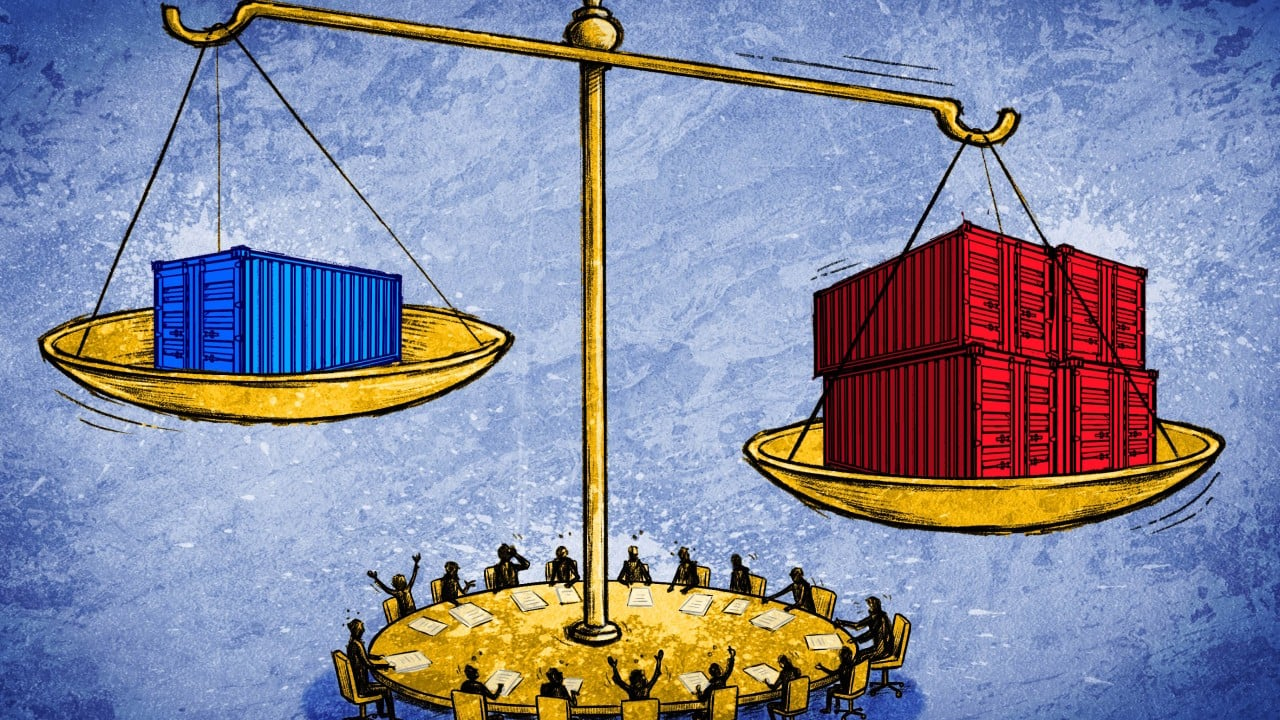
The European Union is marching into a full-scale trade war with China, but Brussels is fundamentally miscalculating its opponent. Policymakers in Europe believe that targeted tariffs on electric vehicles, solar panels, and wind turbines will shield domestic manufacturing from Beijing’s industrial overcapacity. This strategy will fail. Tariff walls cannot solve Europe's core structural weaknesses, which include exorbitant energy costs, fragmented capital markets, and a crippling lack of raw material independence. Instead of forcing Beijing to scale back production, Europe’s aggressive trade maneuvers will likely accelerate the decline of its own industrial base while driving consumer costs higher.
The Flawed Logic of Defensive Tariffs
Brussels operates under the assumption that trade defense instruments can level the playing field. When the European Commission launched its anti-subsidy probe into Chinese electric vehicles, it uncovered a vast network of state-directed credit, cheap land allocation, and direct equity injections. The resulting tariffs were designed to offset these unfair advantages.
The strategy ignores decades of economic history. Tariffs do not make a domestic industry more competitive; they merely grant it a temporary, artificial reprieve. European automakers are currently grappling with structural disadvantages that no tariff can fix. Energy prices in Germany remain double or triple those in the United States or China. Labor regulations lack flexibility. By shielding domestic legacy carmakers from foreign competition, Europe risks incentivizing complacency rather than forcing the radical innovation required to survive.
Beijing treats industrial dominance as a matter of national security, not just commercial profit. When faced with European tariffs, Chinese manufacturers do not simply pack up and go home. They adapt.
The Subsidies Are Already Sunk
To understand why Europe's trade defenses are hitting a wall, one must look at how China structures its industrial policy. The capital has already been deployed. Beijing has spent over a decade building massive supply chains that control everything from raw lithium processing to final vehicle assembly.
Consider the supply chain for a standard lithium-iron-phosphate battery. Chinese firms control over 70 percent of the global refining capacity for the critical minerals that power these units. Even if Europe slaps a 35 percent tariff on a finished vehicle, Chinese manufacturers still hold a massive margin advantage due to their total vertical integration. They can afford to absorb the tariff hit to maintain market share.
European factories rely on imported components. A factory in Saxony or northern France assembling an electric vehicle is often just bolting together parts that were refined, processed, and partially manufactured in Asia. By triggering a retaliatory cycle, Europe risks cutting off its own access to the very components its green transition requires.
Beijing Retaliation Blueprint
China rarely responds to trade pressure with a blunt, symmetrical hammer. Instead, it uses surgical strikes designed to exploit political fractures within the European Union.
We are already seeing this playbook in action. When Brussels moved forward with vehicle duties, Beijing immediately launched targeted anti-dumping investigations into European pork, dairy, and brandy. This choice was highly intentional. The agricultural sector holds immense political sway in France and Spain, two nations that heavily backed the anti-subsidy duties. By squeezing these specific industries, Beijing creates intense domestic political pressure on European leaders, turning local farmers into lobbyists against their own governments.
The Mineral Weapon
The real danger lies in critical raw materials. China holds a near-monopoly on the processing of rare earth elements, gallium, and germanium. These materials are essential not just for civilian electronics, but for defense manufacturing, advanced radar systems, and wind turbines.
+-------------------+-----------------------------+
| Material          | Global Processing Share     |
+-------------------+-----------------------------+
| Rare Earths       | ~90%                        |
| Gallium           | ~98%                        |
| Germanium         | ~60%                        |
+-------------------+-----------------------------+
Beijing has already established an export permit system for these metals. If Europe escalates the trade fight, China can quietly restrict the export of these essential precursors. A European aerospace firm or defense contractor cannot source these minerals from alternative suppliers overnight. Building processing facilities takes years, requires massive capital, and involves navigating mountains of environmental permits. China can shut down European assembly lines with the stroke of a pen in Beijing.
The Trojan Horse Strategy
Instead of retreating, Chinese industrial giants are bypassing tariff walls entirely through direct investment within Europe's borders. This is the Trojan Horse strategy.
Major Chinese battery manufacturers and vehicle brands are currently constructing massive production facilities in Hungary and Poland. By manufacturing inside the EU, these companies completely evade the newly imposed tariffs. They also secure lucrative local subsidies provided by European taxpayers who are desperate for regional job creation.
This creates a bizarre paradox. European policies intended to protect local industry are instead forcing Chinese competitors to establish deep roots inside the European single market. Once these factories are fully operational, they will compete directly with legacy European manufacturers on their own turf, utilizing superior supply chains and highly optimized production processes. The jobs created will be European, but the intellectual property, profits, and supply chain control will remain anchored in Shenzhen and Shanghai.
The Energy Trap
Europe's industrial crisis is fundamentally an energy crisis. The loss of cheap Russian pipeline gas stripped European heavy industry of its primary competitive advantage.
A manufacturing plant in the Ruhr Valley cannot compete with a counterpart in Xinjiang that has direct access to cheap, coal-fired power or heavily subsidized local solar arrays. Automation requires immense amounts of electricity. As European factories attempt to automate to offset high labor costs, their power bills skyrocket.
The European Union's regulatory framework compounds this issue. The Carbon Border Adjustment Mechanism aims to tax carbon-intensive imports, but it also increases the cost of primary inputs like steel and aluminum for domestic manufacturers. European companies are trapped in a regulatory vice, squeezed by high compliance costs from Brussels and aggressive pricing from Beijing.
A Fragmented Capital Market
Washington can counter China's industrial push because the United States possesses a massive, unified capital market capable of funding high-risk technological bets. Europe does not.
The European financial system remains deeply fragmented along national lines. A startup in Milan faces completely different funding hurdles than one in Stockholm. Venture capital in Europe is risk-averse, preferring safe, incremental improvements over radical, capital-intensive industrial transformations.
Without a true Capital Markets Union, Europe cannot mobilize the hundreds of billions of euros needed to build independent supply chains. The public funds available through national governments are restricted by strict state-aid rules designed to prevent wealthy member states like Germany from outspending poorer neighbors. This internal friction paralyzes Europe's collective economic leverage.
The Transatlantic Wildcard
Europe is fighting this trade battle completely isolated. Washington is pursuing its own aggressive protectionist agenda, which treats European industrial exports with a similar level of suspicion.
The US Inflation Reduction Act explicitly lures European clean-tech companies across the Atlantic with massive tax incentives. European manufacturers are faced with a stark choice. They can stay in Europe and face high energy costs and Chinese competition, or they can move their production facilities to the United States to capture American subsidies. This drain of capital and talent is actively hollowing out the European industrial core from the inside out.
The High Cost of the Green Transition
The European Union has legally bound itself to aggressive decarbonization targets. Meeting these goals requires an unprecedented deployment of solar panels, wind turbines, and electric vehicles.
European Decarbonization Dilemma:
[Aggressive Climate Targets] ---> Requires Cheap Technology
[Trade Tariffs on China]     ---> Makes Technology Expensive
Result: The transition stalls, or consumers pay the price.
If Europe completely blocks cheap Chinese imports, the cost of the green transition will soar. Local governments will struggle to fund public transit electrification. Utility companies will slow down the construction of solar farms due to inflated hardware costs. European consumers, already weary from years of high inflation, will face steeper prices for vehicles and household energy. Brussels is discovering that it cannot have a cheap, rapid green transition while simultaneously waging a protectionist trade war against the world's primary manufacturer of green technology.
Structural Reform Over Protectionism
Tariffs are an admission of defeat. They signal that a trading bloc can no longer compete on price, innovation, or efficiency.
If Europe wants to survive the coming decades as a relevant economic power, it must stop relying on trade defense mechanisms as a substitute for real industrial policy. It needs to radically deregulate its energy sector to bring baseline costs down. It must finalize the Capital Markets Union to unlock trillions of euros in private investment. Most importantly, it needs to streamline the bureaucratic permitting processes that currently turn a three-year factory construction project into a decade-long legal saga.
The current strategy of defensive skirmishing is simply managing Europe's industrial decline rather than reversing it. Beijing understands this reality perfectly. Every tariff slapped on a Chinese import is met with a quiet pivot toward a new vulnerability in the European economic model. Europe is bringing legal briefs to a knife fight, and the clock is ticking down on its manufacturing relevance.