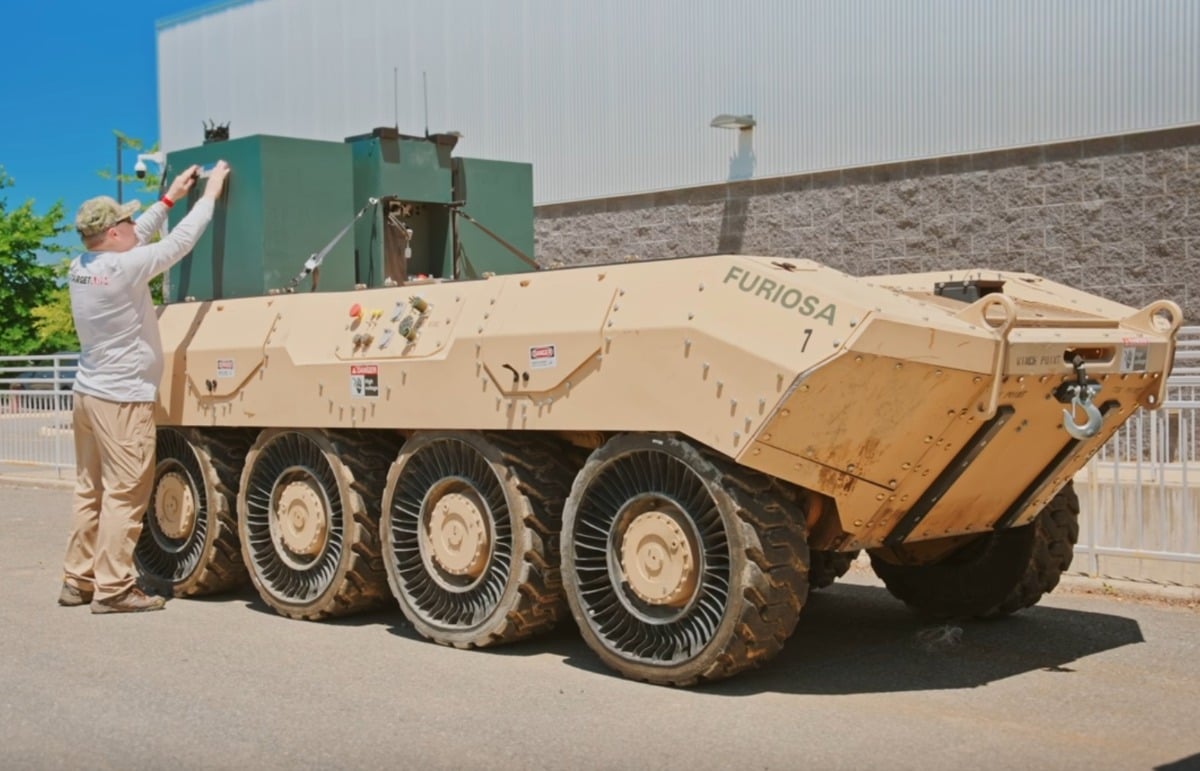
Military and industrial automation is undergoing a quiet shift. Engineering teams are pairing autonomous ground vehicles with aerial drones to solve a fundamental limitation of modern robotics: ground units have unmatched payload capacity but terrible vertical visibility, while quadcopters possess speed and height yet run out of battery in minutes. Ground robots acting as mobile charging nests and launch pads for aerial drones eliminate the need for fixed infrastructure. This architecture lets a heavy rover handle the rough terrain, heavy compute, and primary power generation, while deploying small flyers to scout ahead, inspect elevated structures, or map complex spaces.
Industry press releases celebrate this convergence as a minor miracle. The reality on the factory floor and the contested perimeter is far messier.
The Mechanical Bottleneck
Building a mechanical system that can dock, secure, and recharge a flying drone on top of a moving, vibrating chassis is a masterclass in frustration. Dust accumulates. Wind shears create turbulence directly above the vehicle. Docking pins misalign by millimeters, and a multi-million-dollar deployment stalls in the mud.
Engineers face a constant battle against physical debris. When a heavy ground robot trundles through construction debris or agricultural soil, it kicks up particulate matter. That dust coats landing pads, fouls charging contacts, and jams mechanical locking latches.
- Contact Corrosion: Outdoor elements degrade electrical pins rapidly.
- Vibration Fatigue: Continuous diesel or electric motor rumble shakes sensor calibration loose.
- Thermal Throttling: Enclosed charging bays overheat quickly under heavy electrical load.
Power Math That Fails on the Ground
Conservation of energy remains an unforgiving master. A ground robot carrying a heavy battery pack possesses significant energy reserves, but transferring that power wirelessly or via physical contacts to a secondary aerial vehicle introduces massive conversion losses.
Inductive charging pads lose efficiency rapidly with distance and angular misalignment. If a drone lands slightly crooked on the mobile base, inductive transfer rates plummet, and heat generation spikes. Direct pin connections solve efficiency issues but introduce moving parts prone to mechanical failure.
Operating in remote environments magnifies these flaws. When a charging relay fails three miles from the nearest human technician, the entire combined system becomes dead weight. Redundancy adds weight. Weight drains the main vehicle battery faster.
Software Integration Nightmares
Hardware failures are loud and immediate. Software integration failures are silent, creeping, and catastrophic.
Merging the telemetry of a tracked or wheeled ground unit with a six-axis aerial drone requires translating entirely different coordinate frames, latency constraints, and control loops. Ground navigation relies on slow, deliberate path planning around obstacles. Aerial navigation relies on millisecond adjustments to wind gusts and altitude changes.
When both systems share a single autonomy stack, debugging sensor conflicts turns into detective work across multiple operating systems. Operators report instances where the ground vehicle’s obstacle avoidance routine commands a sudden stop while the newly launched drone expects a stable, moving launch platform. The result is an aerial collision with the host vehicle.
The Security Vulnerability Nobody Mentions
Mobile drone nests introduce a unique cyber-physical attack vector. A ground robot moving through public or semi-secured areas presents a tempting physical target. If an adversary intercepts or overrides the wireless handshake between the drone and the ground base, they gain access to the primary network node.
Furthermore, acoustic and electromagnetic signatures double. A machine emitting both ground-level mechanical noise and high-pitched rotor whines is trivial to detect by electronic surveillance or thermal imaging. Stealth evaporates when pairing two distinct acoustic profiles into a single operational unit.
Deploying these systems outside controlled laboratory environments demands rigorous stress testing against electronic jamming and physical tampering. Most commercial prototypes fail these basic field hardening metrics.
Economic Realities
Budgets dictate reality. Combining two complex robotic platforms into an integrated ecosystem multiplies procurement, maintenance, and training costs.
Organizations frequently discover that purchasing two separate, specialized teams—one set of manual ground operators and one set of basic drone pilots—costs less and yields higher reliability than deploying a fragile, integrated automated pairing. Complexity has a direct price tag. Every additional point of mechanical failure increases lifecycle maintenance overhead by an exponential factor.
The market will eventually stabilize around modular, standardized docking interfaces rather than proprietary towers bolted to specific chassis. Until interoperability standards emerge, early adopters will continue paying the heavy tax of custom integration work.
Engineering progress happens through brutal iterations of failure. The mobile drone base concept is sound in theory, yet the physical world resists easy synthesis.