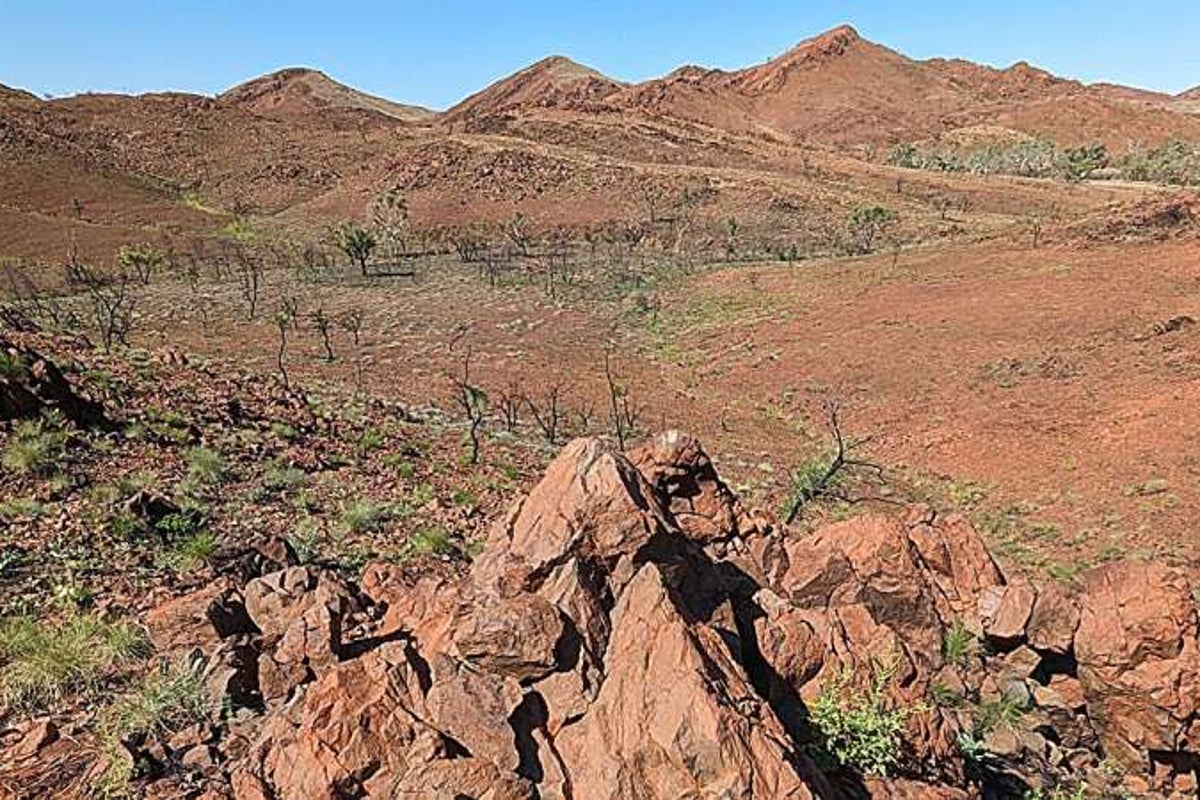
Geologists thought they had found the smoking gun of Earth's violent infancy in Greenland's Maniitsoq structure, a three-billion-year-old scar initially declared the oldest asteroid impact crater on the planet. Recent exhaustive field research and advanced geochemical analysis have entirely dismantled that claim, proving the feature is the result of ordinary, deep-crustal magmatic processes rather than a cosmic collision. This scientific reversal exposes a systemic flaw in how we hunt for ancient impact sites. The frantic race to locate early Earth craters routinely mistakes deep-seated tectonic wounds for astronomical scars, muddying our understanding of the planet's formative years.
The Maniitsoq Illusion and the Rush for Prestige
Discovering an ancient impact site brings immense academic prestige and funding. In 2012, a team of international researchers announced that a massive circular anomaly near the town of Maniitsoq in western Greenland was actually a 3-billion-year-old impact crater. If true, it beat the previous record-holder—South Africa’s Vredefort crater—by nearly a billion years. The scientific community initially embraced the news because it filled a glaring gap in our geological record.
We know the early Moon was battered by giant space rocks during the Late Heavy Bombardment because its lack of atmosphere and tectonic activity preserved the evidence perfectly. Earth should have suffered an even more brutal pummeling. Yet, our planet's relentless tectonic conveyor belt continually subducts, melts, and recycles the crust. This constant renewal wipes away the physical evidence of ancient impacts, leaving geologists searching for needles in a shifting, multi-billion-year-old haystack.
The Maniitsoq claim rested on a series of circumstantial observations. Researchers pointed to crushed rocks, widespread alteration of minerals, and large-scale circular fractures visible from satellite imagery. It looked like an impact site on the surface. But looking like a crater is not enough to prove a crater exists.
The Microscopic Evidence That Shattered the Myth
Science requires definitive proof to validate an impact site. Geologists look for specific shock metamorphic effects that only occur under the extreme, instantaneous pressures generated by a hypervelocity space rock striking solid ground.
- Shocked Quartz: Planar deformation features (PDFs) in quartz crystals that form when immense shockwaves realign the atomic structure of the mineral.
- Cone Fractures: Distinctive cone-shaped shatter cones in surrounding bedrock that point toward the center of the blast.
- Meteoric Fingerprints: Elevated concentrations of platinum-group elements, particularly iridium, that match the chemical profile of chondritic meteorites.
To test the Maniitsoq hypothesis, an independent team led by the Geological Survey of Denmark and Greenland embarked on a multi-year re-evaluation. They analyzed thousands of zircon grains, a resilient mineral that acts as a microscopic time capsule. If a massive asteroid had struck the region 3 billion years ago, the zircons would display widespread shock textures and recrystallization patches.
They found absolutely nothing of the sort. The zircons showed normal, slow growth patterns consistent with deep-crustal igneous activity. The massive rock crushing previously attributed to an asteroid was actually the result of ancient fault lines grinding against each other over millions of years, deep within the Earth's interior. The intense heat had not come from the sky; it had leaked up from the mantle.
Why We Misread the Ancient Earth
The collapse of the Maniitsoq impact theory highlights a deeper structural problem within modern geochronology. As we look further back in time, the boundary between the effects of external cosmic impacts and internal tectonic forces blurs significantly.
Consider a hypothetical scenario where an analyst tries to determine the cause of a structural failure in a concrete building that collapsed billions of years ago. A sledgehammer blow and a slow foundation shift might produce similar-looking cracks in the remaining dust. Without looking at the microscopic fractures within the aggregate material, the analyst is just guessing.
On an ancient Earth, deep-seated magma chambers, intense regional metamorphism, and violent tectonic shearing produced macro-scale structures that mimic the shockwaves of an asteroid. When researchers rely too heavily on large-scale structural mapping and satellite data, confirmation bias easily takes over. They see a circle and assume a falling rock, ignoring the fact that rising plumes of molten rock also form circular footprints.
The True Record Holders Stand Alone
With Maniitsoq officially debunked, the title of Earth's oldest known impact crater reverts to the Vredefort dome in South Africa, safely dated to approximately 2.02 billion years old. Following closely behind is the Sudbury Basin in Ontario, Canada, at roughly 1.85 billion years old.
| Crater Name | Location | Verified Age | Estimated Original Diameter |
|---|---|---|---|
| Vredefort | South Africa | 2.02 Billion Years | 300 kilometers |
| Sudbury | Canada | 1.85 Billion Years | 130 kilometers |
| Chicxulub | Mexico | 66 Million Years | 180 kilometers |
These verified sites do not rely on ambiguous regional geometry. They possess ironclad microscopic proof. At Vredefort, shatter cones are so massive and well-defined that they are easily visible to the naked eye across entire hillsides. The Sudbury site contains thick layers of impact melt rock filled with nickel and copper deposits that were superheated instantly by the kinetic energy of a celestial body.
Finding anything older than Vredefort requires moving away from the hunt for physical craters entirely. Instead, researchers must look for spherule layers. When an ancient asteroid struck the ocean or the crust, it vaporized billions of tons of rock. This vapor cloud shot into the upper atmosphere, condensed into tiny glass droplets, and rained back down across the entire globe.
Scientists have found these ancient spherule beds in Western Australia and South Africa, dating back 3.4 billion years. The craters that spawned them are long gone, swallowed by subduction zones or ground into dust by glaciers. The microscopic glass droplets are all that remain of the violence.
The Flawed Incentive Structure of Discovery
The scientific rush to validate unproven craters points to a systemic issue in academic publishing. High-profile journals favor spectacular, record-breaking announcements over methodical, negative results. A paper claiming to find the oldest crater on Earth guarantees global headlines, institutional prestige, and subsequent grant money. A paper proving that a region is just ordinary granite does not.
This dynamic creates a hostile environment for rigorous skepticism. The team that debunked Maniitsoq spent years collecting samples, analyzing data, and securing funding simply to prove a negative. Their work corrected the historical record, but it required an immense expenditure of resources to undo a claim that should have been subjected to stricter scrutiny before its initial publication.
Future searches for early Earth impacts must abandon the top-down approach of looking for large circular structures on maps. The crust is too warped, eroded, and broken for large-scale morphology to be a reliable guide. True verification belongs strictly to the mineralogists operating at the micron scale. If the atomic lattice of a crystal does not show the violent signature of a cosmic hammer blow, the crater simply does not exist, no matter how perfect the circle looks from space.