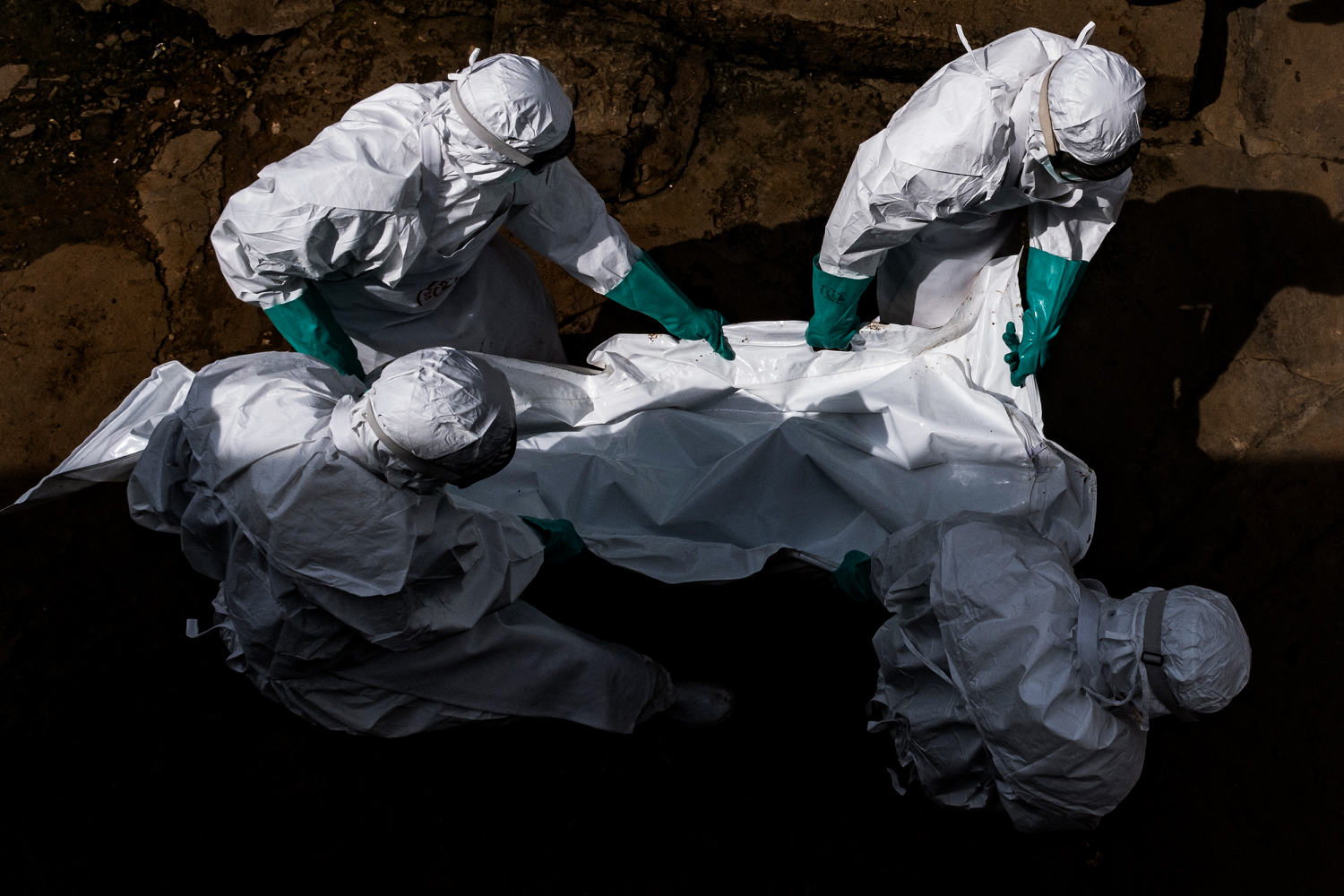
The current Ebola outbreak in Central Africa is pacing to mimic the deadliest global health emergency in modern history, with fresh data indicating it could breach 20,000 cases in less than 90 days if immediate containment strategies falter.
According to new predictive modeling issued by the U.S. Centers for Disease Control and Prevention, the epidemic raging through the Democratic Republic of Congo and neighboring Uganda is following a catastrophic trajectory. The core issue is isolation speed. If the international community and local ministries fail to isolate at least 70% of infected individuals within 48 hours of symptom onset, the virus will likely spiral beyond control, threatening to replicate the horrors of the 2014 West Africa disaster. Discover more on a related issue: this related article.
The Ghost of 2014 Returns
The numbers coming out of the CDC Center for Forecasting and Outbreak Analytics are unsparing. Computer simulations demonstrate a 65% probability that the epidemic will eclipse 20,000 cases and cause a minimum of 4,000 deaths by the end of August if isolation compliance stays near the current baseline of 20%.
This is not a theoretical alarm. It is a mathematical certainty based on current transmission mechanics. More reporting by National Institutes of Health explores comparable views on the subject.
The benchmarks are terrifying. A decade ago, the West African Ebola epidemic infected more than 28,000 people and claimed 11,000 lives. That crisis reshaped global health policy. Today, public health officials are looking at models that show a nearly identical path toward mass casualties, yet the public attention span seems completely exhausted by years of pandemic fatigue.
Epidemiologists tracking the crisis point out that the window to suppress the transmission vector is closing rapidly. Dr. Satish Pillai, the CDC’s incident manager for the response, noted that while the domestic threat to Western nations remains minimal for now, that calculation shifts the moment the pathogen hitches a ride into a major regional transit hub with international flights.
Why the Old Playbook is Failing
The international community is treating this like a standard medical emergency. It is not. It is a security and geopolitical crisis disguised as a viral outbreak, and applying a purely clinical template to the Ituri province of the DRC is a recipe for catastrophic failure.
The Bundibugyo Variable
Unlike the familiar Zaire strain of Ebola that struck West Africa and saw the deployment of highly effective Ervebo vaccines, the current crisis is driven by the Bundibugyo virus.
There is no approved vaccine for Bundibugyo. There are no proven antiviral therapeutics sitting in stockpiles ready for deployment. Medical personnel on the ground are fighting a hemorrhagic fever with nothing but supportive care—intravenous fluids, electrolyte replacement, and pure optimism.
Armed Conflict and Broken Trust
The epidemic is centered in an active war zone. The eastern DRC is home to a tangled web of dozens of armed rebel groups, including the Allied Democratic Forces, which routinely orchestrate massacres and displace entire villages.
When people are running for their lives from gunfire, they do not stay in medical isolation units. They flee into dense forests or crowded displacement camps, carrying the virus with them. Contact tracing—the foundational backbone of any containment strategy—becomes practically impossible when trace teams risk ambush and execution just by driving down a rural road.
"The scope of the outbreak is likely larger than that represented by available data and might prove challenging to contain and control," the CDC stated in its recent briefing papers.
This is bureaucratic understatement for a grim reality. We are flying completely blind.
The Cold Math of Containment
To understand how this ends, one must understand the basic reproduction number ($R_0$) under current field conditions. The mathematics of the CDC's models demonstrate that the size of this outbreak is directly tethered to a single metric: the time between the first drop of sweat and the locking of an isolation ward door.
| Isolation Rate within 48 Hours | Probability of Exceeding 10,000 Cases | Projected Deaths (3 Months) |
|---|---|---|
| 20% (Current Estimate) | 85% | $\ge$ 4,000 |
| 50% (Moderate Improvement) | High Probability | ~ 2,000 to 4,000 |
| 70% (Target Threshold) | 6% | < 2,000 |
If health workers can push the isolation rate to 70%, there is a 94% probability of keeping the outbreak under the 10,000-case mark.
Achieving that requires an immense, sustained influx of cash and logistics that simply has not materialized. The World Health Organization and Africa CDC recently announced a joint response plan aiming to raise $518 million to sustain operations through November. Historically, these funding appeals take months to fill, while the virus duplicates exponentially every few days.
The Fragility of the Global Safety Net
We are fundamentally in a weaker position to handle this than we were two years ago. Humanitarian budgets are stretched thin by competing global conflicts, and the political appetite for multi-million-dollar foreign health interventions has evaporated.
Local health workers in the DRC and Uganda are doing heroic work, but heroism does not buy personal protective equipment or build secure field hospitals. The current case-fatality rate is hovering around 16%, but that number is artificially depressed because hundreds of suspected deaths in remote areas are going completely unrecorded. The real death toll is already much higher.
If the virus breaches the security cordons and establishes a foothold in major East African urban centers, the current models will look conservative. Densely populated cities with high mobility rates turn linear transmission chains into explosive, multi-directional webs. The international community is currently betting its safety on the hope that regional borders and active militia warfare will somehow keep the virus contained in remote provinces. Hope is not a public health strategy.
The warning from the CDC is clear, grounded in data, and terrifyingly familiar. The world has the blueprint to stop an epidemic of this scale, but possessing knowledge is meaningless without the political courage and financial capital to deploy it into a war zone before the numbers become unmanageable.