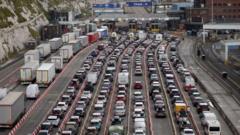
The Port of Dover is currently hurtling toward a massive summer travel crisis, driven by a perfect storm of technical paralysis, political finger-pointing, and the introduction of the European Union’s Entry/Exit System (EES). The core issue is simple: the port has built a custom £40 million biometric processing facility to handle peak tourist flows, yet the French government has failed to activate the database technology needed to run it. As a result, French border guards are forced to manually register UK passengers, turning a high-tech border into a manual checkpoint that can take hours to clear.
With summer traffic expected to peak at over 10,000 cars a day, the narrow roads of Kent are poised to become a sprawling parking lot.
The £40 Million White Elephant at the Western Docks
In preparation for the post-Brexit border shift, the Port of Dover undertook a massive engineering effort. This involved reclaiming land from the sea and constructing a state-of-the-art terminal at the Western Docks, specifically designed to process car passengers under the new EES rules.
EES requires non-EU citizens, including British travellers, to register their fingerprints and facial biometric data upon entering the Schengen Area. The new site was equipped with 84 biometric kiosks designed to capture this data quickly.
These kiosks currently sit dark.
The French authorities have not activated the database integration or deployed the specific tablets required to process the data from these kiosks. Without this software link, the £40 million facility is entirely unusable for car travellers. The port is instead forced to channel thousands of daily vehicles through just 11 manual border positions. It is an administrative bottleneck of historic proportions, transforming a minor inconvenience into a systemic failure of cross-Channel transit.
The Physical Reality of Juxtaposed Controls
Unlike most international travel where border checks occur upon arrival, Dover operates under a system of "juxtaposed controls" established by the Treaty of Canterbury and the Treaty of Le Touquet. This means French border police, the Police aux Frontières, conduct their passport and security checks on UK soil before passengers board the ferries.
While this prevents illegal entry issues on French soil, it shifts the entire physical burden of European border enforcement onto a cramped, cliff-bound strip of the Kent coast.
The physical space inside the Eastern Docks is strictly finite. When processing times spike, there is nowhere for the cars to go. The queue instantly spills backward onto the A2 and A20 dual carriageways, paralyzing the town of Dover and blocking critical freight corridors.
The physical math of the delay is brutal:
| Processing Method | Estimated Time Per Car | Vehicles Processed Per Hour | Resulting Queue Impact |
|---|---|---|---|
| Pre-Brexit checks | 30 to 40 seconds | Up to 100 per lane | Free-flowing traffic |
| Current manual checks | 2 to 4 minutes | Under 30 per lane | Tailbacks onto public highways |
| Fully operational EES | 3 to 5 minutes | Variable | High risk of gridlock |
Biometrics and the Math of Delay
Under the EES rules, every passenger in a vehicle must have their facial image captured and four fingerprints scanned during their initial registration.
The physical process of doing this inside a car is inherently clumsy. Unlike an airport terminal where passengers stand at a fixed counter, a driver and passengers must lean out of car windows, or step out of the vehicle entirely, to reach mobile tablets or kiosks.
If a family of four takes three minutes to register, and 10,000 cars arrive on a Saturday, the port faces 30,000 minutes of cumulative processing time. No amount of lanes can absorb that math without causing severe delays. This explains why during a May half-term test, a relatively minor surge of 8,500 vehicles caused wait times to skyrocket to four and a half hours.
The Geopolitical Blame Game
The ongoing crisis is not merely a technical glitch. It is a highly charged political dispute.
British officials accuse French authorities of administrative inertia, pointing out that UK taxpayers have funded the physical infrastructure, only for France to drag its feet on providing the necessary IT backend and personnel. On the other side, French officials point to the sheer complexity of integrating a massive new EU-wide database, arguing that they cannot risk system crashes that could compromise European security.
Recently, UK Transport Secretary Heidi Alexander met with her French counterpart, Philippe Tabarot, securing a promise of increased border staffing on UK soil for the summer peak. The UK government has also pledged an extra £20 million to help fund emergency measures and temporary booths.
These are temporary patches on a structural wound.
The only real mechanism preventing total gridlock is Article 9 of the EES regulations. This clause allows French border police to temporarily suspend the biometric registration requirements when queue times threaten public safety or severely disrupt transport infrastructure.
French police have already had to use this emergency valve, pausing the extra checks during high-traffic weekends to let vehicles pass through. However, this discretion is set to expire in September. Once the safety valve is removed, the system will have to absorb the full weight of the new checks without any operational fallback.
What Travellers Must Do to Survive the Summer
With the system operating at absolute capacity, holidaymakers cannot rely on the authorities to solve the problem. Survival during the peak travel weeks of July and August requires deliberate planning.
Time Your Arrival Closely
Ferry operators and port authorities are urging travellers to arrive exactly two hours before their scheduled departure. Arriving five or six hours early in the hope of beating the queue actually worsens the bottleneck. It packs the holding lanes with vehicles that cannot yet board, blocking those who have immediate departures.
Prepare for Long Roadside Delays
Because queueing vehicles will be held on the dual carriageways approaching the port, travellers must prepare for hours of waiting in their cars. This means carrying sufficient water, food, and basic medical supplies.
Understand the Flexi Ticket Policies
Most major ferry operators on the Dover-Calais route, including P&O Ferries and DFDS, automatically transfer passengers to the next available sailing if they are delayed by border queues. Do not panic if you miss your scheduled slot due to traffic. Rushing or attempting dangerous detours on Kent's minor roads will only cause further disruption.
The hard truth is that Dover's geography and the post-Brexit border reality are incompatible with high-speed, high-volume travel. Until the biometric kiosks are fully online and the database issues resolved, the crossing will remain a fragile choke point, highly vulnerable to any surge in passenger volume or staff shortages.


