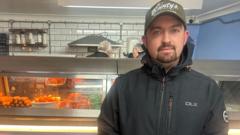
The traditional British fish and chip shop is hitting a breaking point where the cost of a battered cod meets the limits of human patience. When a shop owner in Cardiff recently made headlines for installing self-service kiosks to avoid "abrupt" customers questioning his prices, he wasn't just being sensitive. He was reacting to a fundamental shift in the economics of the high street. The move to automation in the "chippy" sector is less about a love for tech and more about a desperate attempt to survive a volatile cocktail of soaring ingredient costs, rising labor wages, and a public that expects 2019 prices in a 2026 economy.
Fish and chip shops have historically operated on the thinnest of margins, relying on high volume to offset the cheap price of a humble supper. That model is dead. With the price of potatoes, sunflower oil, and white fish doubling or tripling over the last few years, the person behind the counter has become the lightning rod for every customer’s cost-of-living frustration. By removing the human element from the initial transaction, business owners are shielding their staff from abuse while simultaneously streamlining a workflow that can no longer afford a single second of wasted time.
The Psychology of the Digital Shield
When a customer stares at a digital board instead of a person, the dynamic of the transaction changes instantly. You cannot argue with a touchscreen about why a large haddock now costs twelve pounds. The screen is indifferent to your memories of "the good old days." For business owners, this is a strategic defense mechanism.
Front-of-house staff in the food industry are currently facing an epidemic of "price rage." Every time a server has to explain a price hike, it adds thirty seconds to the queue and drains the emotional energy of the worker. In a labor market where finding reliable staff is already a nightmare, losing a good fry-cook or server because they are tired of being shouted at over the price of mushy peas is a risk most owners can't take. The kiosk doesn't get offended, it doesn't need a break, and it never forgets to ask if you want extra salt and vinegar.
Efficiency Over Atmosphere
The nostalgic image of the chippy involves a chatty local character wrapping your meal in yesterday’s news. It is a nice thought, but it is becoming a luxury the industry cannot support. Modern kiosks handle the payment, the tax breakdown, and the kitchen ticket generation in one movement. This allows the skeleton crew in the back to focus entirely on the product.
Efficiency is the only way to counteract the "VAT trap." In the UK, hot takeaway food is subject to 20% VAT, a massive chunk of the revenue that many small businesses struggle to clear while keeping their prices competitive. When you automate the ordering process, you reduce the margin for error. There are no "lost" orders, no misheard requests for "no onions," and no cash handling mistakes. Every penny is accounted for digitally, which is essential for a business fighting for its life in a high-inflation environment.
The Hidden Costs of the Potato Crisis
To understand why a kiosk is necessary, you have to look at the dirt. Potato farming has become a high-stakes gamble. Climate shifts have led to smaller yields and poorer quality crops, forcing wholesalers to hike prices. At the same time, the energy required to run high-output fryers has stayed at historic highs.
A shop owner is looking at a ledger where every single input—from the paper wrap to the tartare sauce—is more expensive than it was six months ago. If they can save £25,000 a year by reducing their front-of-house headcount by one person, that is the difference between staying open and shuttering the windows. It isn't a "game-changer" or a "seamless transition." It is a cold, hard calculation made in a back office under a flickering fluorescent light.
The Death of the Cash Discount
For decades, many independent fish and chip shops survived on the fringes of the cash economy. Digital kiosks kill that. While some might see this as a downside, the reality is that the modern business owner needs the data that comes with digital sales.
Kiosks provide heat maps of when people are buying, what items are being paired together, and which "deals" are actually moving the needle. This data allows for "dynamic menu engineering." If the price of cod spikes on a Tuesday, the owner can update the digital menu across all kiosks in seconds, ensuring they aren't selling at a loss for even an hour. You cannot do that with a chalk board and a busy lunch rush.
Confronting the Service Gap
Critics argue that automation kills the soul of the British high street. They aren't entirely wrong. There is a specific kind of community cohesion that happens in the queue of a local shop. However, that soul is already being eroded by the sheer stress of the current economic climate. A "soulful" shop that goes bankrupt provides zero value to the community.
We are seeing a bifurcated market. On one side, you have the "premium" chippy, which charges £18 for a meal and keeps the high-touch human service. On the other, you have the "volume" chippy, which must automate to keep prices under the £10 mark. The middle ground is a graveyard.
Why the Customer is Losing the Argument
The "abrupt" behavior mentioned by business owners is a symptom of a wider social friction. Customers feel squeezed, so they squeeze back. But the local chippy owner isn't a corporate giant; they are usually a neighbor. When customers treat a small business owner like a representative of a global conglomerate, the owner reacts by installing the barriers that global conglomerates use.
If you want the "personal touch," you have to be willing to pay for the time that touch takes. Most people, when faced with the choice of a cheaper meal or a five-minute chat with the owner, are choosing the cheaper meal. The kiosks are simply the physical manifestation of our own spending habits.
The Global Context of Local Chips
This isn't just a British problem. From the "ramen-bots" in Tokyo to the automated burger flippers in California, the service industry is undergoing a forced evolution. The difference is that the fish and chip shop is a cultural institution, making its transition to automation feel like a betrayal of tradition.
But tradition doesn't pay the electric bill. The technology behind these kiosks has dropped in price significantly, making it accessible to even a single-unit operator. These systems are often "plug and play," requiring little more than a Wi-Fi connection and a power outlet. The barrier to entry for automation has vanished, just as the cost of human labor has reached its peak.
Mapping the Future of the High Street
Expect to see more of this. The "dark kitchen" model, where there is no storefront at all and only delivery drivers interact with the business, is the extreme version of this trend. The self-service chippy is a compromise. It keeps the storefront open, keeps the lights on in the town center, but accepts that the era of cheap, human-led service is over.
The next phase won't just be the ordering process. We are already seeing the integration of automated frying systems that can drop and lift baskets with mathematical precision, ensuring the "perfect" fry every time while reducing the need for an experienced (and expensive) chef.
The Survival of the Fittest
Business owners who refuse to adapt are often doing so out of a sense of loyalty to their staff or their customers. It is an admirable stance, but it is often a terminal one. The data suggests that once customers get over the initial "shock" of using a screen, they actually prefer it for the accuracy and speed. They can take their time looking at the menu without feeling the breath of the person behind them in the queue.
The "abrupt" customer is actually the best argument for the kiosk. By removing the friction point—the payment and the price discussion—the shop can focus on the one thing that actually matters: the quality of the food. If the fish is fresh and the batter is crisp, most people will forgive the lack of a "hello."
Hard Choices for Small Players
For the independent owner, the choice is stark. You can either become a high-end destination or a high-efficiency machine. Trying to be both is a recipe for exhaustion and eventual closure. The Cardiff shop owner who made the jump to kiosks is a canary in the coal mine. He is saying out loud what hundreds of others are thinking: the customer-business relationship has soured to the point where a piece of glass is a better interface than a human face.
Stop looking for the "personal touch" in a business that is fighting for its literal existence. If you want to save the local chippy, pay the price on the screen without a comment, or accept that the person serving you is being replaced by a machine that doesn't care about your opinion on the price of oil. The transition isn't coming; it is already here, and it is powered by our own inability to reconcile our expectations with reality.