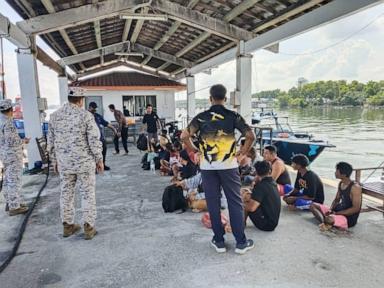
The waters off Pangkor Island are currently the site of a frantic search for 14 missing Indonesian migrants after their vessel capsized in the early hours of Monday. This latest disaster in the Malacca Strait saw 23 survivors pulled from the waves by a local fishing boat, but the fate of the remaining passengers highlights a recurring failure in regional maritime security. These individuals were not merely "missing"; they were participants in a high-stakes economic gamble facilitated by organized smuggling networks that continue to operate with near-impunity despite years of supposed crackdowns.
Anatomy of a predictable disaster
The vessel, reportedly carrying 37 people, departed from Kisaran, Indonesia, on May 9. Its destination was not a single port but a scattered map of Malaysian economic hubs: Kuala Lumpur, Penang, Selangor, and Terengganu. This was a tactical delivery of human capital.
When a local fisherman spotted survivors clinging to debris in the predawn darkness of Monday, May 11, it triggered the standard emergency response. The Malaysian Maritime Enforcement Agency (MMEA) has since deployed a helicopter, surveillance aircraft, and a fleet of patrol boats. While the MMEA director, Mohamad Shukri Khotob, coordinates the tactical rescue, the strategic reality is far grimmer. This boat was overloaded, likely unseaworthy, and lacked even the most basic safety equipment.
It is a story told a hundred times a year.
The Malacca Strait is one of the busiest shipping lanes on the planet, yet it remains a porous graveyard for those crossing in the shadows. The survivors, including seven women, are currently under police custody for documentation. For them, the reward for surviving the sea is an immediate encounter with the legal machinery of a state that relies on their labor while criminalizing their arrival.
The economics of the invisible workforce
Malaysia’s reliance on undocumented labor is an open secret that fuels the construction, plantation, and manufacturing sectors. Conservative estimates suggest that between 100,000 and 200,000 Indonesians attempt this crossing annually.
Why do they take the risk?
The answer lies in the disparity of opportunity and the efficiency of the "agents" who manage these routes. These are not disorganized amateurs. They are sophisticated syndicates that handle everything from transport to job placement. By the time a migrant steps onto a boat in Kisaran, they are often already indebted to the syndicate, ensuring they remain compliant workers once they reach the palm oil plantations or construction sites of Selangor.
The breakdown of the May 9 voyage
| Metric | Details |
|---|---|
| Origin | Kisaran, Indonesia |
| Total Passengers | 37 |
| Rescued | 23 (including 7 women) |
| Missing | 14 |
| Intended Destinations | KL, Penang, Selangor, Terengganu |
Regional failure and the trafficking trap
The timing of this sinking is particularly biting. It comes just months after a similar incident in November 2025 near the Thai-Malaysian border claimed 36 lives. Despite high-profile international operations like Liberterra III, which INTERPOL claimed protected thousands of victims late last year, the fundamental mechanics of the Malacca Strait crossings have not changed.
The "agents" simply adapt. If one route becomes too hot with MMEA patrols, they move twenty miles down the coast. They wait for the moonless nights. They use smaller, faster, and more dangerous boats that can slip under the radar of coastal surveillance.
This is not a failure of technology or even purely a failure of policing. It is a failure of policy. As long as there is a massive demand for cheap, unprotected labor in Malaysia and a lack of safe, legal pathways for workers from Indonesia, the syndicates will continue to find customers. These 14 missing people are the collateral damage of an economic system that treats human beings as disposable inventory.
The search continues amid rough seas
Search and rescue operations are currently hampered by choppy conditions in the Strait. Every hour that passes reduces the likelihood of finding the remaining 14 alive. The MMEA is focused on the immediate task—recovering bodies or, by some miracle, more survivors.
However, once the search ends, the news cycle will move on. The 23 survivors will likely face deportation, and the "agents" in Kisaran will begin prepping the next boat. To treat this as an isolated maritime "accident" is to ignore the industrial-scale human smuggling operation that keeps the region’s economy humming.
The true crisis isn't just the sinking of a boat; it's the fact that for thousands of people, the risk of drowning in the Malacca Strait is still a better bet than staying home. Until the root of that desperation is addressed, the MMEA’s helicopters will stay busy, and the list of the missing will continue to grow.


