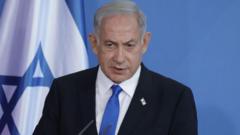
Benjamin Netanyahu says he went to the UAE. The UAE says he didn't. This isn't just a spat over a diplomatic itinerary; it is a high-stakes collision between two desperate survival strategies in a Middle East being physically reshaped by the 2026 war with Iran. Netanyahu’s claim of a "secret breakthrough" meeting with President Sheikh Mohammed bin Zayed (MBZ) in the oasis city of Al-Ain is more than a boast. It is an attempt to cement an anti-Iran axis that the Emirates, battered by thousands of missiles and facing internal economic ruin, is suddenly terrified to acknowledge in public.
The core of the dispute rests on a reported March 26 meeting. Netanyahu’s office insists the Prime Minister touched down on Emirati soil to finalize a "historic" leap in security cooperation. Abu Dhabi’s Foreign Ministry hit back within hours, calling the report "baseless" and "unfounded." Why the discrepancy? To understand the lie, you have to understand the carnage.
The Shadow Alliance Under Fire
During the height of Operation Epic Fury, the joint U.S.-Israeli offensive that decimated the Iranian leadership earlier this spring, the UAE was not just a bystander. It was a target. Iran launched an estimated 2,800 missiles and drones at Gulf infrastructure, specifically punishing Abu Dhabi for its burgeoning relationship with Israel. While the Emirati Foreign Ministry maintains that their ties are "public and known" under the Abraham Accords, the reality is that the war forced the relationship into a dark, necessary corner.
The UAE’s denial is a masterclass in regional optics. While they publicly distance themselves from Netanyahu—a figure currently radioactive in many Arab circles due to the concurrent devastation in Lebanon—they are simultaneously integrating Israeli military hardware into their very survival. We now know, thanks to disclosures from the U.S. embassy, that Israel has deployed Iron Dome batteries and personnel to the Emirates. You do not send your most sensitive defense technology and your own soldiers to a country you aren’t meeting with in secret.
The Al-Ain Disconnect
The reported location of the meeting, Al-Ain, is significant. It is a city away from the prying eyes of Dubai and the diplomatic fishbowl of Abu Dhabi. It sits on the border with Oman, providing a discreet corridor for an unannounced arrival.
Netanyahu’s motivation for leaking this visit now is transparent. Back home, he is under fire for the rising cost of the war and a sluggish economy. He needs a win. He needs to prove that the "New Middle East" he promised is not only alive but thriving under fire. By claiming a secret visit, he signals to his domestic base and the Biden-Trump transition team that Israel has successfully pulled a major Arab power into a permanent military alliance against Tehran.
The UAE, however, is playing a much more delicate game. They are the ones who have to live next to a wounded, vengeful Iran. They have seen their oil facilities in Fujairah burn. For them, acknowledging a secret summit with Netanyahu is an invitation for another thousand drones. Their denial isn't necessarily a claim that the meeting didn't happen—it’s a signal to Tehran that they aren't ready to own the alliance out loud.
Retaliation and the Lavan Island Strike
If the meeting in Al-Ain was the "breakthrough" Netanyahu claims, the results were visible almost immediately. In early April, a refinery on Iran’s Lavan Island was hit by a sophisticated strike. While the world looked toward Jerusalem or Washington, intelligence circles have increasingly pointed toward the UAE as the silent hand behind the attack.
This is the "how" of the new regional dynamic. The UAE is no longer just a financial hub; it has become a belligerent. But the Emirati leadership knows that its legitimacy in the Arab world rests on maintaining a veneer of distance from Netanyahu’s specific brand of hawkishness. They want Israeli tech, Israeli intelligence, and Israeli protection—but they do not want the Israeli Prime Minister’s photo op.
The Economic Divorce
The tension is further complicated by the UAE's recent, shocking exit from OPEC. By leaving the Saudi-led cartel, Abu Dhabi has signaled that its strategic interests are now fully decoupled from traditional Arab bloc politics. They are looking for new partners. They are looking for a security umbrella that Riyadh can no longer provide.
Netanyahu is banking on the idea that the UAE has nowhere else to go. With the U.S. domestic political landscape fractured and the war’s end-game still murky, the Israeli-Emirati security pact is the only thing standing between the Gulf and total Iranian hegemony.
The Intelligence Conduit
It wasn't just Netanyahu. Reports have confirmed that the directors of both the Mossad and Shin Bet made multiple trips to the Gulf throughout the conflict. These weren't diplomatic visits; they were operational. They were there to coordinate the detection and interception of Iranian projectiles.
- Intelligence Sharing: Real-time data on IRGC movements.
- Target Selection: Mapping out Iranian naval assets in the Gulf.
- Technical Support: Managing the laser-based defense systems recently moved to Emirati soil.
The UAE’s insistence that their relations are "not based on secrecy" is technically true in peace, but it is a fantasy in war. The infrastructure of their defense is now inextricably linked to Israeli engineers.
A Breakthrough or a Betrayal?
Netanyahu’s announcement of the "breakthrough" likely refers to a formal, yet-to-be-disclosed mutual defense treaty. If such a document exists, it changes the geometry of the Middle East forever. It would mean that an Arab state has officially moved under the Israeli nuclear and conventional umbrella.
But by leaking it, Netanyahu may have sabotaged the very thing he helped build. The UAE’s "strongly worded" rebuttal is more than a diplomatic correction; it is a warning. Abu Dhabi is willing to fight alongside Israel, but it is not willing to be a prop in Netanyahu’s political survival campaign.
The danger now is a collapse of trust. If the UAE feels that Israel cannot keep a secret, the flow of intelligence could dry up at a moment when Iran is looking for any crack in the armor. Netanyahu may have gained a headline, but he has risked the most important strategic partnership in Israeli history.
The war with Iran has moved into a phase of brinkmanship where the primary weapon isn't a missile, but a narrative. Israel wants the world to see a united front. The UAE wants the world to see a sovereign, independent actor that happened to buy some very good radar systems. Both cannot be true at the same time.
Stop looking at the denials. Look at the batteries on the ground in Al-Ain. The Iron Dome doesn't lie, even when the politicians do.