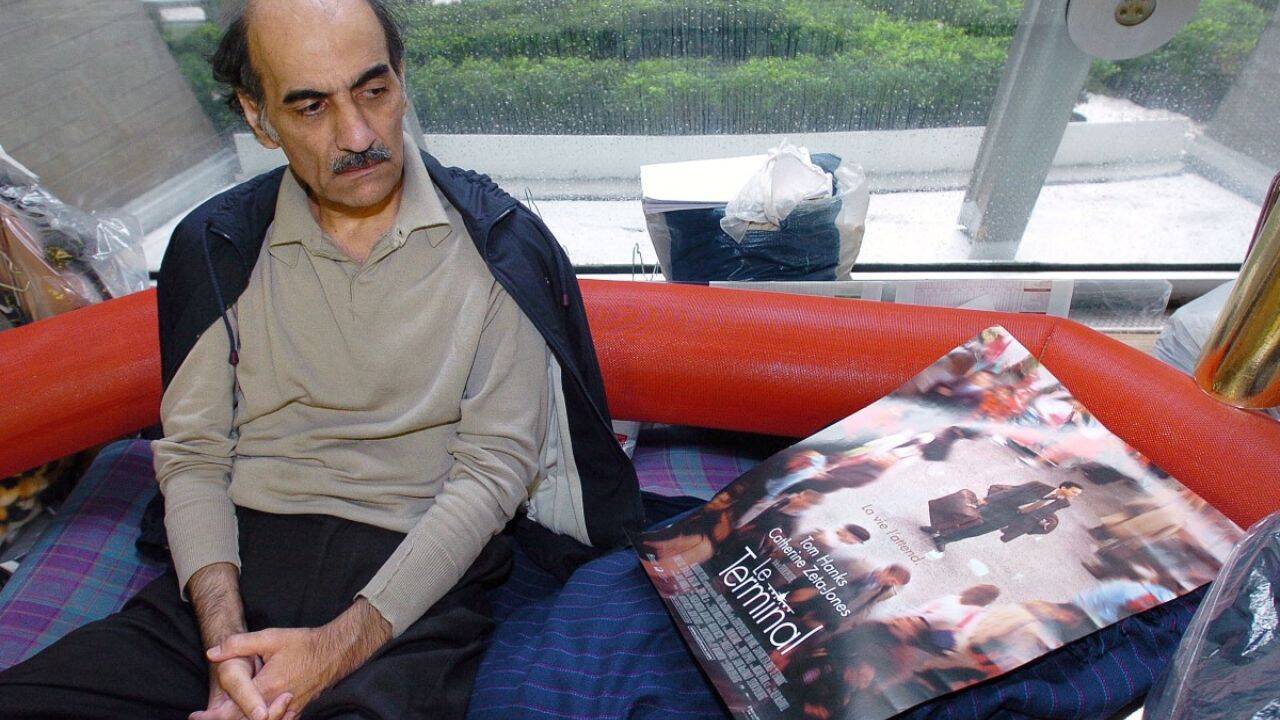
Mehran Karimi Nasseri did not spend eighteen years at Charles de Gaulle Airport because of lost paperwork. While popular culture romanticized his residency as a whimsical tale of a stranded traveler, the reality was a grim study in bureaucratic paralysis, legal abandonment, and severe psychological institutionalization. From 1988 to 2006, Nasseri inhabited a red plastic bench in the basement of Terminal One, transforming a transient public lobby into his permanent residence. His presence exposed a global asylum system completely unprepared for individuals caught in legal limbo, demonstrating how administrative technicalities can strip a person of their basic humanity.
The romanticized narrative suggests a simple mistake kept him there. The truth is far darker and infinitely more complex, involving a man who gradually lost his grip on reality as the legal systems of several European nations failed him.
The Making of a Stateless Ghost
Nasseri arrived in France in November 1988 after a series of expulsions across Europe. Having been stripped of his Iranian citizenship following protests against the Shah, he spent years seeking asylum in various European capitals. Belgium eventually granted him refugee status, which provided him with travel documents. However, while traveling to England via France, Nasseri claimed his briefcase containing those critical papers was stolen at a Paris railway station.
He boarded a flight to London anyway, but British immigration officials immediately turned him back to France. Because he had entered France legally but lacked papers to prove his identity or refugee status, French authorities could not deport him. Yet, they could not let him leave the airport either.
This created an unprecedented legal vacuum. French human rights lawyer Christian Bourget took up Nasseri's case, embarking on a decade-long crusade through the courts. The legal paradox was maddening. Belgium refused to issue replacement documents unless Nasseri presented himself in person to their refugee office. France refused to let Nasseri leave the airport to travel to Belgium to get those documents because he lacked papers.
For years, bureaucrats exchanged letters while Nasseri sat on his bench. He lived on the goodwill of airport employees, who gave him food vouchers and access to the staff washrooms. He brushed his teeth in the public sinks, kept his clothes meticulously clean, and spent his days reading newspapers, studying economics, and writing in his diary. He became a fixture of the terminal, a living monument to international indifference.
The Legal Paradox That Became a Psychological Wall
In 1999, after eleven years of legal battles, Bourget finally achieved what seemed impossible. Belgium agreed to send Nasseri his transit papers, and France granted him a temporary residency permit. He was free to walk out of the terminal and start a new life.
He refused to leave.
By the late nineties, the years of confinement had severely degraded Nasseri's mental health. He had developed a protective fantasy world to cope with his confinement. He insisted that his name was not Mehran Karimi Nasseri, but "Sir Alfred Mehran." He claimed he was British, that his mother was a Swedish nurse, and that he had no connection to Iran or Belgium. When the French residency papers arrived bearing his birth name and Iranian origin, he rejected them outright, claiming the documents were fakes because they did not list him as Sir Alfred.
This was the moment the tragedy shifted from a legal crisis to a psychiatric one. The airport terminal, once his prison, had become his psychological sanctuary. The outside world represented uncertainty, danger, and the loss of the fragile identity he had constructed to survive.
The Industry of Human Curiosity
As Nasseri's stay dragged into its second decade, the media transformed his suffering into entertainment. Journalists from around the world descended on Terminal One, treating him as a philosophical novelty rather than a man undergoing a prolonged psychological crisis.
He was interviewed thousands of times. Film crews set up bright lights around his red bench, stepping over his boxes of books and letters. The attention culminated in DreamWorks purchasing the rights to his life story for several hundred thousand dollars, which served as the loose inspiration for a major Hollywood movie.
This influx of money did nothing to improve his situation. Nasseri had no bank account, so the funds were deposited into a trust. He continued to sleep on the same bench, refusing to buy clothes or comfort. The fame only served to reinforce his delusion. He believed he was a global celebrity who belonged in the terminal, and the constant stream of tourists asking for autographs validated his fantasy.
The system allowed this exploitation to continue because it was convenient. The airport authority tolerated his presence because he was harmless and brought free publicity. The medical services at the airport monitored him but could not force psychiatric intervention without a court order, which no authority wanted to pursue due to the public relations backlash.
The Final Return to the Concrete
Nasseri was finally removed from Terminal One in August 2006, not by choice, but due to a medical emergency that required hospitalization. After his recovery, he was housed in a Parisian shelter, supported by the funds from his movie deal.
For over fifteen years, he lived quietly in various social housing facilities in Paris, away from the public eye. Yet, the deep psychological damage of his eighteen-year confinement was irreversible.
In late 2022, Nasseri made a quiet, unannounced return to Charles de Gaulle Airport. Having spent most of his movie earnings, he returned to the only place where he felt secure. He slept on the benches once again, an elderly, frail shadow of his former self. A few weeks later, on November 12, 2022, he suffered a fatal heart attack in Terminal 2F.
His death inside the airport precinct was the logical, tragic end to a life defined by institutionalization. Nasseri did not die a free man who had conquered a system. He died as a victim of a bureaucratic apparatus that preferred to ignore a legal anomaly rather than solve it, allowing a vulnerable human being to slowly dissolve into the background of a transit hub.