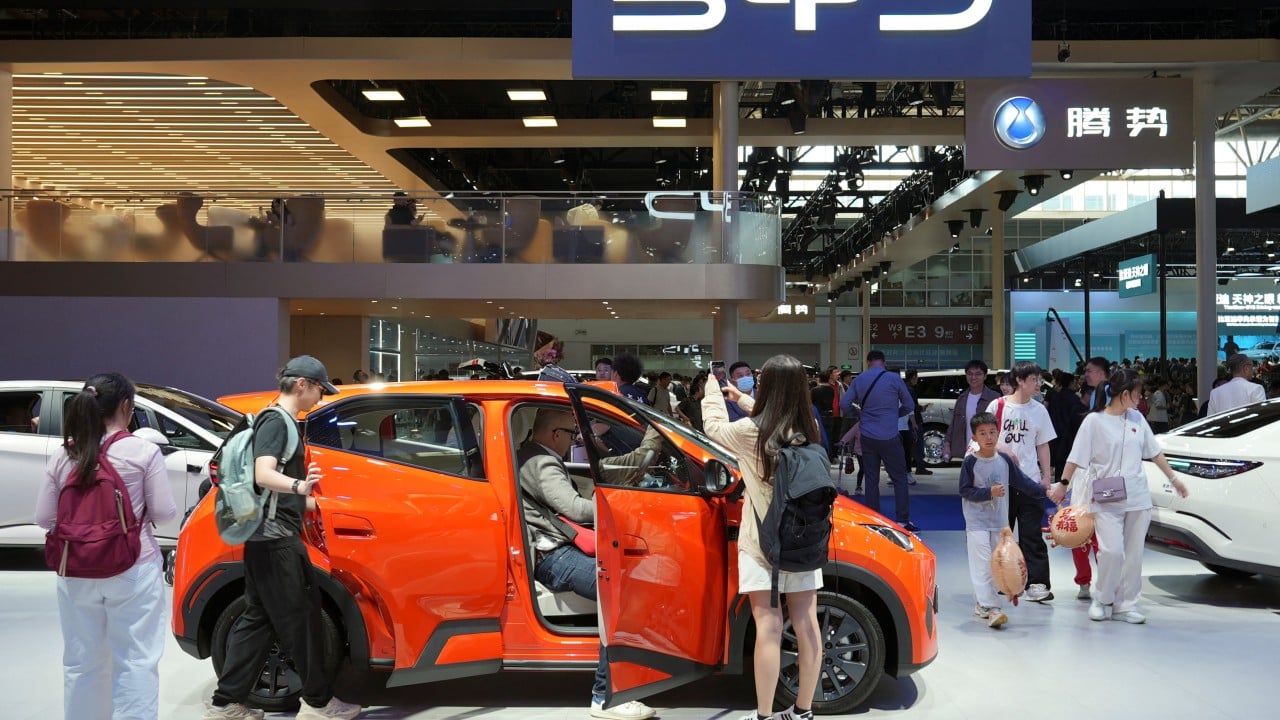
The 47% sequential decline in BYD’s first-quarter net income is not a signal of waning demand, but the mathematical inevitable of a vertically integrated giant weaponizing its balance sheet to force industry-wide consolidation. While headline figures focus on the raw profit slump, a forensic breakdown reveals a deliberate pivot from margin preservation to market-share dominance via aggressive price positioning and massive R&D overhead. The contraction is the result of three distinct economic pressures: the exhaustion of the premium mix, the operational lag of international scaling, and the deliberate compression of the internal combustion engine (ICE) price floor.
The Unit Economics of a Disciplined Price War
To understand the profit drop, one must examine the Gross Margin Per Unit (GMPU) rather than aggregate net income. BYD’s decision to initiate the "Electricity is Cheaper than Oil" campaign in early 2024 involved slashing prices across its Honor Edition lineup by 5% to 20%. This was not a defensive move against inventory buildup; it was a strategic offensive designed to capture the sub-100,000 RMB ($13,800) market. For a more detailed analysis into this area, we suggest: this related article.
The price reductions operate on a non-linear scale. In a standard manufacturing cost function, fixed costs are amortized over volume. However, when price cuts outpace the rate of volume growth in a single quarter, the operating leverage reverses.
- Fixed Cost Absorption: During Q1, BYD’s production lines underwent retooling for new model iterations. The resulting temporary dip in capacity utilization meant that each unit carried a higher share of factory overhead.
- Variable Cost Resistance: While BYD’s vertical integration—owning everything from lithium mines to chip fabrication—protects it from external supplier markups, it does not insulate it from the raw commodity price floor. As lithium carbonate prices stabilized, the "easy wins" in cost reduction from falling battery materials were already realized in 2023.
- The Mix Shift: The Q1 volume was heavily weighted toward lower-margin plug-in hybrid electric vehicles (PHEVs) like the Qin Plus. By flooding the entry-level segment, BYD intentionally diluted its own product mix to starve competitors of the high-volume oxygen needed to survive.
R&D as a Competitive Barrier Rather than an Expense
A critical driver of the net income slump often overlooked is the aggressive expansion of the R&D budget. BYD is currently outspending its peer group to solve the "Second Half" of the EV transition: intelligent driving and software-defined vehicles. For broader context on this topic, comprehensive coverage is available at Financial Times.
The financial statement treats R&D as an immediate hit to the bottom line, but in a structural analysis, this is capital expenditure for market dominance. BYD is currently supporting a workforce of over 100,000 engineers. This creates a high Cash Burn Floor. Even in a low-sales month, the payroll for this technical army remains constant.
This investment is focused on three technological moats:
- Xuanji Architecture: A holistic smart brain that integrates cloud AI with onboard sensors to manage vehicle dynamics.
- e-Platform 3.0 Evo: Increasing the integration of the 8-in-1 electric powertrain to further reduce the physical footprint and assembly time of future models.
- DiSus Intelligent Body Control: A hardware-software hybrid that allows for superior active safety, moving the vehicle from a "dumb" battery on wheels to a high-margin technology platform.
The short-term profit sacrifice is the price of admission to the next era of the industry. If BYD can standardize its autonomous driving stack across its 3-million-unit annual volume, the cost per unit for software will be an order of magnitude lower than that of NIO, Xpeng, or even Tesla in the Chinese market.
The International Logistics Bottleneck and Capital Drag
The transition from a domestic champion to a global hegemon is currently a drag on BYD’s efficiency. Domestic sales in China are highly efficient; the logistics are mature, and the brand is established. International expansion, conversely, introduces significant Friction Costs.
The "BYD Explorer No. 1," the company’s first dedicated roll-on/roll-off (RoRo) carrier, represents the start of a massive capital commitment to logistics. Until BYD has a full fleet of these vessels and operational factories in Thailand, Brazil, and Hungary, it is forced to eat the middleman costs of third-party shipping and import tariffs.
The geographic mismatch of production and consumption creates a "Inventory in Transit" problem. Capital is tied up in tens of thousands of vehicles sitting on ships for 30 to 45 days. This slows down the Cash Conversion Cycle. In Q1, the inventory levels remained high as the company prepared for a massive European and Southeast Asian push. The profit was not "lost"; it was deferred into the balance sheet as finished goods sitting in international ports.
Structural Pressure on the Domestic ICE Market
BYD’s Q1 strategy was specifically targeted at the "Last Bastion" of joint-venture ICE vehicles (VW, Toyota, Honda). By pricing the Qin Plus Honor Edition at 79,800 RMB, BYD broke the psychological barrier that previously protected gasoline cars.
This creates a Death Spiral for Competitors:
- Volume Erosion: As BYD takes the volume, joint-venture factories operate at 40-50% capacity.
- Unit Cost Escalation: Lower capacity utilization for competitors leads to higher per-unit costs.
- Inability to Reinvest: With shrinking profits, these competitors cannot fund their own EV transitions, ceding the future to BYD by default.
The 55% profit slump is the "Customer Acquisition Cost" of destroying the legacy ICE competition. BYD is betting that once these competitors exit the market or consolidate, the resulting oligopoly will allow for a gradual restoration of margins.
The Limits of Vertical Integration
It is a fallacy to assume vertical integration is a perpetual motion machine for profit. There are two primary risks that BYD’s Q1 performance highlights:
- The Complexity Tax: As the company grows, the internal bureaucracy required to manage mining, semiconductors, battery chemistry, and vehicle assembly increases. The "Coordination Cost" can eventually outweigh the "Supplier Margin Savings."
- Technological Lock-in: By owning the entire supply chain, BYD is heavily committed to its current battery chemistry (Lithium Iron Phosphate / Blade Battery). If a breakthrough in solid-state batteries or an alternative chemistry occurs elsewhere, BYD’s massive investment in LFP production lines becomes a "Sunk Cost Trap" rather than an asset.
Strategic Forecast
BYD will continue to experience volatile quarterly earnings as it prioritizes the eradication of smaller EV startups and legacy ICE players through the remainder of the year. The primary indicator of health will not be net margin, but the Operating Cash Flow and the rate of Export Volume Growth.
The strategic play is now a race against time and trade barriers. BYD must achieve local production in key markets (EU, ASEAN, LATAM) before protectionist tariffs become permanent. Domestically, the objective is to reach a 50% New Energy Vehicle (NEV) penetration rate in China, at which point the price war will naturally cool as the industry enters its mature phase.
Expect a secondary "Margin Recovery Phase" in the fourth quarter. This will be driven by the launch of high-end sub-brands like Fang Cheng Bao and Yangwang. These premium models carry margins estimated at 3x to 5x the entry-level series. The Q1 profit slump was the tactical retreat required to position the heavy artillery for a final market takeover. The focus for analysts should shift from "Why did profit fall?" to "Who is left standing to compete?"
The final move in this cycle is the transition of the vehicle into a recurring revenue stream. By sacrificing the initial sale margin, BYD is building a massive installed base for its upcoming software and energy ecosystem (V2G - Vehicle to Grid) services. The hardware is the Trojan horse; the ecosystem is the eventual profit engine.

.jpeg?width=1200&auto=webp&trim=0%2C0%2C0%2C0)