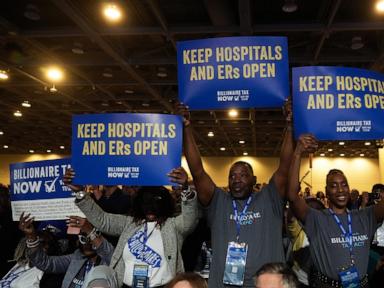
Organizers in California have officially submitted over 1.6 million signatures to place a "one-time" 5% wealth tax on billionaires on the November 2026 ballot. This initiative, spearheaded by the SEIU United Healthcare Workers West, aims to seize roughly $100 billion from approximately 200 of the state’s wealthiest residents to plug a massive hole in healthcare and education funding. While proponents argue this is a surgical strike against inequality, the reality is a high-stakes game of chicken between the state’s progressive base and the titans of Silicon Valley, many of whom are already moving their tax domiciles to Nevada and Florida to escape the January 1, 2026, residency trigger.
The Revenue Mirage and the 26 Billion Dollar Exit
The math behind the Billionaire Tax Act is simple on paper but volatile in practice. By taxing the global net worth of individuals exceeding $1 billion, the state hopes to backfill federal funding cuts to Medi-Cal. However, early data suggests the "wealth flight" has already begun. Estimates indicate that at least six billionaires have legally vacated the state prior to the 2026 cutoff, taking an estimated $26.7 billion in potential tax revenue with them.
This isn't just about losing a 5% slice of their pie. When a billionaire leaves, the state loses their 13.3% top-bracket income tax, their capital gains contributions, and the local economic engine of their venture capital activity. We are watching a slow-motion liquidation of the state's most reliable tax base.
Why the Wealthy are Winning the Logistics War
Unlike income, which is relatively easy to track via W-2s and 1099s, "wealth" is a phantom. It includes illiquid startup stock, private equity holdings, art collections, and intellectual property. The administrative burden of valuing these assets will fall on the Franchise Tax Board, an agency currently unequipped to audit the global holdings of a Mark Zuckerberg or a Larry Page.
- Valuation Disputes: How do you value a private tech unicorn that hasn't raised a round in three years?
- Liquidity Crises: Many billionaires are "paper rich." Forcing a 5% sale of stock in a single year could tank company valuations and hurt 401(k)s of average employees.
- Installment Plans: To soften the blow, the initiative allows payments over five years, but this assumes the billionaire remains "taxable" in California for the duration of the payout.
The Shadow War in Sacramento
The political alignment on this issue has shattered traditional party lines. Governor Gavin Newsom has broken with the labor unions that typically fuel his campaigns, calling the tax "damaging" to the state’s competitiveness. He is joined by a chorus of Democratic mayoral candidates who fear the loss of philanthropic and commercial investment in their cities.
On the other side, the "Save California Health Care" coalition, backed by figures like Bernie Sanders and Robert Reich, views this as the only moral response to federal austerity. They argue that if 200 people can save the state's hospital system from collapse, the economic "risk" is a price worth paying.
Competing Ballot Measures
Silicon Valley is not just fighting this with rhetoric; they are using California’s own direct-democracy system against itself. Groups funded by Sergey Brin and Eric Schmidt have introduced three counter-measures for the 2026 ballot. These are designed to effectively "poison" the wealth tax by:
- Banning retroactive taxation (nullifying the January 2026 trigger).
- Requiring strict audits that would delay the distribution of funds for years.
- Forcing any new tax revenue to be split with police and fire departments, diluting the healthcare fund.
The European Precedent
California is walking a path that most of Europe has already abandoned. In the 1990s, twelve European nations had wealth taxes. Today, only three remain. The reasons for repeal were consistent: the cost of collection often outweighed the revenue generated, and the ultra-wealthy simply moved to the next country over.
In a domestic context, moving from Palo Alto to Austin is significantly easier than moving from Paris to London. If California passes this measure, it becomes a laboratory for a policy that has failed nearly every time it has been tried at scale. The risk isn't just that the $100 billion won't materialize; it's that the attempt to collect it will leave a permanent scar on the state's economic geography.
The ballot in November will not just be a vote on healthcare funding. It will be a referendum on whether California still wants to be the global headquarters for extreme wealth, or if it is ready to trade its billionaires for a more solvent social safety net.
Voters must now decide if they believe the backers' promise of a painless $100 billion windfall, or the warnings of an economic exodus that could leave the state’s coffers emptier than when they started.