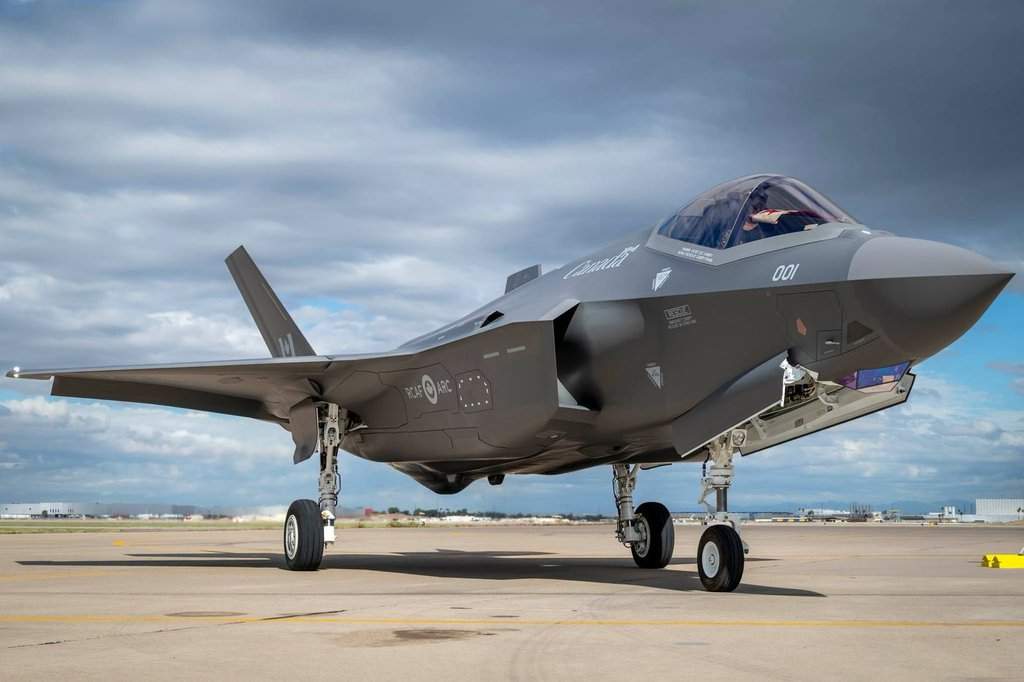
Ottawa wants you to believe it is still deciding whether to buy the F-35. That is a lie wrapped in a press release.
Look at the headlines celebrating the arrival of Canada’s first Lockheed Martin F-35A Lightning II fighter jets while dutifully repeating the government line that the full 88-aircraft order remains "under review." Mainstream defense reporters eat this up. They frame it as a prudent, cautious government weighing geopolitical options, balancing sovereign industrial benefits, and keeping Washington on its toes.
They are missing the entire plot.
Once the first stealth airframes roll onto Canadian tarmac and Royal Canadian Air Force (RCAF) pilots begin training in the cockpit, the "review" is dead on arrival. In modern military procurement, hardware is destiny. You do not casually test-drive a fifth-generation stealth ecosystem, integrate into the Joint Strike Fighter global sustainment network, and then walk away because a parliamentary committee gets cold feet over price tags or trade friction.
I have watched governments across NATO burn billions of taxpayer dollars pretending they had "off-ramps" in major defense contracts. They never do. By the time the first jets arrive, the operational, financial, and diplomatic concrete has already hardened.
The Sunk Cost Trap Disguised as Prudence
Let’s look at the mechanics of what just happened, minus the diplomatic fairy dust.
For over a decade, Canada turned fighter procurement into a national soap opera. Politicians campaigned on canceling the F-35, launched an "open and transparent" competition that everyone in the aerospace sector knew was rigged by operational requirements only one jet could meet, and then quietly selected the F-35 anyway in 2023. Then, amid renewed political friction with Washington and sticker shock over lifecycle costs, Ottawa floated the idea of reviewing the full 88-jet commitment—perhaps capping the buy or mixing the fleet with European alternatives like the Saab Gripen.
Here is the reality nobody in Ottawa wants to put on a podium: a mixed fighter fleet for a middle power is financial suicide.
To understand why, you have to strip away the sticker price of the airframe—roughly $80 million to $85 million USD per Lot 15–17 jet—and look at the sustainment tail. In military aviation, the purchase price is just the cover charge. Roughly 70 percent of a fighter program's total cost happens after delivery, over thirty to forty years of maintenance, software upgrades, depot-level repairs, and pilot training.
If Canada stops at 16 or 32 F-35s and buys 50 Swedish Gripens to punish Washington or appease domestic union lobbyists, the RCAF doesn't get a bargain. It gets two entirely separate:
- Supply chains and spare parts warehouses
- Pilot and maintainer training pipelines
- Weapons integration and certification programs
- Secure communications and mission-data infrastructures
I’ve seen air forces try to run split fleets on tight budgets. You end up with two fragile, under-funded squadrons instead of one functional air force. Every dollar spent duplicating simulator facilities and avionics test benches is a dollar stolen from actual flight hours. The Pentagon and Lockheed Martin know this. They know that once Canada absorbs the upfront infrastructure cost to host the first tranche of F-35s at Cold Lake and Bagotville, canceling the back half of the order drives the per-unit sustainment cost of the remaining jets into the stratosphere.
The "Kill Switch" Myth and Real Sovereignty
Whenever the F-35 comes up in Canadian media, the comments section—and half the op-ed pages—immediately spirals into panic about American control. People ask if Washington has a literal "kill switch" that can ground the RCAF if Ottawa and D.C. have a diplomatic spat over Arctic sovereignty or tariffs.
Let’s dismantle that premise right now. There is no secret button in the Pentagon that turns off a foreign F-35 mid-flight. That is Hollywood nonsense.
The real dependency is far more mundane, and far harder to escape. It lives in Autonomic Logistics Information System (ALIS) and its cloud-based successor, Operational Data Integrated Network (ODIN), alongside the Mission Data Files (MDF).
Think of Mission Data Files as the brain of the aircraft’s sensor fusion. They are massive, continuously updated threat libraries compiled from global intelligence—telling the jet’s radar and electronic warfare suite what a specific Russian surface-to-air missile radar or Chinese fighter signature looks like in real time. Those files are built and validated primarily at U.S.-run reprogramming laboratories, like the one at Eglin Air Force Base in Florida, with input from Tier 1 and Tier 2 partners.
Without continuous access to ODIN for spare parts tracking and regular MDF updates from U.S. labs, an F-35 doesn't fall out of the sky—it slowly degrades into a very expensive, very loud fourth-generation aircraft flying blind against modern air defenses.
That is the trade-off Canada already signed up for. Pretending a "review" of the remaining jets preserves Canadian strategic autonomy is laughable. You cannot be "half-pregnant" with the U.S. defense industrial base. Whether Canada buys 16 F-35s or 88, its air combat survival is hardwired into NORAD, NATO, and American software architecture.
Why Competitors Can't Save Ottawa Now
Whenever Ottawa threatens to pause the full F-35 order, aerospace lobbyists in Stockholm and Paris start salivating. The Saab Gripen E is a brilliant piece of engineering. It can operate off icy highways, requires a tiny maintenance crew, and comes with generous technology-transfer promises to build parts in Canada.
On paper, it looks like the ultimate contrarian play. In practice, it fails the only test that actually matters for Canada’s geography: deep Arctic penetration and NORAD interoperability.
Look at a polar projection map. Canada is not defending a compact European theater with dense ground-based radar coverage and short transit distances. The RCAF has to patrol millions of square kilometers of frozen emptiness where fuel tankers are scarce and Russian long-range aviation—equipped with standoff cruise missiles—probes North American airspace.
- Sensor Fusion and Low Observability: In a contested Arctic environment, detecting an incoming threat first is the difference between deterrence and disaster. The F-35’s AN/APG-81 AESA radar, Distributed Aperture System (DAS), and Electro-Optical Targeting System (EOTS) act as a flying intelligence node, feeding target data to naval vessels and ground batteries. A fourth-generation-plus aircraft, no matter how nimble, lights up on modern long-range radars like a flare in a dark room.
- Alliance Friction: Every major ally Canada actually flies alongside—the United States, the United Kingdom, Norway, Denmark, Finland, Poland, Germany, Australia, Japan—is flying the F-35. When Norwegian and Finnish F-35s patrol the European High North, they share encrypted data over the Multifunction Advanced Data Link (MADL) natively. If Canada shows up to a NORAD or NATO Arctic exercise in a different airframe, it becomes the awkward guest relying on older Link-16 protocols that broadcast its position to adversaries.
Even the strongest proponents of European alternatives admit quietly that switching horses mid-stream delays full operational capability into the late 2030s. Meanwhile, Canada’s legacy CF-18 Hornets—airframes designed during the Carter administration—are literally aging out of structural viability, propped up by used Australian spare parts and heroic maintenance crews.
What Everyone Gets Wrong About the Price Tag
Search online for Canada’s F-35 deal, and you will see wildly contradictory numbers: $19 billion CAD, $27 billion CAD, $70 billion CAD. Critics weaponize these figures to argue the program is spiraling out of control.
Here is how to actually read those numbers without getting played by political spin:
- Acquisition Cost (~$19B CAD): This covers the 88 jets, initial spare parts, simulators, and basic infrastructure setup.
- Full Lifecycle Cost (~$70B+ CAD): This is the Parliamentary Budget Officer’s estimate over the entire multi-decade lifespan of the fleet. It includes jet fuel, pilot salaries, base electricity, runway repaving, inflation adjustments through the 2060s, and mid-life upgrades.
Comparing the lifecycle cost of the F-35 to the flyaway sticker price of a rival fighter is the oldest trick in defense journalism. Any modern fighter fleet operated by a G7 nation over 40 years will cost tens of billions of dollars once you factor in fuel, personnel, and inflation.
Does the F-35 have brutal sustainment costs? Yes. Even the U.S. Government Accountability Office (GAO) has repeatedly hammered Lockheed Martin and the Pentagon over F-35 engine reliability—specifically the Pratt & Whitney F135 running hotter than originally spewed in brochures—and sluggish parts availability. Mission-capable rates across the global fleet have consistently hovered below Pentagon targets, hovering around the mid-50 percent range rather than the promised 70 or 80 percent.
That is the legitimate scandal. Not that Canada is buying the jet, but that Ottawa spent ten years delaying the purchase only to buy into the program right as the F-35 enters its complex Technology Refresh 3 (TR-3) and Block 4 upgrade bottlenecks.
By dithering for a decade, Canada missed the cheap early-production discounts, paid billions to keep obsolete CF-18s airborne, and still ended up in the exact same queue—except now at the back of the line behind European nations scrambling to rearm.
The Real Move Ottawa Should Make
If Canadian policymakers actually wanted to show spine instead of staging a hollow review of jet quantities, they would stop threatening to cut the order and start using their leverage where it hurts.
First, lock in the full 88-aircraft buy immediately to protect unit economics, then hold Lockheed Martin’s feet to the fire on Industrial and Technological Benefits (ITB). Unlike Tier 1 partners like the UK, Canada does not have guaranteed workshare quotas built into the original Joint Strike Fighter MOU—Canadian firms have to compete for contracts. Ottawa should tie every milestone payment on the remaining tranches to verifiable, high-value sustainment and software engineering work inside Canada, not low-margin sheet-metal fabrication.
Second, admit publicly that the F-35 is a network node, not a standalone dogfighter, and fund the unglamorous enablers. Buying 88 stealth jets without investing in Arctic forward operating locations, satellite communications, air-to-air refueling tankers (the CC-330 Husky fleet), and deep magazines of AIM-120D and AIM-260 missiles is like buying a Ferrari and refusing to pay for tires.
Third, kill the "review" rhetoric before it damages alliance credibility. In Washington, Brussels, and Tokyo, Ottawa’s constant hand-wringing over defense commitments isn't viewed as shrewd negotiating. It is viewed as chronic unreliability. Allies do not share sensitive targeting data or priority production slots with partners who keep one foot out the door.
The arrival of Canada’s first F-35s isn't the beginning of a careful evaluation period. It is the end of a decade-long delusion. The jets are on the tarmac, the pilots are in the seats, and the bill is already on the table—whether Ottawa has the guts to admit it or not.