The stone of Notre-Dame still carries the ghost of smoke. Everyone remembers the spring night when the spire dissolved into orange flame, when the world watched a symbol of eternity turn into a torch. But years later, beneath the scarred ribs of the French capital, a different kind of fire swept through the streets. It was not destructive. It was tidal.
Picture a carpenter standing in the damp morning air near the edge of the sprawling grass at Longchamp. His hands are calloused, stained with centuries-old pine resin and modern sealants. He has spent the last year hoisting heavy oak beams into the skeletal roof of the wounded cathedral across the river. He knows the weight of wood. He knows the endurance of stone. In related updates, read about: Why the Moral Panic Over Pre Ordered Babies Misses the Brutal Economics of Adoption.
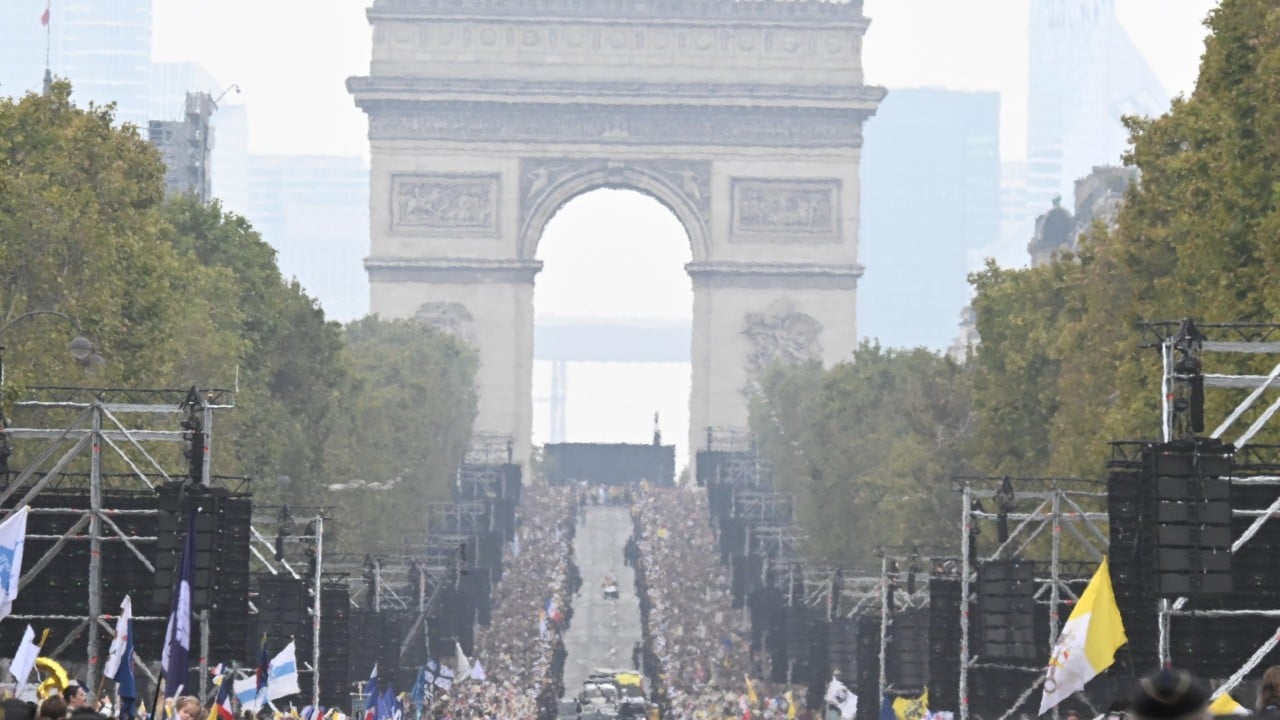
On this Sunday morning, he did not go to the workshop. He stood shoulder to shoulder with hundreds of thousands of others in an open-air expanse that stretched as far as the eye could see.
Silence. Al Jazeera has provided coverage on this critical topic in extensive detail.
It is a rare commodity in a city of sirens, espresso machines, and hurried footsteps. Yet, when the Popemobile rolled past the edges of the crowd, a collective hush fell over the French landscape. Not a frightened quiet. An expectant one.
We often forget why millions of people still gather in the open air to listen to a single man in white speak about ancient doctrines. In an era dictated by fragmented algorithms and the frantic glow of handheld screens, the sheer physical reality of a crowd is radical. It demands presence. It requires breath.
Pope Francis stepped up to the altar constructed under the grey Parisian sky, bringing with him a deliberate, unhurried cadence. He did not offer easy platitudes. He spoke into the wind about exhaustion, about the quiet despair that creeps into modern European cities despite all their wealth and infrastructure.
Consider what happens when a metropolis pauses. The traffic on the périphérique slows to a hum. Delivery trucks idle in alleyways. For a few hours, the usual frantic rhythm of urban survival bends toward something older, deeper, and harder to quantify.
The mass was massive in scale, yes. The statistics matter: tens of thousands filling the grounds, security cordons stretching for miles, global broadcasts carrying the liturgy into living rooms from Buenos Aires to Berlin. But numbers flatten the human experience.
To understand the weight of the visit, look at the edges of the crowd. Look at the elderly woman gripping a rosary she has carried since her wedding day in the 1960s. Look at the young architecture student who has spent months analyzing medieval buttresses, standing next to a migrant worker who found refuge in a parish basement three winters ago. They do not share a political party, a bank account, or even a native language. For eighty minutes, they shared the sound of church bells echoing across concrete and grass.
Critics often reduce these mega-events to spectacle, performance, theater. Sometimes they are right. Hierarchies love pageantry. But beneath the velvet vestments and the diplomatic handshakes lies a simpler human hunger. People are lonely. People are tired of living in a permanent state of emergency.
When the Pope addressed the crowd, his voice carried the rasp of age and the steady conviction of someone who spends his days listening to the grievances of the brokenhearted. He spoke of hope not as a cheap emotional sticker, but as a stubborn, militant choice.
Hope is difficult in Paris. The city has seen its share of grief, from the smoking embers of April 2019 to the darker nights of street-level terror that scarred the previous decade. Joy here is always a bit defiant. It has to earn its keep.
As the final blessing rolled across the amplifiers, the crowd did not instantly shatter. There was a lingering hesitation. People checked their phones, yes, but slowly. They turned to strangers and offered small nods. They folded blankets. They packed thermoses.
The carpenter walked back toward his bicycle leaning against a rusted iron fence. His shoulders were relaxed in a way they hadn't been all week. The cathedral across the river was still wrapped in scaffolding, its ultimate restoration years away. But the city had breathed together. And sometimes, in the long arc of history, that is enough to keep the walls standing.