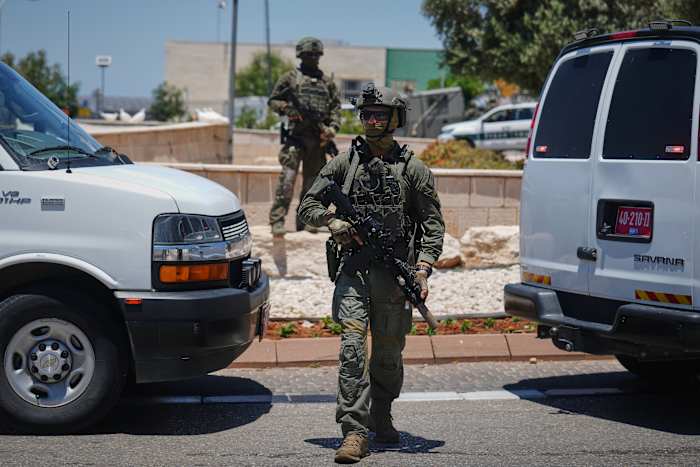
A quiet Sunday morning in central Israel shattered in minutes. A lone gunman behind the wheel of a car turned a routine commute into a multi-city tragedy, leaving one dead and five wounded in a series of rapid-fire shootings near the West Bank boundary. It's the nightmare scenario Israeli security officials have quietly dreaded, but with a twist that makes it far harder to prevent. The attacker wasn't a cross-border infiltrator. He was an Israeli citizen.
The details of the June 7 attack show just how fragile the domestic security situation has become. For months, towns lining the Green Line have braced for an October 7 style raid from across the West Bank wall. Instead, the threat came from within, exposing deep internal vulnerabilities that walls and checkpoints simply cannot fix.
Madness on the Highway
The chaos kicked off around 10:30 a.m. at a gas station near Kokhav Yair, a town sitting right on the Israeli side of the West Bank border. According to emergency responders from Magen David Adom, the shooter pulled up, opened fire, and killed a 35-year-old Israeli man on the spot.
He didn't stop there. He kept driving.
Staying inside his vehicle allowed the gunman to move fast. Within a few short minutes, he hit multiple locations, firing at people in Tsur Natan and Tsur Yitzhak. Reports also placed gunfire near the West Bank settlement of Sal'it. The sheer speed and spreading geography of the calls initially triggered panic that a coordinated cell had crossed the border.
Panicked residents scrambled for cover. One wounded man ran into a nearby McDonald's, bleeding heavily as paramedics rushed to treat him, leaving his stained clothes piled at the entrance. Schools immediately went into lockdown, and families were ordered to bolt their doors.
Police eventually intercepted and killed the gunman, later tracking down an accomplice who tried to attack officers with a broken glass bottle during his arrest. Magen David Adom confirmed that beside the single fatality, two victims are in severe condition, while three others suffered moderate injuries.
The Threat From Within
The immediate assumption during any attack near the border is that the perpetrator came from the West Bank. When identity checks revealed the shooter was a Palestinian citizen of Israel from the neighboring town of Taybeh, the narrative shifted completely.
This internal origin complicates things for intelligence agencies. Regional council head Oshrit Gani Gonen noted that while local towns spent months preparing for external raids, nobody expected the threat to carry an Israeli ID card.
The attack highlights a growing trend of self-radicalization within Arab-Israeli communities, fueled by the grinding, ongoing war in Gaza. It proves that tactical concrete walls don't stop ideas. When an individual with full freedom of movement across Israeli roads decides to strike, traditional border security measures become obsolete.
National Security Minister Itamar Ben-Gvir quickly capitalized on the moment, posting a video next to the blurred body of the gunman, declaring that this must be the fate of every terrorist. But political grandstanding doesn't solve the intelligence failure. Tracking an individual citizen with no previous security record who decides to weaponize his daily commute is nearly impossible.
What This Means for Everyday Security
If you live in or travel through central Israel, the reality on the ground is changing. You can expect a noticeable shift in how security forces operate along the seam line towns.
- Enhanced Domestic Profiling: Expect more internal police checkpoints inside Israel, particularly on roads connecting Arab-Israeli towns to majority-Jewish suburbs.
- Changes to School Security: Local councils are already demanding permanent armed guards and hardened perimeters for schools that previously relied on standard fencing.
- Aggressive Traffic Monitoring: Because the shooter used his car to maximize casualties across multiple towns, security forces will likely deploy more automated license plate readers and rapid-response highway patrols.
The immediate step for anyone in these border-adjacent communities is to update emergency contact protocols and remain hyper-aware during routine stops like refueling. The old assumption that danger only looks a certain way or comes from a certain side of the wall is gone.