Every founder pitching me right now has the exact same pitch deck. Slide three shows a monkey playing Pong with its thoughts. Slide four claims a total addressable market in the hundreds of billions for paralysis treatment. Slide five promises high-channel-count Utah arrays and flexible threads sewn into the motor cortex by surgical sewing machines.
They are building for the obituary page.
The media loves the narrative. Beijing issues standard guidelines for neurotechnology, Silicon Valley startups chase Elon Musk down a rabbit hole of invasive electrode surgery, and the consensus agrees that the future of brain-computer interfaces belongs to whoever can drill the deepest hole into your skull without causing a stroke.
It is a cargo cult.
I have watched venture funds pour hundreds of millions into biocompatible polymers and sub-micron titanium needles while ignoring the fundamental economics of human biology and regulatory reality. The lazy consensus says that direct cortical recording is the only path to high-bandwidth neural interfaces.
That premise is a lie.
The Surgical Fallacy
Let us talk about what happens when you slice open the dura mater. Brain tissue is not a passive circuit board waiting for a USB-C port. It is a living, reactive ecosystem that treats foreign objects like invaders.
When you shove a thousand microscopic electrodes into gray matter, the body initiates a neuroinflammatory response. Microglia activate. Astrocytes form a glial scar. Within months, that high-impedance signal degrades into electronic mush as scar tissue insulates your electrodes from the very neurons you wanted to listen to.
You can make the threads as flexible as you want. You can coat them in hydrogels. Biology does not care. If you break the blood-brain barrier for a commercial consumer or even a clinical chronic implant, you are signing up for an FDA trial that takes a decade and costs more than a satellite launch.
The companies trying to out-Neuralink Neuralink are playing a game they are mathematically designed to lose. They are competing on surgical complexity and hardware miniaturization in a domain where biology always wins in the end.
The Bandwidth Myth
Where did we get this idea that we need ten thousand channels recording individual action potentials to build a useful interface?
From academic neurophysiologists who spend their lives staring at single-unit spike trains in restrained rodents. Single-unit recording is the microscope of brain research. It is brilliant for mapping localized neural circuits in a lab setting. It is an engineering nightmare for scalable products.
Individual neurons drift. Action potentials change amplitude as the brain shifts inside the skull. If you rely on single-unit isolation, your calibration drifts every time the user sneezes or drinks a cup of coffee.
Real-world consumer and clinical utility does not require listening to the chatter of individual cells. It requires decoding macro-level population dynamics.
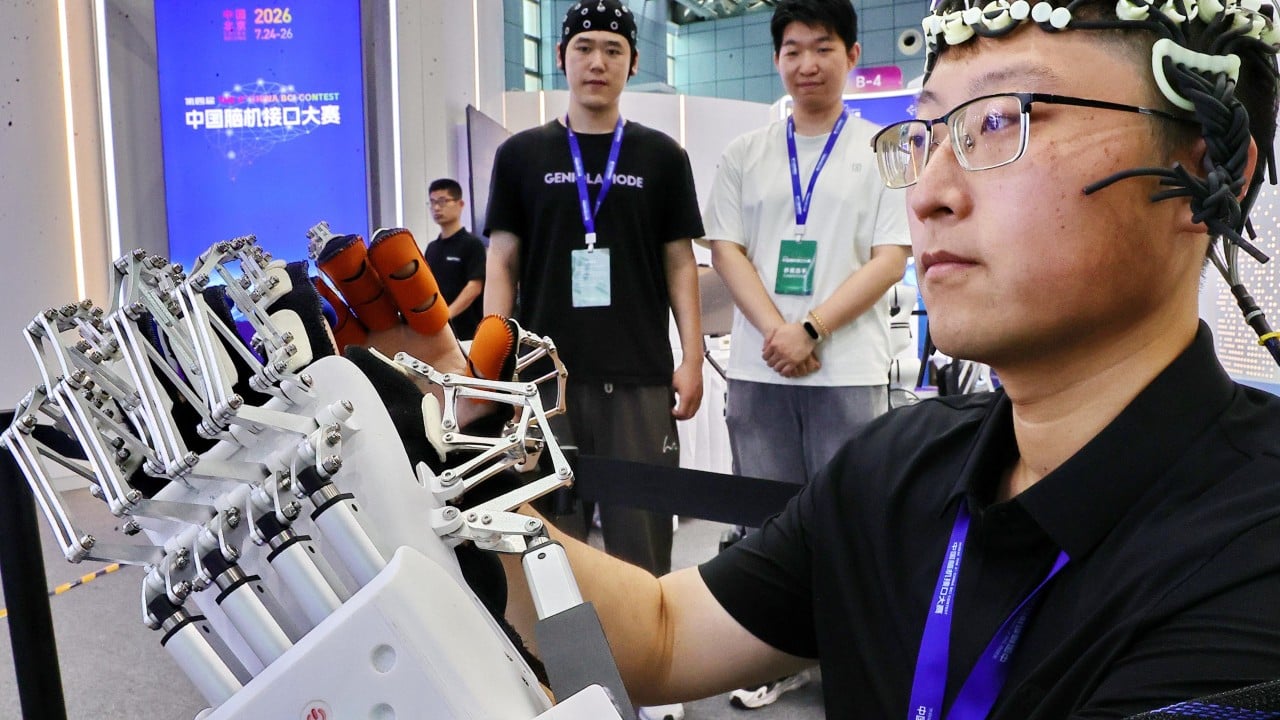
EEG, high-density surface electromyography, functional near-infrared spectroscopy, and non-invasive or minimally invasive transvenous approaches capture population envelopes with zero risk of catastrophic infection or cortical bruising. The information density of local field potentials and scalp-derived macro-signals is staggering when paired with modern transformer models and state-space decoders.
We do not need to pierce the brain to read its intent. We need better decoders, not sharper needles.
What China Gets Right And Wrong
Beijing's recent push into brain-computer interface standards is fascinating to watch from the inside. The state-backed initiatives are establishing rigorous testing protocols for electromagnetic compatibility, signal-to-noise ratios, and data security.
On one hand, this regulatory clarity accelerates clinical translation. It cuts through the vaporware. It forces engineering teams to focus on safety and reproducibility rather than flashy PR stunts with primates.
On the other hand, the heavy focus on invasive paradigms risks locking national infrastructure into a dead-end architectural paradigm. If you codify standards around high-risk cortical implants, you create a regulatory moat that protects a legacy approach just as non-invasive and endovascular methods are about to render open-brain surgery obsolete for ninety-five percent of use cases.
Governments always regulate the technology of yesterday because it is the easiest to measure.
The Endovascular Advantage
If you must go inside the body, stop cutting bone.
Stent-electrode arrays placed via the jugular vein into the motor cortex tap into the blood supply directly. They record local field potentials from inside the vasculature without ever opening the cranium.
I've seen venture capitalists dismiss endovascular approaches because the initial channel count is lower than a direct cortical grid. That criticism reveals a profound misunderstanding of information theory. A clean, stable signal from a blood vessel near the cortex, processed by a recurrent neural network, outperforms a noisy, degrading array of spikes stuck inside scar tissue every single time.
Stability beats channel count. Always.
How To Build A Real Neurotech Company
If you are founding a company in this space today, throw away your invasive roadmap unless you are treating locked-in syndrome or severe drug-resistant epilepsy where the risk-reward ratio justifies open surgery.
For everyone else, follow these principles:
- Prioritize zero-risk deployment. If your device requires a neurosurgeon in an operating room under general anesthesia, your addressable market is capped at a tiny fraction of the clinical population. You have built a medical procedure, not a technology platform.
- Invest in software, not substrate. The competitive moat in neurotech is no longer hardware fabrication. It is the decoding pipeline. The winners will be software companies that happen to use sensors, not sensor companies struggling to write decoding software.
- Design for daily drift. Build adaptive decoding algorithms that self-calibrate continuously. If a user has to sit through a thirty-minute calibration routine every morning, they will throw your device in a drawer.
The race to match Neuralink is a suicide pact for venture capital. Let your competitors bleed out in the operating room while you build the software layer that actually makes the human brain extensible.
Stop drilling holes. Start decoding.


