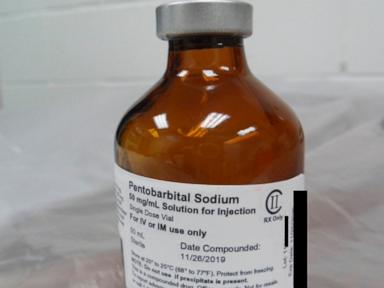
A cold metal table. A sterile room humming with the low, indifferent thrum of fluorescent lights. To the public, the machinery of state-sanctioned execution is often envisioned as an orderly, clinical descent into sleep—a quiet subtraction from the living world. But beneath the institutional polish lies a fragile, deeply contested chemistry.
When things go wrong in a execution chamber, they do not go wrong with theatrical violence. They go wrong in silence. They go wrong when the invisible formulas meant to usher a human being out of existence fail to perform their quiet duty, leaving behind a terrifying vacuum between science, law, and human error. In other developments, take a look at: The Legal Reckoning Over Military Force Against Drug Traffickers.
Consider the machinery of a lethal injection. For decades, the public imagination was anchored to a simple tripartite protocol: a fast-acting barbiturate to render the person unconscious, a paralytic to stop breathing, and a potassium chloride solution to stop the heart. It sounds orderly. It sounds like medicine. But medicine is practiced to preserve life, whereas these compounds are conscripted into an entirely different ledger. When supply chains fracture, when pharmaceutical companies forbid the use of their products in executions, states are forced into the shadows of compounding pharmacies and alternative chemical cocktails.
This is where the story shifts from legal abstraction to a stark, physical reality. BBC News has provided coverage on this fascinating issue in extensive detail.
In Tennessee, as in several other states bound by the rigid mechanics of capital punishment, the pursuit of lethal drugs has occasionally collided with severe operational friction. History carries a long shadow. Past scrutiny over execution protocols—ranging from the efficacy of specific drugs to the precision of their delivery—has repeatedly dragged the state’s death penalty machinery into public view, not because of ideological debates alone, but because of technical failure and profound procedural ambiguity.
Imagine standing in a room where a mechanical pump fails to deliver the expected pharmacological depth, or where a substituted compound behaves with unpredictable recalcitrance. The public rarely sees the frantic legal maneuvers unfolding in midnight hearings hours before a scheduled execution. They do not see the affidavits from pharmacologists warning that a particular compound might not block pain effectively, leaving a conscious mind trapped behind a paralyzed body.
To understand why this matters, we have to look past the courtroom podiums and examine the nature of chemical execution itself.
A lethal injection is not an exact science; it is a legal fiction draped in medical theater. Real anesthetics are titrated meticulously by trained physicians monitoring continuous brain activity and vital signs. Executions, by ethical mandate, cannot involve licensed medical doctors acting in their professional capacity. They are instead carried out by execution teams working under immense psychological and temporal pressure, often administering substances they did not formulate, tested by laboratories whose exact processes remain shrouded in state secrecy laws.
When a state uses a drug that has faced intense scrutiny, it is rolling dice with the boundary between humane execution and cruel and unusual punishment. The Eighth Amendment of the United States Constitution was written to prevent needless suffering, yet the modern death chamber often relies on secrecy laws that keep the public—and defense attorneys—in the dark about the exact source, purity, and composition of the lethal substances.
Why shroud the process in secrecy if the process is sound?
That is the question that lingers in the air long after the legal briefs are filed and the microphones are turned off. Transparency is the antidote to suspicion. Yet, when states like Tennessee face judicial challenges over their execution drugs, the immediate legislative reaction is frequently to tighten the cloak of confidentiality rather than open the doors to independent scientific review.
The repercussions ripple outward, touching everyone involved. Corrections officers, tasked with carrying out an irreversible state mandate, find themselves navigating protocols that change with every pharmaceutical shortage or court injunction. Legal scholars watch as constitutional protections are bent to accommodate logistical expediency. And the public is left suspended in a perpetual ethical fog, forced to ask whether a government wielding the ultimate power can even execute its own laws reliably, letously, and transparently.
There is a profound discomfort in realizing that life and death can hinge on a supply chain issue or a chemical substitution concocted behind closed doors. We like our legal systems to be monolithic, rational, and foolproof. We want to believe that a sentence handed down by a judge flows seamlessly into an outcome dictated by immutable logic.
Instead, we find a messy, improvised science. We find a system constantly trying to launder the raw mechanics of killing through the language of clinical mercy.
The drug used in Tennessee's failed execution and the subsequent scrutiny it attracted are not isolated anomalies. They are symptoms of a deeper structural contradiction: the attempt to use the tools of modern chemistry to perform an act that resists both medical ethics and absolute certainty. As long as the machinery of capital punishment persists, these chemical shadows will continue to lengthen, reminding us that whenever the state claims mastery over life and death, it is ultimately at the mercy of the formulas it tries to hide.