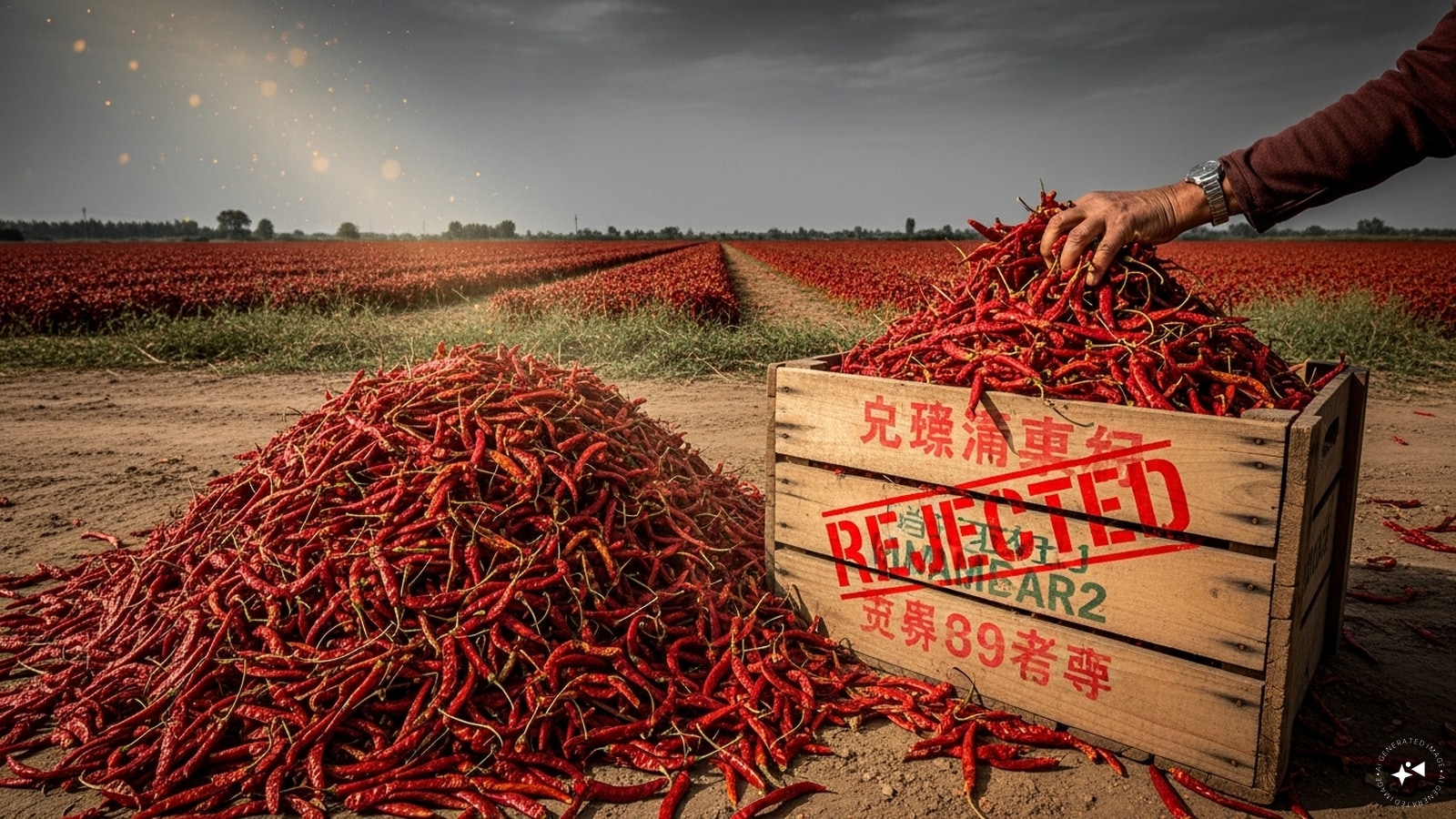
The mainstream trade press is panicking over Chinese customs officials turning away Indian red chilli containers. The narrative is comforting, familiar, and entirely wrong.
Exporters are crying foul, pointing to sudden regulatory shifts, geopolitical friction, and arbitrary quality standard checks at Chinese ports. The lazy consensus says Beijing is tightening the screws on New Delhi through trade technicalities, leaving Indian farmers holding bags of rotting Teja and Sanmanam chillies. You might also find this similar story useful: The Frozen Detour Why Middle East Conflict is Forcing Cargo Ships North.
That story is a convenient shield for lazy supply chain management.
China is not rejecting Indian chilli shipments because of a sudden spike in geopolitical malice. They are rejecting them because a massive segment of the Indian export market relies on a business model built on outdated farming practices, chemical dependency, and a fundamental misunderstanding of global food safety evolution. As discussed in detailed articles by The Wall Street Journal, the effects are widespread.
I have spent fifteen years auditing agricultural supply chains across Asia. I have watched exporters blow millions of dollars on freight costs for rejected containers because they trusted a middleman's word over a gas chromatography-mass spectrometry test. The panic isn't about a trade war. It is about a structural refusal to adapt to modern compliance.
The Myth of the Sudden Regulatory Wall
The loudest complaint from the spices export community is that China changed the rules without warning. This is a fabrication designed to protect margins.
The General Administration of Customs of China (GACC) did not wake up yesterday and invent new maximum residue limits (MRLs) for pesticides. The global tightening of food safety standards has been tracking visibly for a decade. What worked in 2016—sending bulk shipments with a prayer and a basic phytosanitary certificate—does not fly in a digitized, highly scrutinized customs environment.
The core issue centers on specific chemical compounds: Aflatoxin and pesticide residues like Profenofos and Chlorpyrifos.
For years, the domestic market in India tolerated higher thresholds of these chemicals. Exporters treated the international market as a monolith, assuming that if a product cleared basic visual inspection, it was good to go.
It is a basic chemistry problem, not a political one.
When a commodity trading house buys thousands of metric tons of dried red chilli from aggregated auctions in Guntur, Andhra Pradesh—the largest chilli market in Asia—they are buying a genetic lottery. They are mixing crops from hundreds of smallholder farms.
Some farmers followed strict integrated pest management protocols. Others sprayed a cocktail of unapproved chemicals forty-eight hours before harvest to save a crop from thrips.
Once those chillies are mixed, bagged, and stuffed into a 40-foot reefer container, the entire shipment is compromised. Chinese customs labs use advanced testing equipment that detects parts per billion. You cannot bribe, fast-talk, or politically maneuver your way past an automated lab report showing 0.05 milligrams of an unapproved pesticide per kilogram.
Dismantling the People Also Ask Panic
The industry FAQs circulating right now show exactly how disconnected the market is from reality. Let us break down the flawed premises driving the current panic.
Is China using non-tariff barriers to hurt Indian agriculture?
This is the ultimate cop-out question. Labeling a food safety standard as a "non-tariff barrier" implies that the standard is arbitrary and unfair.
Let us look at the data objectively. China is the world's largest consumer and producer of chilli, but they specifically rely on Indian imports for high-color extraction and specific heat profiles that their domestic crops lack. They want the product. What they do not want is to import a public health liability.
If Mexico, Thailand, or Vietnam can meet stringent chemical residue profiles, then the standard is not the barrier; your production line is. Calling compliance a non-tariff barrier is just a way for exporters to avoid investing in testing infrastructure.
Will redirecting shipments to Southeast Asia solve the exporter crisis?
This is the strategy being pushed by traditional trade brokers: "If China won't take it, dump it in Bangladesh, Indonesia, or Malaysia."
This is short-sighted and financially suicidal. Southeast Asian nations are rapidly harmonizing their food safety frameworks with global standards. Vietnam and Indonesia are upgrading their border inspection protocols.
Dumping substandard, high-residue chilli into alternative markets just depresses prices globally and trashes the reputation of Indian spices everywhere. It turns a temporary compliance hurdle into a systemic brand devaluation.
The High Cost of the Middleman Ecosystem
To understand why the supply chain breaks down, you have to look at the traditional Adat (commission agent) system dominant in Indian spice hubs.
Imagine a scenario where a corporate exporter needs 500 tons of stemless dry red chilli for a Chinese buyer. The exporter does not buy from 200 individual farmers. They go to a network of commission agents at the mandi.
These agents prioritize volume over traceability. They aggregate, blend, and package. They have zero visibility into the agricultural inputs used during the cultivation phase.
The exporter buys the lot, pays for a basic certificate of analysis from a local, under-equipped laboratory, and ships it out. The transaction relies entirely on trust in a system designed for regional trade, not highly regulated international commerce.
When that container lands in Qingdao or Shanghai and gets flagged by GACC, the financial chain reaction is brutal:
- Demurrage and Detention Fees: Thousands of dollars accumulate daily while the container sits in port custody during an appeal.
- Return Freight Costs: Shipping a rejected container back to India frequently costs more than the residual value of the cargo.
- Destruction Orders: In worst-case scenarios, Chinese authorities order the immediate destruction of the goods at the importer's expense.
The exporter bears 100% of this risk. The commission agent has already cashed their check. The farmer has moved on to the next sowing season. The entire structure incentivizes ignorance at the top and negligence at the bottom.
Stop Chasing Volume, Start Competing on Purity
The survival of the Indian chilli export industry depends on abandoning the obsession with gross tonnage and focusing exclusively on absolute traceability.
If you want to sell to premium, high-value markets like China, the European Union, or the United States, you have to build a closed-loop supply chain from scratch. The era of buying blind from the open market auction is over.
Step 1: Contract Farming with Ironclad Input Control
You cannot fix the chemical residue problem at the port; you have to fix it in the soil. Forward-thinking agribusinesses must bypass the traditional mandi system entirely for their premium export lines.
This means entering into direct, legally binding contract farming agreements with grower clusters.
You supply the seeds. You supply the approved biopesticides. You send field agronomists to monitor compliance every two weeks. If a farmer uses an unapproved chemical spray, they are immediately dropped from the export pool.
Step 2: Implement Batch-Level Cryogenic Grinding and Testing
Testing must happen before the product ever touches a shipping container. Forwarding bulk, whole dried chillies is an invitation for random sampling failure.
By shifting to processing, value addition, and batch-level testing using liquid chromatography-mass spectrometry (LC-MS/MS), exporters can isolate contaminated batches before they leave the factory floor.
Yes, this infrastructure requires heavy capital expenditure. Yes, it compresses immediate margins. But it eliminates the catastrophic tail risk of a total port rejection.
The Hard Truth of Global Food Logistics
Let us be completely transparent about the downside of this contrarian approach. Transitioning to a fully traceable, zero-residue supply chain will shrink the pool of eligible exporters by 80%.
The small-time trading houses that operate on wafer-thin margins by playing arbitrage between the Guntur market and international buyers will go out of business. They cannot afford the testing. They cannot afford the field agronomists. They cannot afford the long-term capital commitment required to build relationships with farmers.
But that contraction is exactly what the industry needs to survive.
The current crisis is not a disaster; it is a market clearing mechanism. It is weeding out the speculators who treated food logistics like a casino. The companies that survive will be the ones that realize a shipping container is not just a metal box full of hot peppers—it is a delivery vehicle for a highly regulated chemical compound that must meet exact scientific specifications.
Stop blaming Beijing's customs officials for doing their jobs. Fix your supply chain, or get out of the market.