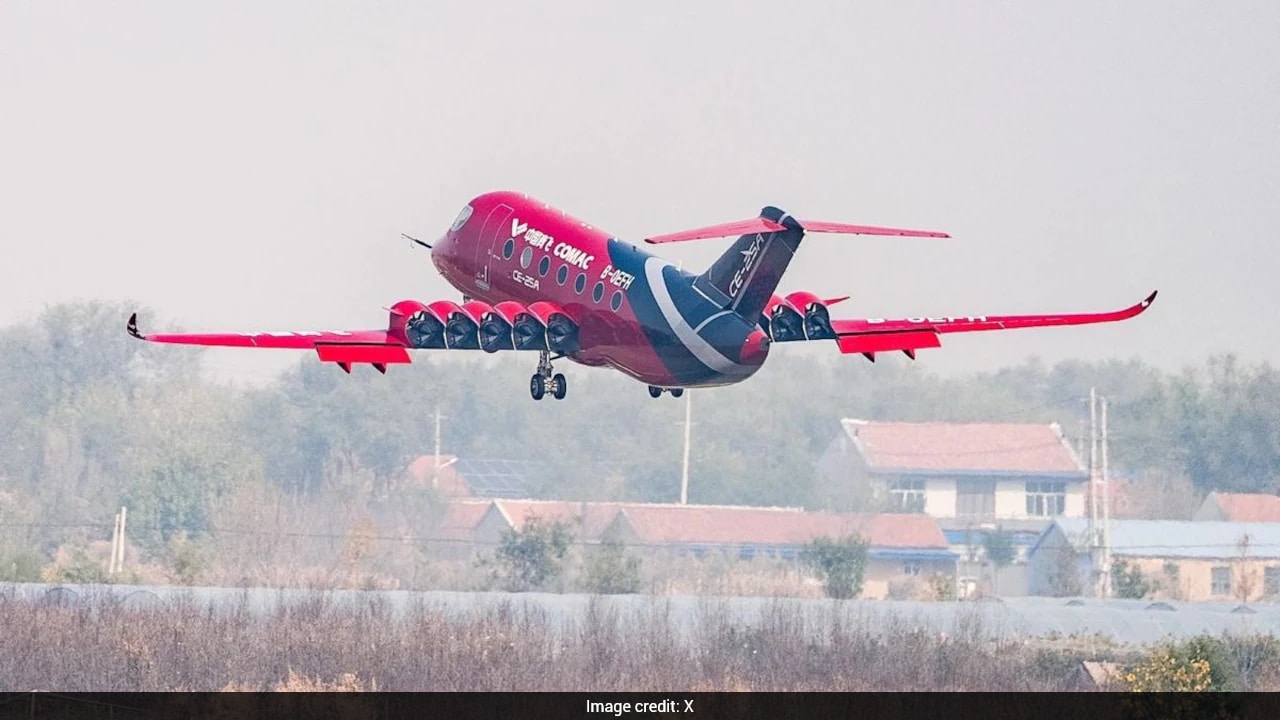
China’s latest electric aircraft—a massive 10-metric-ton (22,000-pound) twin-engine transport—has officially completed its first manned test flight, signaling a sharp break from the battery-weight penalties that have grounded heavy electric aviation for decades. While Western startups remain largely confined to lightweight, two-to-four-seat air taxis, Chinese aerospace engineers just put a human pilot at the controls of an aircraft roughly the size and weight of a regional commuter plane or a heavy military cargo drone. The flight proves that high-density battery packs and high-output electric motors can now lift substantial payloads without relying on liquid fossil fuels.
To understand why aviation veterans are paying sudden, nervous attention to this milestone, you have to look at the brutal physics of flight. For over a century, kerosene has ruled the skies because of a simple metric called specific energy. Jet fuel packs roughly 12,000 watt-hours of energy into every kilogram of weight. Even the best commercial lithium-ion batteries today struggle to clear 300 to 500 watt-hours per kilogram. Meanwhile, you can read related developments here: Asymmetric Cold-Chain Sabotage Why Low-Complexity ICS Exploits Threaten European Infrastructure.
In an airplane, weight is a compounding penalty. Unlike an electric car, which merely suffers reduced range when you add heavy battery packs, an aircraft has to generate enough aerodynamic lift to keep that dead weight airborne. Furthermore, as a conventional plane burns jet fuel, it gets lighter, making it more efficient as the flight progresses. An electric aircraft lands at the exact same weight it took off. For years, aerospace engineers treated the 22,000-pound threshold as a hard ceiling for pure battery-electric propulsion. Crossing it with a human onboard means the underlying propulsion architecture has crossed a critical efficiency threshold.
The Anatomy of a Heavyweight Electric Flyer
Getting ten metric tons off the ground without burning a drop of aviation fuel requires more than just strapping oversized golf-cart batteries into an existing airframe. It demands a complete rethinking of propulsion, thermal management, and structural integration. To see the bigger picture, check out the excellent analysis by Mashable.
In heavy electric aircraft of this class, the powerplant is built around high-voltage electric propulsion systems. Moving megawatts of power from a battery bank to spinning propellers generates immense heat and requires thick, heavy copper cabling. To keep the wiring from eating into the payload capacity, engineers must push system voltages well past the 800-volt architectures found in modern electric vehicles, operating in the kilovolt range.
The motors themselves are typically axial-flux or high-torque permanent magnet synchronous motors paired with multi-blade, variable-pitch propellers. Because electric motors deliver instant torque and do not lose power at higher altitudes the way oxygen-starved internal combustion engines do, they can spin larger, slower-turning propellers. This improves aerodynamic efficiency and drastically cuts down on the acoustic signature—a quiet advantage that has obvious implications for both urban cargo hubs and tactical military logistics.
Then there is the battery architecture. To hit the energy density required for a 22,000-pound maximum takeoff weight, aircraft designers rely on cell-to-airframe integration. Rather than placing battery modules inside heavy protective boxes and bolting them to the fuselage floor, the cells are built directly into the wing spars and structural ribs. The battery becomes part of the skeleton of the airplane. Combined with semi-solid-state or advanced high-nickel chemistries pioneered by China's dominant battery manufacturing sector, this structural integration trims enough parasitic weight to make a manned test flight viable.
Supply Chain Dominance Translated to Altitude
The aerospace industry in North America and Europe often views aviation as an isolated discipline, separate from automotive or consumer electronics manufacturing. China’s industrial strategy treats them as the exact same supply chain.
The country controls over 70 percent of global lithium-ion battery manufacturing capacity, alongside the refining networks for lithium, cobalt, graphite, and rare-earth elements used in permanent magnet motors. Companies like CATL have already publicly demonstrated condensed-matter batteries hitting 500 watt-hours per kilogram specifically aimed at aviation applications. When a state-backed aerospace institute or a domestic aviation manufacturer wants to build a 10-ton electric prototype, they do not have to wait three years for a custom battery supplier to tool up a pilot line. They walk down the hall to the world's largest EV supply chain and pull high-discharge, aviation-grade cells off an active production line.
This vertical integration slashes the cost and timeline of prototyping. While Western aviation firms spend hundreds of millions of dollars navigating venture capital rounds and bespoke component manufacturing just to get a 6,000-pound demonstrator into the air, Chinese teams can iterate on airframes at a fraction of the cost. They are applying the exact same manufacturing playbook that allowed Chinese automakers to overtake legacy European and American brands in the global electric vehicle market.
The Economics of Short-Haul Cargo and Regional Routes
Forget transcontinental electric passenger jets. Anyone promising battery-powered flights from New York to London within the next twenty years is selling fiction. The physics simply do not allow it. Where a 22,000-pound electric aircraft makes immediate, devastating economic sense is in the unglamorous world of regional cargo and feeder routes.
Consider how regional air freight operates today. Logistics companies rely heavily on aging turboprops—aircraft like the Cessna Caravan, the Beechcraft 1900, or the ATR 42—to move packages between major international hubs and secondary cities. These flights are typically short, ranging from 150 to 400 miles.
On these short hops, traditional turboprops are wildly inefficient. Jet fuel costs are volatile, and turbine engines suffer their highest wear and tear during takeoff and climb cycles. Maintenance intervals on turboprop engines are measured in flight hours and cycles, requiring frequent, expensive teardowns by certified mechanics.
An electric aircraft in the 10-ton class flips those operating economics upside down. Electricity costs a fraction of Jet-A fuel per mile flown. More importantly, an electric motor has roughly one-tenth the moving parts of a gas turbine. There are no combustion chambers, no high-pressure fuel pumps, and no turbine blades operating at thousands of degrees. Scheduled maintenance drops dramatically, pushing aircraft utilization rates higher.
To see how this plays out in practice, consider a hypothetical regional cargo route spanning 250 miles between a manufacturing hub and an international airport. A conventional twin-turboprop burning Jet-A might spend $1,200 on fuel and engine reserves for that single leg. An equivalent electric transport, charged via industrial grid rates at the depot, could cover the exact same distance for under $200 in electricity, while carrying a comparable palletized payload. Over thousands of cycles per year, those savings turn thin-margin regional routes into highly profitable corridors.
The Dual-Use Reality Nobody Wants to Mention
In aviation, cargo capacity is never purely commercial. A 22,000-pound aircraft capable of hauling several tons of freight out of short, unimproved airstrips is the definition of a dual-use technology.
China’s civil-military fusion strategy ensures that breakthroughs in commercial aerospace feed directly into defense logistics. In rugged, high-altitude regions like the Tibetan plateau, or across remote island chains in the South China Sea, traditional internal combustion engines lose up to 30 or 40 percent of their power due to thin air. Electric motors suffer zero power degradation from low air density. As long as the propellers can bite into the air, the motors deliver 100 percent of their rated torque.
Furthermore, a heavy electric transport produces a fraction of the thermal and acoustic signature of a turboprop. Infrared-guided missiles lock onto the intense heat plumes of exhaust gases. An electric aircraft runs cool, making it vastly harder to detect and track with standard heat-seeking sensors. Putting a human pilot onboard for this initial flight validates the flight controls, structural integrity, and emergency handling characteristics, paving the way for optionally piloted or fully autonomous heavy logistics drones that can resupply forward operating bases without risking aircrew lives.
The Certification Wall and the Range Reality Check
Despite the engineering triumph of getting a 22,000-pound electric plane off the runway, massive operational hurdles remain before these aircraft enter routine commercial service.
First is the hard ceiling of turnaround time. A conventional turboprop can land, take on 2,000 pounds of Jet-A fuel, and be back in the air in twenty minutes. Charging a multi-megawatt battery pack on a 10-ton aircraft without destroying the battery cells requires massive liquid-cooled charging infrastructure at every regional airport it visits. Swappable battery packs—where a depleted pack is unbolted and replaced with a fresh one via forklift—offer a workaround, but they add structural complexity and require standardized ground support equipment across entire route networks.
Second is the thermal runaway nightmare. Aviation regulators, including the Civil Aviation Administration of China (CAAC), the FAA in the United States, and EASA in Europe, have zero tolerance for in-flight fires. If a lithium-ion cell goes into thermal runaway at 15,000 feet, you cannot simply pull over to the side of the highway. Containing a cascading battery fire inside a 22,000-pound aircraft requires heavy fire-suppression barriers, venting channels, and redundant electrical isolation systems. Every pound of fireproofing eats directly into the cargo payload.
Finally, there is the geopolitical barrier of international certification. While CAAC can certify this aircraft for domestic operations within China—and quickly export it to partner nations in Southeast Asia, Africa, and Latin America—getting bilateral certification from the FAA or EASA will be a slow, politically fraught slog. Western regulators will scrutinize every line of flight-control software and every battery management algorithm before allowing a 10-ton Chinese electric aircraft to fly over populated Western airspace.
The Quiet Reshaping of the Skies
For decades, Western aerospace giants like Boeing and Airbus have maintained a comfortable duopoly over large commercial aircraft, shielded by insurmountable barriers to entry in jet engine metallurgy and complex supply chains. You cannot easily copy a modern high-bypass turbofan engine; the single-crystal turbine blades alone take decades to master.
Electric propulsion bypasses that moat entirely. It replaces precision metallurgy with electrochemistry and power electronics—two fields where China holds an undeniable global lead. By proving that a 22,000-pound electric aircraft can safely carry a human pilot into the sky, Chinese engineers have demonstrated that the battle for the future of regional aviation will not be fought with jet fuel and turbine blades, but with battery density and megawatt charging grids. Legacy aerospace manufacturers now face a stark choice: accelerate their own heavy-electric programs immediately, or watch another vital sector of global transportation slip out of their grasp.