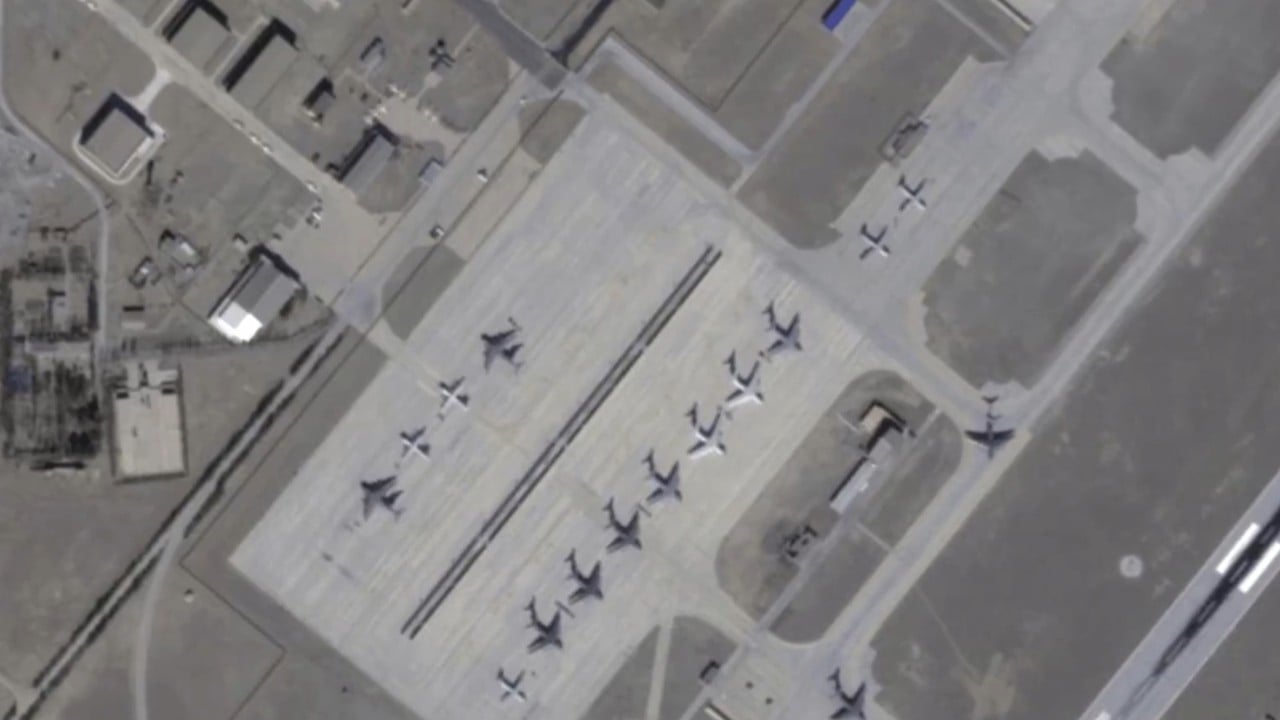
Defense analysts love a clean spreadsheet. Count the fuselages, tally the radar cross-sections, compare the annual production rates of Chengdu and Shenyang against Lockheed Martin, and declare an imminent shift in the global balance of power.
That accounting exercise is comforting, predictable, and entirely wrong.
When you look at the rapid expansion of the People’s Liberation Army Air Force (PLAAF), you are not looking at an unstoppable juggernaut preparing to sweep the Western Pacific. You are looking at an industrial panic response. Beijing is frantically building airframes because its strategic doctrine has a glaring, structural hole in it—and throwing aluminum and composites at the problem is the only lever its state-run defense sector knows how to pull.
Most commentary treats fleet size as a direct proxy for combat readiness. More fourth- and fifth-generation fighters equal higher lethality. More bombers equal greater reach. If you spend any time studying actual air campaign mechanics, supply chain fragility, and pilot training pipelines, you know that raw hull counts are a vanity metric. In high-intensity peer conflict, a bloated fleet without the underlying nervous system to sustain it does not win wars. It just creates more wreckage.
The Bean-Counting Fallacy in Modern Air Power
Every year, the Pentagon publishes its report on Chinese military power, and every year, headlines scream about the sheer volume of J-20 Mighty Dragons and J-16 multirole fighters rolling off assembly lines. The lazy consensus says that because China outproduces the United States in certain fighter categories, Beijing has achieved parity—or worse, local superiority—in the Indo-Pacific.
This logic relies on a 20th-century industrial mindset applied to a 21st-century information war.
I have spent years watching defense programs burn through billions of dollars chasing platform numbers while starving the unglamorous back-end systems that actually keep jets in the sky. When a military prioritizes visible hardware over invisible sustainment, it is usually compensating for a lack of institutional confidence. Beijing knows that in a conflict over Taiwan or the South China Sea, its initial attrition rates will be catastrophic. They are not building a massive air force because they expect to dominate effortlessly; they are building a massive air force because they expect to lose hundreds of aircraft in the first seventy-two hours.
Let’s define combat readiness properly, because defense pundits abuse the term constantly. Readiness is not the number of aircraft parked on an apron during a satellite pass. Readiness is the sortie generation rate—how many combat-effective missions a wing can launch, recover, rearm, refuel, and relaunch per day under active enemy fire.
You can park five hundred stealth fighters at airbases across the Eastern Theater Command. If your runway repair crews cannot fill craters fast enough, if your fuel bladders are burning, and if your maintenance technicians lack the diagnostic autonomy to clear fault codes without calling a factory engineer in Shenyang, your five hundred fighters are expensive lawn ornaments.
The Pilot Pipeline Bottleneck Nobody Wants to Measure
Hardware scales linearly if you have enough factories and state subsidies. Human expertise does not.
You cannot 3D-print a flight lead with three thousand hours of tactical experience. For decades, the PLAAF operated under a rigid, ground-controlled interception model. Pilots were treated like flying bus drivers, executing scripted maneuvers dictated by radar operators sitting in bunkers hundreds of miles away. Beijing recognized this flaw and overhauled its flight training curriculum, pushing more realistic, free-play combat exercises like the Golden Helmet competition.
Credit where it is due: Chinese fighter pilots today are vastly better than their predecessors from twenty years ago. They fly more hours, use better simulators, and train against simulated foreign tactics.
Yet a massive structural lag remains between China’s aircraft production rate and its human capital development. When you induct dozens of brand-new J-20s and J-16s every single year, you have to pull experienced pilots out of operational squadrons to staff the new units, train the rookies, and write the tactical manuals. This dilutes the institutional knowledge of your frontline wings.
Consider the instructor pilot deficit. In Western air forces, the backbone of combat readiness is a deep bench of seasoned weapons officers who have deployed, flown in complex multinational strike packages, and experienced the sensory overload of real-world combat operations. The PLAAF has zero institutional memory of modern air warfare. The last time Chinese fighter pilots engaged in air-to-air combat was 1958 over the Taiwan Strait.
Simulators are brilliant tools, and China has invested heavily in networked virtual training environments. Still, a simulator never replicates the gut-wrenching terror of a live surface-to-air missile lock, the chaos of degraded communications in a heavy electronic warfare environment, or the split-second judgment required when a wingman goes down. Rapidly expanding the fleet forces the PLAAF to promote junior aviators into leadership slots before they are ready, creating a fragile command structure that looks terrifying on paper and brittle in the cockpit.
Engine Dependency and the Maintenance Trap
If you want to understand the true health of an air force, ignore the weapons bay and look at the exhaust nozzles.
For twenty years, China’s aerospace industry suffered from an acute inability to manufacture reliable, high-thrust turbofan engines. Early J-20s flew with Russian AL-31 engines, and even the indigenous WS-10 series struggled with mean time between overhauls (MTBO). Today, Beijing has made undeniable strides with the WS-10C and the developmental WS-15, finally giving its flagship stealth fighter the supercruise capability it was designed to have.
Solving the metallurgy problem is only half the battle. Now comes the logistics nightmare.
High-performance military jet engines are temperamental beasts. They require pristine maintenance facilities, specialized tooling, and a predictive supply chain capable of delivering turbine blades and fuel controllers to forward operating bases at a moment's notice. Historically, Soviet and Chinese engine design philosophies favored shorter service lives and modular replacement—pull the whole engine out, ship it back to a depot, and drop a new one in.
That approach works fine when you have a static front line and secure rail networks. It collapses in an expeditionary or high-tempo defensive war where forward bases are under constant threat from long-range precision strikes.
Furthermore, maintaining low-observable (stealth) coatings is a dark art that still gives the U.S. Air Force headaches after forty years of operational experience with the F-117, B-2, F-22, and F-35. Every time a technician opens an access panel on a J-20 to fix a hydraulic leak or swap an avionics card, the radar-absorbent tape and coatings must be stripped, reapplied, and cured under strict environmental conditions. If you rush that process to generate more sorties, your stealth fighter suddenly lights up on enemy Aegis radars like a flying barn door.
China’s rapid fleet growth has outpaced its depot-level maintenance infrastructure. Building an airframe takes months; building the decentralized, battle-hardened logistics network required to keep that airframe stealthy and airborne during a prolonged campaign takes decades.
The Invisible War: Why ISR and Tankers Matter More Than Fighters
Ask a casual observer what determines air superiority, and they will talk about turn rates, thrust-to-weight ratios, and missile ranges. Ask an air component commander, and they will talk about tankers, AWACS, and electronic warfare pods.
A fighter jet is merely a delivery truck for sensors and munitions. Without external eyes and gas stations in the sky, modern fighters are blind and short-legged.
Look closely at the composition of China’s air force expansion, and the asymmetry becomes obvious. While Beijing has churned out hundreds of tactical fighters, its fleet of aerial refueling tankers and airborne early warning and control (AEW&C) aircraft remains dangerously thin.
The PLAAF relies heavily on the KJ-500 for airborne radar coverage and has only recently begun fielding the YY-20 tanker in meaningful numbers to replace its tiny, obsolete fleet of H-6U tankers and three Russian Il-78s. Compare that to the United States Air Force, which operates hundreds of KC-135s, KC-46s, and KC-10s—a global refueling bridge that allows tactical fighters to operate thousands of miles from their bases for twelve hours at a stretch.
Imagine a scenario where the PLAAF attempts to project sustained air power east of Taiwan into the Philippine Sea. Because China lacks a massive tanker fleet, its fighters must fly off coastal bases, burn half their fuel climbing to altitude and transiting the strait, loiter on station for twenty minutes, and turn around to go home. Meanwhile, those coastal bases sit squarely inside the engagement envelope of American and allied cruise missiles, stealth bombers, and submarine-launched munitions.
Beijing knows this. That is why the PLAAF is rushing YY-20 production right now. Yet until those tankers reach critical mass and crews master the unforgiving choreography of night-time, radio-silent aerial refueling under combat conditions, China’s massive fighter fleet remains tethered to a very short leash.
Answering the Wrong Questions About Chinese Air Power
Whenever news breaks about a new Chinese aircraft carrier or a fresh batch of J-20s spotted at a test facility, the public conversation immediately spirals into unhelpful territory. Let’s dismantle the three most common misconceptions driving the debate.
Does China have more fighter jets than the United States?
No, and even if it did, the raw tally is meaningless. When you combine the U.S. Air Force, Navy, and Marine Corps, Washington still fields a larger, far more experienced tactical air arm—especially when you factor in the hundreds of F-35s operated by regional allies like Japan, South Korea, and Australia. More importantly, comparing total fleet sizes ignores geography. The U.S. has global commitments and must spread its forces across Europe, the Middle East, and the Pacific. China gets to concentrate nearly its entire air force in one theater. Beijing does not need more jets than the Pentagon globally; it only needs local density for a few weeks. Framing the issue as a global head-to-head numbers game misses the operational reality of regional deterrence.
Is the J-20 better than the F-35?
This is the ultimate bar-stool argument, and it fundamentally misunderstands how modern air combat works. The J-20 and the F-35 were built for entirely different jobs. The J-20 is a large, twin-engine long-range interceptor designed to punch through defensive screens, use its speed and frontal stealth to hunt down high-value American tankers and AWACS planes, and launch long-range PL-15 missiles before disappearing. The F-35 is a multirole sensor node built to penetrate dense integrated air defense systems, vacuum up electronic intelligence, share targeting data across every ship and ground unit in the battlespace, and strike hardened targets. Pit them against each other in a hypothetical dogfight, and you have already failed to understand why either plane exists. The winner will not be decided by aerodynamic agility; it will be decided by whose data link survives jamming long enough to cue a missile from two hundred miles away.
Why is China building so many bombers if it doesn't plan to invade the US mainland?
The H-6K and H-6N bombers are not meant to fly over California. They are airborne missile trucks designed to carry massive anti-ship ballistic missiles and long-range land-attack cruise missiles out to the Second Island Chain. By pushing these bombers past Okinawa and the Philippines, China forces American aircraft carriers to operate further away from the Chinese coast, stretching the operational range of U.S. carrier air wings past their breaking point. It is a classic anti-access/area denial (A2/AD) strategy, not a global power-projection play.
The Vulnerability of Centralized Command
There is an elephant in the hangar that military analysts rarely discuss because it cannot be measured with satellite imagery: command culture.
Modern air warfare rewards decentralized execution. When communications are jammed, satellites are blinded, and command bunkers are destroyed, the side that wins is the side where a twenty-eight-year-old flight lead can look at a deteriorating tactical picture, tear up the pre-planned mission brief, and improvise a solution on the fly.
The People’s Liberation Army is a political army loyal to the Chinese Communist Party, built around top-down control and strict adherence to hierarchy. While PLA doctrine explicitly calls for "informatized" warfare and greater initiative at lower echelons, decades of institutional DNA do not vanish overnight.
In peacetime exercises, centralized command looks brilliant. Every aircraft arrives on time, every missile hits its designated target box, and the synchronization is flawless. In actual war, friction destroys synchronization within minutes. When the plan breaks, junior officers raised in a system that punishes unauthorized deviation tend to freeze, waiting for orders from higher headquarters that may no longer exist.
No amount of stealth coating or thrust-vectoring nozzles can compensate for tactical paralysis in the cockpit.
What Actually Matters in the Pacific Air Balance
To be clear, dismissing China’s air force as a paper tiger would be suicidal. The threat is dead serious. A massive fleet of fourth- and fifth-generation fighters armed with long-range PL-15 missiles, backed by the densest surface-to-air missile network on Earth, poses an existential challenge to traditional American air superiority. Even an imperfect force with flawed logistics can overwhelm an adversary through sheer volume of fire if that adversary is caught flat-footed.
To assess the real balance of power in the Indo-Pacific, stop reading press releases about aircraft production milestones and start watching four specific indicators:
- Hardened Aircraft Shelters and Dispersal Infrastructure: Watch how fast both sides pour concrete. In the era of cheap, long-range precision munitions, an airbase without hardened shelters, redundant runways, and rapid repair capabilities is a death trap. China has spent the last decade building hundreds of reinforced bunkers across its eastern bases; the U.S. is scrambling to catch up with its Agile Combat Employment doctrine.
- Electronic Warfare and Data Link Resilience: Pay attention to investments in counter-space capabilities, high-powered jamming pods, and resilient mesh networks. The next major air war will be won in the electromagnetic spectrum before a single missile leaves a rail.
- Munitions Stockpiles: Aircraft are reusable; precision-guided munitions are not. War games consistently show that both the U.S. and China would burn through their inventories of advanced air-to-air and anti-ship missiles in less than two weeks. Production rates for semiconductors, rocket motors, and seekers matter far more than airframe assembly lines.
- Tanker and ISR Survivability: Watch how both militaries develop unmanned loyal wingmen and long-range sensors to replace vulnerable manned tankers and radar planes. Whoever figures out how to fuel and guide their fighters without putting giant, non-stealthy targets in the sky wins the endurance race.
Beijing’s massive warplane build-up is an impressive feat of state-directed industrial mobilization. It gives China tremendous regional mass and forces every military planner in Washington, Tokyo, and Canberra to rethink decades-old assumptions about command of the skies.
Yet mass is not mastery. Beneath the gleaming radar-absorbent skin of China’s expanding air fleet lies a brittle logistics tail, an overstretched pilot training pipeline, and a rigid command culture that has never been tested in the crucible of modern combat. Beijing is buying all the hardware it can afford because it knows time is running out to solve the human and systemic weaknesses underneath.
If you want to know who controls the skies over the Pacific in the next decade, stop counting the jets on the runway and start counting the fuel trucks, the spare engines, and the pilots trusted to disobey orders when everything goes wrong.


